
ESG management for enterprises, funds and financial institutions
ESG management is the structured governance, measurement and control of environmental, social and governance risks and performance across an organisation and its value chain.
Request a demo










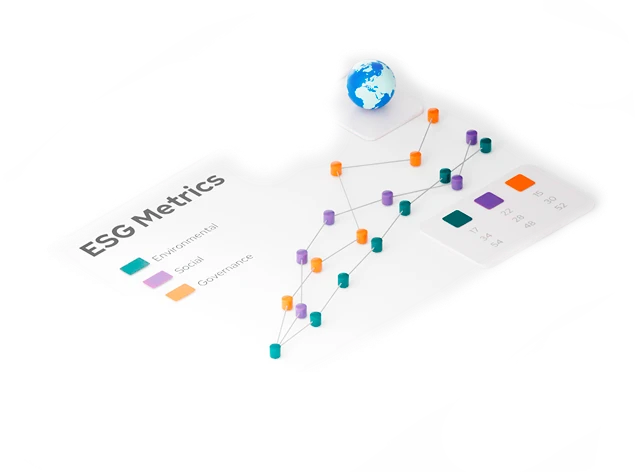
Structured definition of ESG management
What is ESG management?
ESG management is the internal control system used to identify, measure, monitor and report environmental, social and governance risks, impacts and performance indicators.
Governance structure and board oversight
Risk identification and materiality assessment
KPI definition and calculation methodology
Data collection and validation controls
Consolidation across entities
Regulatory disclosure alignment
ESG reporting is the output.
ESG management is the system that produces reliable disclosures.
Regulatory landscape by jurisdiction
Global regulatory convergence is accelerating. Requirements differ in scope but share common characteristics: standardisation, traceability and accountability.
Europe
The European Commission implemented sustainability reporting through:
- Corporate Sustainability Reporting Directive — Directive (EU) 2022/2464
- European Sustainability Reporting Standards issued by European Financial Reporting Advisory Group
- Sustainable Finance Disclosure Regulation
- EU Taxonomy Regulation (Regulation (EU) 2020/852)
Key regulatory characteristics:
- Double materiality assessment
- Digitally tagged disclosures
- Mandatory sustainability KPIs
- Principal Adverse Impact (PAI) indicators (14 mandatory indicators for financial market participants)
- Consolidation across group structures
United States
The U.S. Securities and Exchange Commission adopted climate-related disclosure rules requiring:
- Governance of climate-related risks
- Disclosure of material climate impacts
- Scope 1 and Scope 2 greenhouse gas emissions
- Integration of climate risk into financial reporting controls
Asia-Pacific
The Monetary Authority of Singapore and the Financial Services Agency require climate disclosures aligned with international sustainability standards.
Global baseline standards
The International Sustainability Standards Board issued IFRS S1 and IFRS S2 (2023), establishing a global baseline for sustainability-related financial disclosures.
The Global Reporting Initiative provides widely adopted sustainability reporting standards used across continents.
Why ESG management is necessary
Even where ESG disclosure is not legally mandatory, structured ESG management provides strategic and financial value.

Capital access
Banks, private equity funds and institutional investors increasingly require ESG due diligence. Structured ESG data improves transparency and financing conditions.

Risk mitigation
Climate transition risk, supply chain disruption, labour compliance and governance failures create financial exposure. System-based ESG management reduces unmanaged risk.

Operational efficiency
Monitoring energy, emissions, waste and workforce metrics enables cost optimisation and performance benchmarking.

Long-term strategy
ESG management integrates sustainability objectives into measurable KPIs with board-level accountability.
Manual versus system-based ESG management
Manual ESG management
GIG ESG management
Data collection
Spreadsheet-based collection
Centralised controlled database
Methodology
Inconsistent methodologies
Version-controlled KPI logic
Consolidation
Manual consolidation
Automated multi-tier aggregation
Audit trail
No structured audit trail
Timestamped approval workflows
Double counting
Risk of double counting
Hierarchy-based consolidation rules
Reporting readiness
High reporting burden
Disclosure-ready outputs
Regulators increasingly expect system-based controls rather than narrative disclosures.
How Generation Impact Global enables ESG management
Generation Impact Global provides a structured ESG and impact data management and regulatory reporting platform for enterprises, funds and financial institutions.
Governed data collection
- Role-based access control (Super Admin, Admin, Entity Users)
- Pre-built regulatory-aligned questionnaires
- Customisable data fields
- Validation rules and logic checks
- Centralised document repository
- Complete audit logs
Data inputs are permission-controlled and traceable.








Multi-tier consolidation
- Supports complex structures:
- Group → Holding → Fund → Portfolio Company
- Consolidation at any level
- Prevention of double counting
- Automatic recalculation of KPIs
- This is critical for:
- SFDR Principal Adverse Impact monitoring
- ESRS group reporting
- Cross-border financial structures
Regulatory mapping engine
- Each KPI can be mapped to:
- ESRS disclosure requirements
- SFDR PAI indicators
- EU Taxonomy alignment criteria
- GRI disclosures
- IFRS S1 and IFRS S2
- Structured data can be transformed into disclosure-ready outputs without manual reconciliation.








KPI logic and methodology control
- Configurable formulas
- Intensity metrics (e.g., emissions per revenue, per FTE)
- Threshold monitoring (e.g., Do No Significant Harm limits)
- Methodology version control
- Distinction between reported and inferred data
- Consistency across reporting periods is preserved.
Audit and supervisory readiness
- The system records:
- User activity
- Submission timestamps
- Approval and review workflows
- Supporting evidence attachments
- This supports regulatory supervision, external assurance and internal audit processes.




Frequently Asked Questions
What is ESG management?
ESG management is the structured internal control system used to identify, measure and monitor environmental, social and governance risks and performance indicators across an organisation.
Is ESG management mandatory?
It depends on jurisdiction and company size.
In the European Union, large companies and listed entities are subject to Directive (EU) 2022/2464 (CSRD). Financial market participants are subject to Regulation (EU) 2019/2088 (SFDR).
In other jurisdictions, climate-related disclosures are increasingly mandatory for listed companies.
What is the difference between ESG management and ESG reporting?
ESG management refers to the internal data governance and control system.
ESG reporting refers to the external disclosures derived from that system.
What software is used for ESG management?
ESG management software typically provides:
- Structured data collection
- Multi-entity consolidation
- KPI calculation engines
- Regulatory mapping
- Audit-ready documentation
Generation Impact Global provides an ESG and impact data management and regulatory reporting platform for enterprises, funds and financial institutions operating across jurisdictions.