
ESRS, European Sustainability
Reporting Standards
Table of contents
Jump to section
Introduction
On July 31, 2023, the European Commission adopted the European Sustainability Reporting Standards (ESRS), enhancing Directive 2013/34/EU of the European Parliament and of the Council regarding sustainability reporting standards for companies subject to the Corporate Sustainability Reporting Directive (CSRD).
This delegated act, grounded in Article 29b (1), first subparagraph, of the Accounting Directive, delineates the ESRS that companies must use to fulfill their sustainability reporting obligations in line with Articles 19a and 29a of the Accounting Directive. The adoption of ESRS represents a significant step towards harmonizing ESG disclosures across regulations and setting the stage for interoperability in ESG reporting.
For the first time at an EU-wide level, companies are required to report ESG and corporate sustainability information in a standardized, comparable, and consistent format, establishing high-quality ESG reporting as a business standard. Approximately 50,000 European companies, along with non-EU companies with significant branches in the EU, must comply with ESRS. While this progress helps combat corporate greenwashing, it also presents considerable challenges for many companies, especially those new to sustainability reporting.
Legal Reporting Obligations on Corporate Sustainability
Legal reporting obligations on corporate sustainability are often dispersed across multiple legal frameworks. Despite the inclusion of over 40 legal cross-references in the CSRD, their primary aim is to create consistency in disclosure requirements. By achieving this, the CSRD not only enhances the value of sustainability reporting but also simplifies the process for both preparers and users. The following briefing provides concise definitions of the essential cross-references, improving understanding of the mandatory measures outlined in the directive and clarifying implications for companies preparing their management reports.
| Main Goals of SRD |
Consistency in Reporting The CSRD aligns various sustainability reporting rules across the EU, ensuring that all reports are comparable and reliable. Simplified Process By bringing different reporting obligations under one directive, the CSRD makes it easier for companies to prepare their sustainability reports. |
| Key References |
Accounting Directive (2013/34/EU) The basic framework for financial and non-financial reporting in the EU, updated by the CSRD to include new sustainability reporting requirements. Sustainable Finance Disclosure Regulation (SFDR) Requires financial entities to disclose how they handle sustainability risks in their investment decisions. Taxonomy Regulation (EU 2020/852) Defines criteria to determine if an economic activity is environmentally sustainable. |
| Key Amendments Introduced by the CSRD |
Accounting Directive (Directive 2013/34/EU)
Transparency Directive (Directive 2004/109/EC)
Audit Directive (Directive 2006/43/EC)
Audit Regulation (Regulation (EU) No 537/2014)
|
| Additional Relevant Regulations: |
EU Taxonomy Regulation on Sustainable Investment (Regulation (EU) 2020/852)
|
By standardizing sustainability reporting, the CSRD ensures that the information provided is clear, comparable, and useful for everyone involved.
CSRD vs NFRD
The Non-Financial Reporting Directive (NFRD) and the Corporate Sustainability Reporting Directive (CSRD) are two key legislative measures by the European Union aimed at enhancing corporate transparency and accountability on social and environmental issues.
NFRD
Non-Financial Reporting Directive
CSRD
Corporate Sustainability Reporting Directive
| Affects | |
|
Approx. 11700 companies including:
|
Approx. 42500 companies including:
Example: Large companies should exceed at least two of the following three criteria:
|
| When | |
|
2018: first report |
2025: first report from large listed companies 2026: first report from large companies 2027: first report from SMEs which are PIE (with option to opt out to 2029) 2029: first report from third-country companies |
| Disclosure requirements | |
|
Disclose information on:
|
Disclose information on 10 topics in line with EU standards (ESRS):
|
| Assessment requirement | |
|
Double materiality in the NFRD’s guidelines (soft law) |
Double materiality in the directive (hard law) |
| Audit requirement | |
|
On a voluntary basis by Member States |
From limited assurance of the reporting (for the first report) to reasonable assurance of the reporting (after the adoption of a standard on it no later than 1 October 2028) |
| Reporting format | |
|
Online reporting / PDF format |
Human-readable format of reporting with structured machine-readable data, compliant with European Single Electronic Format (ESEF), based on online XBRL |
| Located reporting | |
|
In the management report or in a separate non-financial statement |
Specific section of the management report |
| Standards | |
|
Voluntary disclosure based on international, European or national guidelines |
Mandatory disclosure based on European Sustainability Reporting Standards (ESRS), including sector-agnostic and sector-specific standards and a robust materiality assessment |
Who and when under scope of CSRD
The CSRD significantly expands its scope compared to the NFRD, increasing the number of covered companies from 11,000 under the NFRD to about 42,500 within the EU. Additionally, several thousand non-EU companies will also fall under these new rules.
The directive covers various types of companies as listed in Annex I of the Accounting Directive (2013/34/EU), primarily targeting public and private companies limited by shares or by guarantee. For non-EU companies, the directive applies to those with legal forms comparable to the listed types.
The CSRD applies to several categories of companies based on specific size criteria, including large, small, and medium public-interest entities (PIEs), such as:
– Listed companies on regulated markets recognized by national authorities and compliant with EU rules on financial instruments.
– Credit institutions and insurance companies, including cooperatives. Member States may exclude central banks and certain public credit institutions at their discretion.
Furthermore, all EU-based companies that meet at least two of the following thresholds on a consolidated basis fall within the CSRD’s scope:

An average net turnover of EUR 50 million

An average balance sheet total of EUR 25 million

At least 250 employees
Companies below these thresholds are defined as micro, small, and medium enterprises (SMEs). Micro-companies not exceeding two of the following criteria are excluded from the directive:
Net turnover of EUR 900,000
Balance sheet total of EUR 450,000
10 employees
Non-EU companies with significant EU operations, either through a large, small, or medium listed subsidiary or a branch, are included if:
The subsidiary is a PIE listed on an EU-regulated market
The branch generates more than EUR 40 million in net turnover annually

The parent company generates over EUR 150 million in the EU during two consecutive years
Furthermore, all EU-based companies that meet at least two of the following thresholds on a consolidated basis fall within the CSRD’s scope:
Thresholds (m = millions)
2025 (on 2024 data)
Large listed companies
with balance sheet (total) in excess of € 25m; and/or net turnover in excess of € 50 m; with more than 500 employees during the financial year.
Public interest entities (PIEs) other than large listed companies, credit institution and insurances
Pending Member State’s applicable rules.
Listed parent companies of a large group
with balance sheet (total) in excess of € 25m; and / or net turnover in excess of € 50 m; with more than 500 employees (consolidated basis) during th e financial year.
Excluded from the scope: Micro-undertaking
Do not exceed two of the following three criteria:
- € 450 000 (balance sheet total);
- € 900 000 net turnover;
- 10 employees during the financial year.
2026 (on 2025 data)
Large companies and groups
Exceeding at least two of the following three criteria:
- € 25m (balance sheet total);
- € 50m net turnover;
- 250 employees during the financial year.
Parent companies of a large group
Pending Member State’s applicable rules.
Listed parent companies of a large group
Exceeding at least two of the following three criteria on a consolidated basis:
- € 25m (balance sheet total);
- € 50m net turnover;
- 250 employees (consolidated basis) during the financial year.
2027 (on 2026 data)
Possibility of an opt-out for 2 years
Listed Small and Medium Enterprises (SMEs)
Do not exceed two of the following three criteria:
- € 25m (balance sheet total);
- € 50m net turnover;
- 250 employees during the financial year.
Small, non-complex credit institutions that are small and medium size public interest entities or large undertakings
Thresholds of Small and Medium Enterprises (SMEs) or Large companies and groups
Captive insurance or reinsurance companies if they are small and medium size public interest entities or large undertakings
Thresholds of Small and Medium Enterprises (SMEs) or Large companies and groups
2029 (on 2028 data)
Impact reporting only
Third-country companies
with net consolidated turnover of more than € 150 m in the EU; and has either a lrge or listed subsidiary or a European branch with net turnover in excess of € 40m
When must companies disclose sustainability information according to the ESRS?
Compliance with the new reporting regulations will be phased in over time, dependent on the profile of the organization:
2025
(on 2024 data)
2026
(on 2025 data)
2027
(on 2026 data)
2028
(on 2027 data)
January 2024
Companies already subject to the Non-Financial Reporting Directive
January 2025
Large companies not currently subject to the Non-Financial Reporting Directive
January 2026
Listed SMEs and other undertakings
January 2026
Non-EU companies with significant undertakings in the EU
It’s worth noting that some SMEs have been granted three additional years to achieve compliance with the CSRD and may opt out until 2028.
The rollout of the ESRS digital taxonomy for the Corporate Sustainability Reporting Directive (CSRD) reporting appears to be set for 2025.
2023
2024
2025
2026
2027
2028
2029
2030
Legislatives acts and proposals
05/01 Entry into force of the CSRD
06/07 End of transposition period for the Member State
First report (based on limited assurance)
Evaluation report on the directive
EU Commission assessment of possible legal measures to ensure sufficient diversification of the sustainability assurance market
For which companies?
Public interest entities (PIEs) subject to a regulated market, bank, insurance companies if >500 employees
Large companies
Listed SMEs (but possible to opt out during 2 years)
Non EU-companies if net consolidated turnover >150 millions euros
End of exemption for Listed SMEs
Under which standards?
31/07 Sector-agnostic standards
By June Standards for SMEs By June Sectoral standards and for Non-EU companies
By October Standards on limited assurance
First revision of the standards
By October Standards on reasonable assurance
End of the artificial EU consolidation for subsidiaries with parents’ HQ outside the EU
What are the European Sustainability reporting Standards – ESRS?
The ESRS are the new mandatory standards set by the EU that companies under the CSRD must follow. These standards aim to ensure that relevant companies provide reliable, comparable, and pertinent sustainability data, clearly defining what needs to be reported. Developed by the European Financial Reporting Advisory Group (EFRAG) and adopted by the Commission through a delegated regulation, the first wave of companies will need to start disclosing this information as early as the 2024 reporting period.
What are the Requirements for Setting ESRS Standards under the CSRD?
Article 1 of the CSRD introduces new articles (19a and 29a) in the Accounting Directive, specifying with various levels of detail what information must be disclosed on environmental, social, and governance (ESG) matters. Companies are required to disclose information in five areas:
- Business model
- Policies, including due-diligence processes
- Outcomes of these policies
- Risks and risk management
- Key performance indicators relevant to the business
The breakdown of the ESRS Standards
Different sets of ESRS are designed for various types of companies within the CSRD’s scope: the full ESRS for listed and large companies, a standard for listed SMEs, and a standard for third-country companies.
The ESRS package includes the Commission’s Delegated Act, which outlines two Cross-Cutting Standards (ESRS 1 and ESRS 2) and ten specific sustainability standards for reporting on environmental, social, and governance issues (Topical Standards). These standards reflecting ESG dimensions. Each standard is indicated by a letter and number (e.g., ESRS E1 focuses on environmental aspects related to the climate change). They are structured into sustainability topics, sub-topics, and sub-sub-topics.
Starting in 2027, companies will report on sector-specific disclosures once these standards are adopted by the EU. Until then, companies must determine sector-specific material information independently.
ESRS 1
General Requirements
ESRS 2
General Disclosures
ESRS E1
Climate Change
ESRS E2
Pollution
ESRS E3
Water & Marine Resources
ESRS E4
Biodiversity and Ecosystems
ESRS E5
Resource use & circular economy
ESRS S1
Own workforce
ESRS S2
Workers in the value chain
ESRS S3
Affected communities
ESRS S4
Consumers and end-users
ESRS G1
Business conduct
Standards for listed SMEs
These standards are simpler than the full ESRS and are proportionate to SMEs’ capacity to report, considering their scale and complexity. They include requirements on sustainability matters and targeted metrics for performance assessment. The standards for listed SMEs are expected to be adopted by June 2024 and will apply from fiscal year 2026, with a possible two-year opt-out option. (currently published by EFRAG as draft).
Voluntary standards for SMEs:
Non-listed SMEs, which are outside the CSRD’s scope, can use these standards voluntarily. They focus on narratives regarding the company’s policies, actions, and targets without the need for data assurance. A materiality assessment is still required. ( currently published by EFRAG as draft).
Standards for third-country companies:
These standards specify the information required in sustainability reports for non-EU companies with significant EU operations, including an annual net turnover of EUR 150 million in the EU and at least one subsidiary or branch. These standards are to be adopted by June 2026 and applied from fiscal year 2028. They focus on the sustainability performance and impacts of these companies.
Additionally, the CSRD allows the European Commission to recognize equivalent sustainability standards from non-EU jurisdictions, enabling third-country companies to use these standards if granted equivalence status by the EU.
Terminology of the ESRS standards
Disclosure Requirements (DR)
These encompass all the information that must or can be disclosed within the different categories of the ESRS.
Application Requirements (AR)
These support the application of Disclosure Requirements and hold the same authority. They provide further guidance for entity-specific disclosures and help determine the relevant disclosures for each company. The ARs ensure that the qualitative characteristics of the information, such as relevance and faithful representation, are maintained.
Datapoint (DP)
The smallest, most specific reporting element within the disclosure requirements. Datapoints can be narrative (e.g., describing stakeholder engagement) or quantitative (e.g., the percentage of employees in collective bargaining agreements). ESRS 2 and the topical standards collectively include over 1,000 datapoints, but companies only need to report those deemed material.
Impacts, Risks, and Opportunities (IROs)
These refer to environmental, social, and governance issues relevant to a company’s operations and value chain that must be reported. Only material IROs need to be disclosed.
Entity-Specific Disclosure
When specific IROs are not covered or sufficiently detailed in the ESRS but are considered material by the company, additional disclosures can be provided. This helps users understand the specific impacts, risks, or opportunities. Until sector-specific standards are fully developed, companies must identify and report these material IROs themselves, potentially using other frameworks like IFRS or GRI Sector Standards.
Materiality Assessment
ESRS 1 requires companies to perform a materiality assessment using the principle of double materiality, which considers both the relevance of impacts and financial materiality. This assessment determines the material information to be disclosed and which IROs need reporting, based on the company’s specific context and value chain.
The detailed structure and requirements of the ESRS are designed to provide a comprehensive framework for sustainability reporting, ensuring consistency and comparability across the EU (ESRS).
Sustainability Matters covered in topical ESRS
Environmental
E1
Environmental
Climate change adaptation
Climate change mitigation
Energy
E2
Pollution
Pollution of air
Pollution of water
Pollution of soil
Pollution of living organisms
Substances of concern
Substances of high concern
Microplastics
E3
Water and marine resources
Water
- Water consumption
- Water withdrawals
- Water discharges
- Water discharges in ocean
Marine resources
- Extraction and use of marine resources
E4
Biodiversity and ecosystems
Direct impact drivers of biodiversity loss
- Climate changes
- Land-use change, fresh water-use change
- Water Invasive alien species
- Pollution
- Others
Impacts on the state of species
- e.g. Population size
- e.g. Extinction risk
- e.g. Migration patterns
Impacts on the extent and condition of the ecosystems
- e.g. Desertification
- e.g. Degradation
- e.g. Deforestation
Impacts and dependencies on ecosystem services
E5
Circular economy
Resources inflows, including resource use
Resource outflows related
to products and services
Waste
Social
S1
Own workforce
Working conditions
- Secure employment
- Working time
- Adequate wages
- Social dialogue
- Freedom of association, the existence of work councils and the information, consultation and participation rights of workers
- Collective bargaining, including rate of workers covered by collective agreements
- Work-life balance
- Health and safety
S2
Workers in the value chain
Working conditions
- Gender equality and equal pay for work of equal value
- Training and skills development
- Employment and inclusion of persons with disabilities
- Measures against violence and harassment in the workplace
- Diversity
Other work related rights
- Child labor
- Forced labor
- Adequate housing
- Privacy
S3
Affected communities
Measures against violence and harassment in the workplace
- Adequate housing
- Adequate food
- Water and sanitation
- Land related impacts
- Security related impacts
Communities’ civil and political rights
- Freedom of expression
- Freedom of assembly
- Impact on human right defenders
Rights of indigenous people
- Free, prior and informed consent
- Self-determination
- Cultural rights
S4
Consumers and end users
Information-related impacts for consumers and/or end-users
- Privacy
- Freedom of expression
- Access to information
Personal safety of consumers and/or end-users
- Health and safety
- Security of a person
- Protection of children
Social inclusion of consumers and/or end-users
- Non-discrimination
- Access to products and services
- Responsible marketing practices
Governance
G1
Own workforce
Corporate culture
Protection of whistle blowers
Animal welfare
Political engagement
and lobbying activities
Management of relationships
with suppliers including payment practices
Corruption and bribery
- Prevention and detection
- Incidents
Reporting format
Location
The CSRD requires that sustainability information be included in a specific section of the annual management report, rather than in a separate sustainability report. The structure, outlined by the ESRS in Appendices D and F, consists of four parts: general, environmental, social, and governance information. This means that financial and sustainability information will be disclosed together. Companies should publish their management report on their website or provide a hard copy upon request. The report must also be submitted to the appropriate authority as per national regulations.
Language
The management report should be written in the language of the Member State where the company is based, or another language accepted by that state’s authorities. To avoid unnecessary costs, EU regulators have waived the requirement for certified translations, provided the absence of certification is clearly indicated.
Electronic format
Since 2020, companies listed on European regulated markets must use the European Single Electronic Format (ESEF) for their annual financial reports. The CSRD extends this requirement to include sustainability information and applies it to non-listed companies within its scope. Companies covered by the CSRD will need to prepare their management reports in electronic format and tag their sustainability information according to the digital taxonomy.
EFRAG has developed the XBRL digital taxonomy for sustainability reporting, including the markup of datapoints related to the EU Taxonomy for sustainable activities. XBRL tagging ensures that sustainability-related data are labeled consistently across different organizations and regions. This computer-based language facilitates the electronic communication of structured business data, making it machine-readable and removing language barriers. For example, XBRL tagging allows users to compile data from documents written in various languages, such as Finnish or Welsh. This consistency is crucial for accurate benchmarking and comparative analysis of sustainability practices, enabling investors and stakeholders to make better-informed decisions.
The European Single Access Point (ESAP)
ESAP: A Centralized Digital Platform for EU Company Information
The ESAP (European Single Access Point) is designed to provide a single digital access point for both financial and non-financial information about EU companies and investment products.
Key features
- Centralized Digital Platform
ESAP is built to centralize access to information that is already published in line with existing and future European regulations. This includes financial regulations and ESG (Environmental, Social, and Governance) disclosure regulations such as the Sustainable Finance Disclosure Regulation (SFDR) and the Corporate Sustainability Reporting Directive (CSRD).
- User-Friendly and Free
The platform will be user-friendly and accessible for free, located in a single central location.
Objectives
- Enhanced Visibility for Companies
One of the main goals is to provide companies, especially small ones in smaller capital markets, with greater visibility to investors. This can help open up more financing opportunities.
- Accessibility for Stakeholders
The platform also aims to make information easily accessible for other stakeholders.
Voluntary Information Submission
- Companies that are not covered by EU regulations (like many SMEs) can voluntarily submit their information to the platform.
Process
- National Collection Bodies
Companies will file their reports to designated national “collection bodies” (e.g., a public authority specifically appointed for this role) and Officially Appointed Mechanisms (e.g., national stock exchanges). These bodies will check, approve, and make the data available through the ESAP.
- Verification
The verification process will ensure that all necessary documents are submitted in the correct format.
Implementation Timeline
- The ESAP platform is expected to be available from summer 2027 and will be gradually phased in. Information required by the CSRD will be available from the first year.
Consolidation of subsidiaries
What is a Subsidiary?
A subsidiary is a company that is controlled by another company, known as the parent or holding company. In accounting terms, a parent company along with its subsidiaries forms a group. A parent company can also be a subsidiary if it is controlled by another higher-level parent company. The parent company has the authority to manage the financial and operational policies of the subsidiary to benefit from its activities. Control typically involves owning more than 50% of the voting rights in the subsidiary.
What is Consolidation?
Consolidation involves combining the financial and sustainability information of a parent company and its subsidiaries into a single set of consolidated statements. These consolidated statements provide a comprehensive view of the entire group’s financial status and activities, rather than looking at each entity individually. This process ensures that the financial and sustainability reports are aggregated and presented cohesively, and are subject to audit or assurance.
How Does the CSRD Affect Consolidation?
The CSRD (Corporate Sustainability Reporting Directive) enhances the rules for disclosing and consolidating sustainability information, covering environmental, social, human rights, and governance topics. Both financial and sustainability information must be included in the consolidated management report, with the sustainability statement in a dedicated section.
Subsidiaries are generally exempt from providing a full individual sustainability statement if they are included in their parent company’s consolidated management report. However, large listed subsidiaries on an EU-regulated market must still produce their own sustainability statements, regardless of consolidation.
Key Points for Subsidiaries Under CSRD:
- Exemption for Subsidiaries
Subsidiaries included in a parent company’s consolidated sustainability statement are exempt from publishing separate sustainability reports.
- Mandatory Reporting for Listed Entities
Large, listed subsidiaries must still provide their own sustainability statements.
- National Discretion
Member States can impose additional reporting requirements or restrict exemptions.
- Reporting Requirements for Exempted Subsidiaries:
- Disclose the name and registered office of the parent company.
- Provide web links to the parent company’s consolidated management report.
- Clearly state the exemption from individual sustainability reporting.
Special Case for Non-EU Parent Companies
Until 2030, EU subsidiaries with non-EU parent companies can be exempt from individual reporting if included in a consolidated report using ESRS (European Sustainability Reporting Standards). The largest EU-based entity by turnover will handle the consolidation. This transitional measure aims to ease the reporting burden on non-EU groups without a single EU holding entity.
Consolidation of a third-country parent group with subsidiaries or branches in the EU
Until 2030, EU subsidiaries with non-EU parent companies can be exempt from individual reporting if included in a consolidated report using ESRS (European Sustainability Reporting Standards). The largest EU-based entity by turnover will handle the consolidation. This transitional measure aims to ease the reporting burden on non-EU groups without a single EU holding entity.
Consolidation of a third-country parent group with subsidiaries or branches in the EU
2026
2027
2028
2029
2030
after 2030
Outside EU
Third-country parent group (TCPG)
Inside EU
Case 1
TCPG consolidates for its subsidiaries which are large companies in the EU (provided it surpasses the CSRD thresholds on a consolidated basis)
Case 2
TCPG directly generates > €150 m net turnover in the EU (for 2 consecutive years at least)
And/Or
TCPG has an EU branch (that generated > €40 m net turnover per year)
From 2026
The subsidiary that has the largest turnover in the EU consolidates for the other EU subsidiaries in the same group (using the full ESRS)
or
TCPG publishes its management report including the sustainability reporting of its consolidated EU subsidiari(es)* (provided it uses the full ESRS or standards deemed equivalent to them)
After 2030
The subsidiary that has the largest turnover in the EU can no longer consolidate for the other EU subsidiaries in the same group
After 2028
The branch publishes the sustainability report (using either ESRS for third-country companies, equivalent standards to ESRS or the full ESRS)
(*) In that case the EU subsidiaries are exempted from publishing a management report that includes sustainability information unless they are large listed public-interested entities.
Consolidation of a third-country parent that has listed subsidiaries in the EU
2025
2026
2027
2028
2029
2030
after 2030
Outside EU
Third-country parent group (TCPG)
Inside EU
Case 1
TCPG has a small, medium or large subsidiary with securities admitted to trading on an EU regulated market (By consolidating it surpasses the CSRD thresholds)
Case 2
TCPG directly generates > 150m
net turnover in the EU that are
independent of the activities of its subsidiaries (for 2 consecutive years at least) TCPG has a small, medium or large subsidiary with securities admitted to trading on an EU regulated market
Progressive application as of 2025
Those listed subsidiaries publish a stand-alone management report. (It can use: full ESRS, ESRS for listed SMEs if it is a listed SME)
TCPG can also publish a consolidated report that includes its listed subsidiaries in the EU, it can use either: full ESRS, equivalent standards to ESRS
After 2028
The listed subsidiary publishes the sustainability reporting of the third-country parent group (using ESRS for third-country companies). TCPG can also publish a consolidated report that includes its listed subsidiaries in the EU and information at group level. It can use either: full ESRS,
equivalent standards to ESRS)
Consolidation of a parent company in the EU that has subsidiaries listed or not
2026
2027
2028
2029
2030
after 2030
| Inside EU | |
|
Case 1
|
Progressive application as of 2026
|
(*) In that case the EU subsidiaries are exempted from publishing a management report that includes sustainability information unless they are large listed public-interested entities
Reporting by international companies
The Corporate Sustainability Reporting Directive (CSRD) broadens the scope of reporting obligations to include international companies. It applies to:
- Third-country companies with securities listed on an EU regulated market (approximately 100 companies, according to the European Commission’s estimate).
- Non-EU companies that generate over EUR 150 million in net turnover within the EU and have a subsidiary or a branch with a net turnover of at least EUR 40 million in the EU, or a listed subsidiary in the EU that is an SME or a large company.
Though there are no official figures on the number of third-country companies with significant EU business, Refinitiv, a global financial market data provider, estimates that around 11,000 companies headquartered outside the EU could be affected by these reporting obligations, including about 1,000 in the UK and over 3,000 in the US.
The directive mandates that branches or subsidiaries are responsible for publishing their controlling company’s sustainability report. This report must be in a language accepted by the Member State where they are registered.
From 2028 onwards, third-country companies meeting these criteria have the following options for reporting their sustainability information:
- Use the standards for third-country companies.
- Use the full set of European Sustainability Reporting Standards (ESRS) available at that time.
- Use their own domestic reporting rules, provided these rules are deemed equivalent to the ESRS by the European Commission. This applies to both third-country companies and parent companies outside the EU consolidating their EU subsidiaries’ reports. The European Commission assesses equivalence on a country-by-country basis upon request.
The European Commission will publish a list of third-country companies that have applied the ESRS
on its website, based on information from EU Member States.
While the CSRD allows third-country companies to use equivalent sustainability standards, the specific standards deemed equivalent have not yet been decided. Equivalent standards will only be available
for reporting at the parent-company level outside the EU; EU subsidiaries must use the ESRS for their reporting.
The criteria for assessing the equivalence of sustainability reporting standards used by third-country issuers will ensure that these standards require:
- Disclosure of information on environmental, social, and governance factors.
- Reporting the impacts the company has on sustainability matters and how these affect the company’s development, performance, and position.
This means the standards must incorporate double materiality. Policymakers worldwide can align their national reporting standards with the ESRS to facilitate future equivalence and support their companies by adopting widely accepted global standards like those from the GRI and ISSB.
EU companies exceeding the CSRD thresholds with parent companies outside the EU must produce their sustainability statements according to the ESRS, unless their parent company issues a sustainability statement compliant with the ESRS or equivalent standards recognized by the European Commission. Until 2030, an EU subsidiary of a non-EU group with the highest turnover within the EU can prepare a consolidated sustainability statement for all EU subsidiaries within the group, provided they are not listed, to benefit from the exemption.
The CSRD and Audit Requirements
The Corporate Sustainability Reporting Directive (CSRD) has amended both the Audit Directive (Directive 2006/43/EC) and the Audit Regulation (Regulation EU No 537/2014). These changes establish laws and regulations for the statutory audit of annual and consolidated financial and sustainability statements in the EU. The Audit Regulation also sets specific requirements and rules for the conduct and oversight of statutory audits of public-interest entities.
Mandatory Assurance of Sustainability Information
The CSRD introduces a mandatory assurance (audit) of sustainability information by an independent third party. This can be the statutory auditor, who already audits financial information, or another auditor or Independence Assurance Service Provider (IASP), if allowed by national public authorities. The directive introduces a limited assurance review in the European Single Market, with a planned transition to reasonable assurance over time.
To promote diversity in the audit market, the directive allows shareholders with more than 5% voting rights or capital to request an accredited third party to prepare a report on some of the sustainability information. This third party cannot be affiliated with the same audit firm or network as the statutory auditor.
Assurance Engagements and Requirements
The CSRD introduces:
- Levels of assurance engagements (limited and reasonable)
- Assurance requirements for companies inside and outside the EU
- Organization of the audit market in Europe, especially for sustainability assurance services
The European Commission is mandated to develop assurance standards outlining the technical aspects of the assurance engagement of sustainability information by auditors and IASPs. These standards will be adopted through delegated acts. The Committee of European Auditing Oversight Bodies (CEAOB) will provide technical advice for drafting these standards, expected before May 2025.
General EU-Wide Audit Requirement
The CSRD establishes an EU-wide audit (assurance) requirement for reported sustainability information. This addresses investor and stakeholder concerns about the reliability of sustainability information reported by companies. Initially, the CSRD requires a “limited” assurance, aiming to introduce EU-wide standards for limited assurance by October 1, 2026. A “reasonable” assurance will be required from October 1, 2028, pending a favorable assessment by the Commission.
Sustainability Assurance Market
The directive allows Member States to open the sustainability assurance market to Independent Assurance Service Providers (IASP). This means that firms other than the usual financial auditors can assure sustainability information, promoting fairer access to the audit market for non-statutory auditors.
Member States choosing to open their market to IASPs must appoint a public authority or body to handle the accreditation process. This process must adhere to EU Regulation requirements on accreditation
and market surveillance, ensuring objectivity and impartiality.
Passporting System
The CSRD establishes a “passporting system” for IASPs, allowing accredited service providers in one Member State to operate in another Member State without seeking additional accreditation. France currently offers this opportunity, with other Member States planning to follow.
Organization of the Assurance Profession
Member States authorizing IASPs must set requirements equivalent to those for statutory auditors under the Audit Directive. This includes professional ethics, independence, objectivity, confidentiality, and professional secrecy regarding sustainability reporting assurance. Statutory auditors and IASPs must meet specific educational, training, and examination requirements, as well as adhere to quality assurance systems, and rules on irregularities, investigation, and sanctions.
Equivalence with Third-Country Audit Companies
The directive provides a mechanism for recognizing third-country auditors if their regulatory framework is equivalent to the EU’s for statutory audits. Third-country auditors must register with the competent authority of the Member State where they intend to carry out audits.
Review Clause
By December 31, 2028, the Commission will review and report on the concentration of the sustainability assurance market and assess possible legal measures to ensure market diversification and the quality of sustainability reporting.
Double Materiality vs Financial Materiality
The Importance of the Materiality Assessment
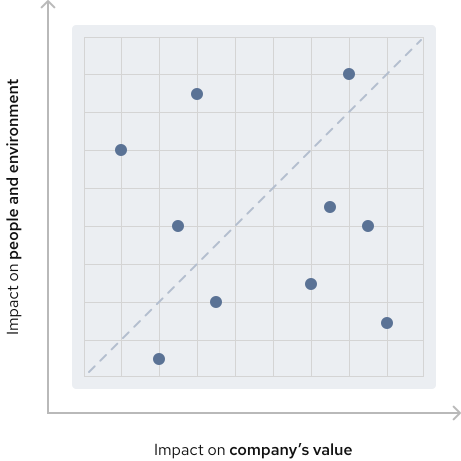
The Corporate Sustainability Reporting Directive (CSRD) emphasizes the importance of materiality assessment, recognizing the diverse users and purposes of reported information. Companies must evaluate materiality considering both impact and financial aspects of their activities, acknowledging their interconnections. Although separate and independent procedures are not required, identifying material impacts is typically the starting point, as financial evaluations often benefit from this assessment.
Material impacts often lead to significant risks, opportunities, and financial consequences.
The European Sustainability Reporting Standards (ESRS) do not prescribe a specific method for conducting materiality assessments. Each company should develop a tailored process that fits its unique circumstances, including the depth of the assessment. Professional associations representing specific sectors can also help companies determine recurring impacts, risks, and opportunities, particularly
in the absence of sector-specific standards in the EU.
Steps to Conduct a Materiality Assessment
Companies seeking guidance on materiality assessment can refer to guidance from EFRAG and GRI. The process starts with understanding the company’s context, including its activities, business relationships, and the broader environment. Key steps include:
- Identifying relevant stakeholders.
- Engaging with stakeholders to understand their concerns and expectations.
- Mapping potential sustainability issues based on industry standards, regulations, and best practices.
- Assessing the significance and potential impacts of these issues on the company and its stakeholders.
- Prioritizing issues based on their importance to the business and its stakeholders.
This inclusive approach enhances the credibility and relevance of sustainability reporting.
Including Value Chain Impacts, Risks, and Opportunities
The sustainability statement must cover all significant impacts, risks, and opportunities (IROs) related to all activities, including those from business relationships across the value chain. While not all data points require value chain information, it is necessary for significant IROs beyond the company’s operations. If primary value chain information is unavailable, companies should estimate using reasonable and supportable data, including proxies and sector data.
Responsibility of Supervisory Bodies and Audit Committees
Effective sustainability reporting requires collaboration among various teams and stakeholders, including top management and supervisory boards. The CSRD enhances accountability, mandating that administrative, management, and supervisory bodies ensure compliance with its requirements.
This includes preparing and publishing management reports with all necessary sustainability disclosures, corporate governance statements, and assurance reports in electronic formats.
For listed companies, the directive strengthens the role of audit committees in supervising the assurance of sustainability data. These committees monitor the sustainability reporting process, ensuring accuracy and independence. Corporate sustainability reporting committees within companies or sectoral associations can also play a crucial role in coordinating and overseeing sustainability performance data collection and reporting.
Materiality Thresholds
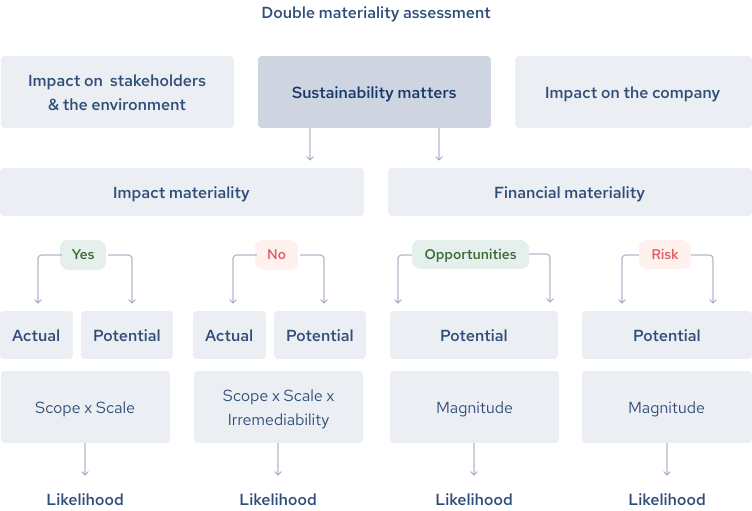
In double materiality reporting, a materiality threshold refers to the criteria (qualitative and/or quantitative) used to determine which topics are material to the company. The ESRS prescribe rules for applying double materiality, evaluating IROs based on severity and likelihood. For negative impacts, severity considers scale, scope, and the irremediable nature of impacts. For risks and opportunities, criteria are based on the magnitude and likelihood of financial effects.
Further implementation and penalties
Understanding Secondary Legislation
EU delegated and implementing acts are considered secondary legislation, as opposed to primary legislation like regulations or directives. These acts provide a flexible and efficient mechanism for the European Commission to adapt and execute legislative measures. In some years, secondary legislation has represented up to 90% of the legislative volume produced by the European Union.
Delegation of Power to the European Commission
In EU law, delegation of power refers to the authority granted by the EU legislator (usually the European Parliament and the Council of the EU) to the European Commission to adopt legal acts in specific policy areas. This delegation is outlined in primary legislation and allows the Commission to supplement or amend non-essential elements of the legislation. However, this delegation comes with clear limits and conditions to ensure accountability and transparency, and the Commission must act within the framework set by the legislator.
Types of Secondary Legislation
Delegated Acts
Delegated acts are secondary legislative acts that the European Commission is empowered to adopt under the delegation of power from the EU legislator. They allow the Commission to supplement or amend non-essential elements of primary legislation within the limits set by the legislator. These acts are crucial for the effective implementation of EU laws, providing detailed rules and technical specifications necessary for consistency and adaptability in various policy areas. The European Parliament and the Council can object to a delegated act proposed by the Commission. In the European Parliament, this can happen through a resolution adopted by the majority of its members.
Implementing Acts
Implementing acts are secondary legislative acts adopted by the European Commission to ensure the uniform application of EU regulations or directives across all Member States. Unlike delegated acts, implementing acts are not delegated by the legislator but are directly mandated by primary legislation. They contain specific measures, such as technical details or procedural rules, necessary for the practical implementation of EU laws. While the Commission proposes and adopts implementing acts, it must consult with a committee composed of representatives from the Member States in a process known as “comitology.”
Legislations mandated by CSRD
| Category | Attribute | Formal deadline | Status | Provided to the EU Commission | Comment |
|---|---|---|---|---|---|
| Delegated Act | ESRS SET 1 – Sector agnostic | June 2023 | Published | EFRAG | 12 standards |
| Delegated Act | ESRS SET 2 – Sectoral standards | June 2026 | Early drafting | EFRAG | Standards progressively adopted, with 6 to 11 foreseen by June 2026 |
| Delegated Act | ESRS for listed SMEs | June 2024 | Public consultation on draft | EFRAG | Drafts are being finalized; possible delay foreseen for Q1 2025 tbc |
| Delegated Act | ESRS for third-country companies | June 2026 | Not started | Being considered | Shall focus on sustainability impacts reporting only |
| Delegated Act | Limited assurance standards | October 2026 | Not started | Internal process at Directorate-General level | Based on technical advice by the CEAOB |
| Delegated Act | Reasonable assurance standards | October 2028 | Not started | Internal process at Directorate-General level | Pending a favorable assessment report by the EU Commission |
| Delegated Act | Digital taxonomy (tagging & XBRL technical standards) | No formal deadline | Full ESRS datapoint released | EFRAG & ESMA | Early draft foreseen for Q4 2024 |
| Implementing Act | Equivalence with third-country reporting regimes | No formal deadline | – | Internal process at Directorate-General level | Led by the European Commission |
| Guidelines | Voluntary standards for SMEs | June 2024 | – | EFRAG | Drafts are being finalized; possible delay foreseen for Q1 2025 tbc |
| Guidelines | Supervision for sustainability reporting for listed companies | No formal deadline | – | ESMA | Public consultation ended on March 15, 2024 |
| Guidelines | Procedures for assurance | – | – | CEAOB | Guidelines to be developed by July 2024, for adoption by Q4 2024 |
National Implementation and Penalties
Transposition into National Law
The CSRD provides a harmonized framework for transparency, accounting, and audit, allowing flexibility for Member States to implement its provisions in their national legal systems. The directive must be transposed by all Member States into their national law by July 6, 2024. While Member States have little flexibility regarding the content of the reporting standards, they are required to incorporate the directive’s provisions into their national legal framework and publish the necessary administrative provisions to comply with the CSRD.
Penalties for Non-Compliance
The CSRD does not introduce new penalties but requires Member States to establish effective, proportionate, and dissuasive penalties for infringements, including sustainability disclosures.
Member States are responsible for providing adequate resources for supervisory authorities to control corporate sustainability reporting practices.
For example, France has introduced criminal sanctions for directors who fail to appoint an auditor
of sustainability information and for obstructing a sustainability audit. In Hungary, non-compliance with ESG reporting obligations can result in financial penalties imposed by the national Supervisory Authority for Regulated Activities.
Scope and Applicability
Member States must ensure that the directive’s requirements apply to specified companies, including public-interest entities (PIEs) and others meeting certain size criteria. They are responsible for ensuring compliance with the prescribed content and format of annual financial and sustainability statements, including electronic reporting requirements.
Compliance Oversight
To ensure compliance with reporting requirements, Member States must designate National Competent Authorities (NCAs) responsible for overseeing the CSRD implementation. Under the previous NFRD framework, these authorities were typically financial regulators or relevant bodies with limited supervisory powers. With the integration of financial and sustainability information, the supervisory measures for listed entities should now extend to sustainability reporting. Member States have the flexibility to decide whether to extend administrative supervision by NCAs to non-listed companies, opt for another competent body, or leave compliance checks to the judicial system.
Auditing Requirements
The directive includes provisions related to the audit of financial and sustainability statements. Member States are responsible for implementing rules on the statutory audit of annual and consolidated accounts, including the appointment and independence of auditors and Independent Assurance Service Providers. NCAs must monitor possible breaches of these provisions, imposing penalties such as fines or other disciplinary measures. In cases of serious misconduct, auditors could lose their authorization to conduct statutory audits. NCAs may also require audit firms and independent assurance service providers to take corrective measures to address deficiencies in their audit processes.
Public Oversight and Transparency
The directives emphasize the importance of transparency, requiring NCAs to make certain information related to penalties publicly available while respecting business confidentiality. The Committee of European Auditing Oversight Bodies (CEAOB) coordinates national audit oversight bodies at the EU level, including aspects of cross-border enforcement and penalties. The CSRD also mandates the European Securities and Markets Authority (ESMA) to issue guidelines on the supervision of sustainability reporting by national competent authorities.
By understanding these elements, companies and stakeholders can better navigate the requirements and implications of the CSRD and related secondary legislation in the EU.
EFRAG and GRI: Joint statement of Interoperability
September 4th, 2023, EFRAG and GRI published a joint statement on the high level of interoperability achieved between the European Sustainability Reporting Standards (ESRS) and the GRI Standards.
Following the requirement of the CSRD to adopt a double materiality approach and to take account of existing standards, ESRS and GRI definitions, concepts and disclosures regarding impacts are fully or, when full alignment was not possible due to the content of the CSRD mandate, closely aligned.
Existing GRI reporters will be well prepared to report under the ESRS. Entities reporting under ESRS are considered as reporting with reference to the GRI Standards and will therefore avoid the burden of multiple reporting.
Interoperability between ESRS and ISSB Standards. EFRAG Assessment and mapping table
August 23rd, 2023, EFRAG published the paper “Interoperability between ESRS and ISSB standards EFRAG assessment at this stage and mapping table “.
The objective of this paper is to present the EFRAG’s assessment at this stage on the interoperability between ESRS 2 General Disclosures and ESRS E1 Climate and IFRS S1 & S2 Climate-related Disclosures and to provide a supporting mapping table. This paper and the climate-related disclosures mapping table is a contribution to the ongoing joint work with the ISSB on interoperability guidance on ESRS and ISSB standards.
Background: The CSRD requires that in adopting the Delegated Acts the European Commission shall to the greatest extent possible take account of the work of global standard-setting initiatives. In addition, ESRS should contribute to convergence of global standards to reduce the risk of inconsistent reporting requirements for undertakings that operate globally. EFRAG stated that It is important to present the EFRAG’s assessment at this stage on the interoperability between ESRS 2 General Disclosures and ESRS E1 Climate and IFRS S1 & S2 Climate-related Disclosures and to provide a supporting mapping table, which is a contribution to the ongoing joint work with the ISSB on interoperability guidance on ESRS and ISSB standards.
Generation Impact Global follows EFRAG, GRI, IFRS statements and presents interoperability between frameworks in the system for easy reporting sustainability and avoid company burden.
Omnibus I Reforms, Revised ESRS, and the 2026 Legislative Landscape
The regulatory landscape governing corporate sustainability within the European Union has undergone a paradigm shift following the formal adoption of the “Simplification Omnibus” package on February 24, 2026. This legislative intervention, formally known as Directive (EU) 2026/… of the European Parliament and of the Council, represents a decisive pivot from the expansive regulatory ambitions of the 2022-2024 era toward a more streamlined, competitiveness-focused architecture. Driven by the findings of the Draghi Report on “The Future of European Competitiveness” and the mandates of the Budapest Declaration, the Union has moved to reduce administrative, regulatory, and reporting burdens by approximately 25% for the first half of 2025, culminating in the 2026 sign-off.
This structural overhaul fundamentally alters the scope, technical requirements, and enforcement mechanisms of the Corporate Sustainability Reporting Directive (CSRD), the Corporate Sustainability Due Diligence Directive (CSDDD), the Accounting Directive, and the Audit Directive. By drastically raising the employee and turnover thresholds for mandatory compliance, the Union has effectively exempted nearly 80% of undertakings previously slated for “Wave One” and “Wave Two” reporting. Furthermore, the conceptual application of the Double Materiality principle has been refined to prioritize quantitative precision and scoping-based identification over exhaustive narrative disclosure. This report provides a detailed examination of these updates, their technical implications for European Sustainability Reporting Standards (ESRS), and the revised implementation timelines that now define the EU’s sustainability reporting trajectory.
Executive Summary: The 2026 “Reset”
On February 13, 2026, the European Council signed off on a critical legislative act (PE-CONS 66/25) designed to boost EU competitiveness by simplifying sustainability reporting. The primary mechanism is a two-year postponement of sector-specific reporting standards and requirements for non-EU companies. This pause aims to allow companies to focus on the core Double Materiality assessment within the general standards before facing additional granular requirements.
2 Year Delay
For Sector-Specific ESRS adoption.
Non-EU Relief
Reporting obligations pushed to 2028.
Digital Focus
New push for digital tools to aid SMEs.
Macroeconomic Drivers and the Competitive Compass
The impetus for the 2025-2026 simplification revolution was an emerging consensus among EU Heads of State that the cumulative regulatory burden was beginning to undermine the resilience and global positioning of European businesses. The contextual landscape was defined by high energy prices exacerbated by geopolitical instability, rising trade tensions, and a divergence in regulatory approaches between the EU and other major jurisdictions. Mario Draghi’s 2024 report emphasized that the original CSRD and CSDDD frameworks, while noble in their environmental and social intent, created compliance costs that risked driving capital out of the Union.
The “Competitive Compass for the EU” and the Communication on “A simpler and faster Europe” (COM (2025) 47 final) provided the administrative framework for this bold action. The objective was not to dismantle the European Green Deal, but to ensure its objectives—climate neutrality by 2050 and a just transition—were delivered via a cost-effective, manageable regulatory framework that does not leave “any person or place behind”. The result is a legislative package that maintains the core objectives of transparency and accountability while introducing significant flexibilities and protections for the value chain.
Structural Revision of Mandatory Thresholds and Personal Scope
The most impactful change introduced by the Omnibus package is the substantial upward revision of the size criteria that trigger mandatory sustainability reporting. This change is rooted in the “think small first” principle and aims to align the CSRD more closely with the CSDDD to avoid fragmented compliance requirements.1
The Move to the “1000/450” Standard
Prior to the 2025 amendments, the CSRD utilized a “large undertaking” threshold that captured entities with more than 250 employees and either €50 million in turnover or €25 million in balance sheet total. The new Omnibus framework effectively replaces this trigger for sustainability reporting purposes with a significantly higher bar. Mandatory individual and consolidated sustainability reporting is now restricted to undertakings and groups that exceed a net turnover of €450,000,000 and an average of more than 1,000 employees during the financial year.
The Timeline Shift
The most immediate impact of the 2026 update is the amendment to the Corporate Sustainability Reporting Directive (CSRD) timelines. The goal is to reduce the administrative burden by roughly 25% without compromising the long-term transparency goals. The visualization highlights the original versus the new adoption deadlines for key reporting milestones.
Why the Delay?
- ✓ Prioritize implementation of General ESRS (Set 1).
- ✓ Allow EFRAG to refine Sector-Specific standards.
- ✓ Provide breathing room for Double Materiality assessments
| Reporting Category | Previous CSRD/CSDDD Thresholds | New Omnibus Simplification Thresholds |
| Mandatory Reporting (Individual) | > 250 employees / > €50M turnover | > 1,000 employees / > €450M turnover |
| Mandatory Reporting (Consolidated) | Parent of Large Group | Parent of Group > 1,000 employees / > €450M consolidated turnover |
| Listed SMEs | Mandatory (after phase-in) | Excluded from Mandatory Scope (Voluntary only) |
| Non-EU Undertakings (Union Group level) | > €150M EU turnover | > €450M EU turnover |
| EU Branch / Subsidiary (of Non-EU parent) | Branch > €40M / Subsidiary as Large | Branch > €50M / Subsidiary > €200M turnover |
| CSDDD Primary Scope (Group 1) | > 5,000 employees / > €1500M turnover | > 5,000 employees / > €1500M turnover (Delayed implementation) |
Strategic Exclusions and Exemptions
The Omnibus Directive provides specific relief for sectors and entities where the reporting burden was deemed disproportionate to the governance benefits. For example, the European Financial Stability Facility (EFSF) is now explicitly exempted from the sustainability reporting regime to ensure parity with the European Stability Mechanism (ESM). Additionally, financial holding undertakings that do not engage in the management of their subsidiaries, and whose subsidiaries’ business models are independent, are granted the option to omit consolidated sustainability reporting. This recognizes that for diversified investment holdings, consolidated ESG data can often be misleading or of limited utility to market participants.
Technical Evolution of European Sustainability Reporting Standards (ESRS)
The Commission has been mandated to revise the “First Set” of ESRS (adopted in July 2023) to deliver on the simplification agenda. This revision, often referred to as the “Quick Fix” amendments, aims to reform the standards by prioritizing quantitative data over narrative descriptions and distinguishing more clearly between mandatory and voluntary datapoints.
Removal of Sector-Specific Standards
In perhaps the most significant structural simplification, the Omnibus Directive deletes the empowerment for the Commission to adopt sector-specific reporting standards. Originally, the CSRD envisioned a sprawling library of industry-specific requirements for high-impact sectors. The 2026 update removes this requirement to prevent an exponential increase in prescribed datapoints. Instead, the Commission may support undertakings through non-binding sector-specific guidance, focusing on how to conduct materiality assessments for typical industry risks rather than imposing new mandatory disclosures.
Reporting Topics Scope
The ESRS framework covers Environmental, Social, and Governance (ESG) topics. The chart illustrates the distribution of topical standards that companies must assess. The “Simplification” primarily delays the addition of new slices to this pie (the Sector-Specific layers).
Key Takeaway:
Companies must still assess all General topical standards (E1-E5, S1-S4, G1) now, but the 40+ anticipated sector- specific standards are on hold.
Adoption of the Voluntary SME Standard (VSME)
For the 80% of companies now outside the mandatory scope, the Commission will adopt a proportionate standard for voluntary use by mid-2025. This VSME standard, developed by EFRAG, is intended to be a simple, modular, and widely recognized tool. It uses simplified language and the “think small first” principle, allowing smaller undertakings to provide verified sustainability data to banks and large corporate partners without the overhead of the full ESRS. The voluntary standard is crucial for maintaining market access for SMEs that face growing demands for ESG information from their financial and value-chain partners.
Refinement of the Double Materiality Principle
The “Double Materiality” principle remains the conceptual anchor of the ESRS, requiring entities to report on both their “impact materiality” (impacts on people and the environment) and “financial materiality” (sustainability-related risks and opportunities affecting the company’s performance). However, the Omnibus update provides clearer instructions and stricter thresholds to prevent “information overload” and ensure that only truly material information is reported.
Impact and Financial Interconnection
Under the ESRS framework, a sustainability matter is material when it meets the criteria for either impact materiality or financial materiality, or both. The 2025-2026 revisions emphasize that these two lenses are often interconnected: a severe environmental impact (e.g., water pollution) often triggers a financial risk (e.g., regulatory fines or loss of social license). The Omnibus Directive requires companies to use objective criteria and evidence-supported thresholds to determine materiality, moving away from subjective or purely narrative justifications.
The “Scoping” and “In-Depth” Assessment Duality
In the context of the CSDDD, the methodology for identifying adverse impacts has been refined into a two-stage process:
- Scoping Exercise: Companies must first identify general areas within their own operations, subsidiaries, and business partners where adverse impacts are most likely to occur and be most severe. Crucially, this exercise is to be based “solely on reasonably available information,” precluding the need for large-scale data requests from business partners during the initial phase.
- In-Depth Assessment: For the high-risk areas identified during scoping, companies must then perform an in-depth assessment using quantitative and qualitative data, including stakeholder consultations.
This duality ensures that the most severe risks are prioritized, allowing companies to allocate resources effectively rather than attempting to map their entire global value chain simultaneously.
Double Materiality: The Core Engine
Despite the timeline delays, Double Materiality remains the non-negotiable cornerstone of the ESRS. The “Simplification” does not remove this requirement but clarifies the focus: Report what matters, exclude what doesn’t.
Changes in the 2026 Context
Focus on Quality
The delay in sector-specific standards removes the pressure to check thousands of boxes immediately. Companies can now dedicate resources to a robust, defensible Double Materiality Assessment (DMA) for the general standards.
Value Chain Rationalization
A key part of the simplification is limiting the “trickle-down” burden. Large companies are encouraged to use estimates or sector averages rather than demanding primary data from every SME in their supply chain for non-material issues.
Rebuttable Presumption
Simplification reinforces that if a topic is not material, it doesn’t need to be reported. The focus shifts from “comply with everything” to “comply with what is relevant.”
The Value-Chain Cap and Protection of “Protected Undertakings”
A central pillar of the simplification package is the introduction of protections for undertakings in the value chain that fall below the 1,000-employee threshold—defined in the legislation as “protected undertakings”.
Limiting the Trickle-Down Effect
To prevent large reporting entities from shifting the administrative burden onto their smaller suppliers, the Omnibus Directive establishes a “value-chain cap”. Reporting undertakings are prohibited from requesting information from protected undertakings that exceeds the requirements specified in the VSME standards. Furthermore:
- Self-Declaration: Reporting undertakings may rely on a self-declaration from value-chain partners to determine their size and status as a protected undertaking.
- Statutory Right to Refuse: Protected undertakings are granted a legal right to refuse to provide information that exceeds the VSME cap.
- Duty to Inform: If a large company requests data that exceeds the cap, it must explicitly inform the protected undertaking of its right to decline the request.
These measures are designed to ensure that the “simplification revolution” for large companies does not inadvertently increase the burden on the SMEs they rely on.
Corporate Sustainability Due Diligence: Streamlining and Enforcement
The 2026 updates introduce far-reaching changes to the CSDDD, primarily aimed at reducing complexity and increasing legal certainty for companies operating in complex global value chains.
Targeted Due Diligence Measures
The revised Article 8 of the CSDDD limits the proactive identification of adverse impacts to own operations, subsidiaries, and “direct business partners”. Companies are only required to look beyond direct (Tier 1) partners if they possess “plausible information” suggesting an adverse impact at the level of an indirect partner. Plausible information is defined as information of an “objective character,” such as credible media reports, NGO alerts, or complaints through the notification mechanism.
Monitoring and Reporting Frequency
To reduce recurring compliance costs, the frequency of periodic monitoring has been significantly extended. Companies are now required to assess the adequacy and effectiveness of their due diligence measures at least every five years, rather than every twelve months as originally proposed. Ad hoc assessments remain necessary only if there is a “significant change” or reasonable grounds to believe that existing measures are no longer effective.
Removal of Mandatory Climate Reporting Burdens
The requirement for companies to “put into effect” a transition plan for climate change mitigation under Article 22 has been repealed to streamline obligations and avoid duplication with the CSRD/ESRS reporting requirements. Instead, companies must adopt a plan that outlines implementing actions, both planned and taken, aimed at ensuring best efforts toward compatibility with the 1.5°C goal of the Paris Agreement.
Revised Enforcement and Liability
The Omnibus Directive removes the uniform, Union-wide civil liability regime from the CSDDD. Instead, liability for damages caused by a failure to comply with due diligence requirements will be governed by national law. Member States must ensure that victims have a right to “full compensation” while implementing safeguards to prevent overcompensation through punitive or multiple damages.
Furthermore, the “minimum cap” for fines (which was set at 5% of worldwide turnover) has been removed. Member States are now prohibited from setting a “maximum cap” that would prevent supervisory authorities from imposing “effective, proportionate and dissuasive” penalties. The Commission, in collaboration with Member States, will issue guidance to assist authorities in determining penalty levels, which must take into account the gravity of the infringement and the company’s consolidated worldwide turnover.
Corporate Sustainability Due Diligence (CSDDD)
1,000
Employees
New threshold for company scope (raised from 500).
€450M
Turnover
Financial threshold for inclusion.
2027+
Phase-In
Application starts for largest companies.
Risk
Based
Approach to value chain diligence.
Assurance and Audit: The Limited Assurance Ceiling
The 2025 simplification proposal brings significant clarity to the future of sustainability assurance. To provide cost certainty to undertakings, the requirement for the Commission to adopt “reasonable assurance” standards has been entirely removed. Sustainability statements will remain subject to “limited assurance” for the foreseeable future.
Postponed Adoption of Limited Assurance Standards
The deadline for the Commission to adopt mandatory limited assurance standards has been postponed to July 1, 2027. This extension allows the Commission to address concerns regarding the “work carried out by assurance providers” and provides flexibility in addressing specific risks identified during the early implementation phase. By 2026, the Commission will issue targeted assurance guidelines to clarify the necessary procedures practitioners must perform, ensuring consistency across the Union until the delegated acts are finalized.
Key Sustainability Partner Requirement
For audit firms, the approval requirements have been simplified. To carry out sustainability assurance, a firm is no longer required to meet the same ownership and management criteria as for financial audits. Instead, it must designate at least one “key sustainability partner” who is an approved statutory auditor and possesses the necessary competencies in sustainability assurance. This allows specialized audit firms to enter the sustainability assurance market more easily, fostering competition and potentially reducing costs for reporting undertakings.
Digital and Electronic Reporting: ESAP and the Digital Taxonomy
Digitalization is viewed as a primary mechanism for reducing the long-term administrative burden of sustainability reporting. The Omnibus Directive maintains the requirement for sustainability statements to be prepared in the XHTML format and digitally tagged using an XBRL taxonomy.
The European Single Access Point (ESAP)
From January 1, 2031, companies subject to the CSDDD and CSRD must submit their annual sustainability statements to a designated collection body for publication on the ESAP. This centralized portal will make sustainability information accessible, comparable, and machine-readable for investors and other stakeholders.
Transitional Marking-Up Flexibilities
Recognizing the technical complexity of digital tagging, the Omnibus Directive clarifies that undertakings are not required to mark up their sustainability reports until the final digital taxonomy is adopted by the Commission. This prevents companies from investing in marking-up processes that may be superseded by subsequent technical updates to the ESEF (European Single Electronic Format) delegated regulation.
Reporting on Technological Solutions
By early 2028, the Commission will submit a report to the European Parliament on technological solutions for sustainability reporting. This report will focus on initiatives that enable undertakings to collect, process, and exchange activity data (such as Scope 3 emissions or supplier data) in a “secure, seamless and automated manner”. This includes exploring harmonized digital formats like electronic invoices and digital VSME reports to facilitate business-to-business data sharing.
SMEs & The Digital Future
The scope of CSRD expands progressively. We are currently in the transition between Wave 1 (NFRD entities) and Wave 2 (Large non-NFRD).
- Voluntary SME Standards (VSME)
- Free digital reporting platforms
- “Data Once, Use Many” principle
Implementation Timelines and Application Waves
The Omnibus Simplification package adjusts the staggered timeline for CSRD and CSDDD application to reflect the revised scope and the two-year postponement for certain entities.
CSRD Application Waves (Post-Simplification)
| Wave | Group / Company Category | Start of Reporting (FY) | First Report Publication |
| Wave 1 (Amended) | Large PIEs > 1,000 employees / > €450M turnover | FY 2024 | 2025 |
| Wave 2 (Amended) | Other Large Undertakings > 1,000 employees / > €450M turnover | FY 2027 | 2028 |
| Wave 3 | Non-EU Undertakings > €450M EU turnover | FY 2029 | 2030 |
| Transitional Wave | Large Subsidiaries/Branches of Non-EU parents | FY 2029 | 2030 |
CSDDD Application Waves (Post-Simplification)
| Phase | Company Thresholds (Employees / Turnover) | Application Date |
| Phase 1 | > 5,000 employees / > €1,500M turnover | July 26, 2028 |
| Phase 2 | > 3,000 employees / > €900M turnover | July 26, 2028 |
| Phase 3 | > 1,000 employees / > €450M turnover | July 26, 2029 |
| Phase 4 | Franchising > €75M royalties / > €275M turnover | July 26, 2029 |
Member States are required to transpose the CSRD-related amendments (Articles 1, 2, and 3 of the Omnibus) by mid-2026, while the CSDDD-related amendments (Article 4) must be transposed by July 26, 2028.
The Future Outlook: Sustainability as a Competitive Advantage
The 2025-2026 simplification updates mark a shift from sustainability reporting as a compliance-heavy “check-the-box” exercise to a strategic tool for corporate resilience and transition finance. The introduction of “opt-in” regimes for taxonomy reporting—where companies with turnover below €450 million can choose to disclose only their CapEx or turnover KPIs—allows transitioning companies to attract investment without the pressure of full mandatory taxonomy alignment.
By focusing on the most “consequential” entities and protecting the value chain, the EU aims to create a high-quality ESG data standard that is indistinguishable from financial reporting in its rigor, but manageable in its implementation. The “simplification revolution” ensures that the European Green Deal remains a mid- to long-term driver of competitiveness, providing investors with the reliable data they need to manage risks while ensuring that European undertakings are not bogged down by excessive administrative complexity.
Conclusion: Synthesizing the 2026 Regulatory Landscape
The structural updates finalized in early 2026 represent a pragmatic recalibration of the EU’s sustainability agenda. The reduction of mandatory reporting scope to entities exceeding 1,000 employees and €450 million in turnover provides immediate relief to the European mid-market while ensuring that the 20% of companies responsible for the vast majority of environmental and social impacts remain subject to rigorous oversight. The evolution of the Double Materiality principle toward a scoping-based, risk-prioritized methodology reflects a technical maturity that seeks “faithful representation” rather than exhaustive narrative.
With the postponement of limited assurance standards to 2027, the removal of the reasonable assurance threat, and the strengthening of the VSME value-chain shield, the Union has delivered a framework that is both “simpler and faster”. As the first waves of revised sustainability statements are published in 2025 and 2026, the focus will shift to digital implementation and the automated exchange of data, cementing the EU’s role as a global leader in sustainable finance while safeguarding the competitive prosperity of its internal market.
Omnibus I Reforms, Revised ESRS, and the 2026 Legislative Landscape
Executive Summary: The State of EU Sustainability Law in Mid-February 2026
As of mid-February 2026, the European Union’s corporate reporting landscape is undergoing a profound structural recalibration. Following the “Competitiveness Compass” initiative and the Draghi Report on European Competitiveness, the European Commission, Parliament, and Council have executed a series of legislative interventions designed to reduce administrative burdens while retaining the core transparency objectives of the European Green Deal.1 This report provides an exhaustive technical analysis of the status of the Corporate Sustainability Reporting Directive (CSRD), the European Sustainability Reporting Standards (ESRS), and the Corporate Sustainability Due Diligence Directive (CSDDD).
The legislative architecture as of February 2026 is defined by two primary vehicles:
- Directive (EU) 2025/794 (The “Stop-the-Clock” Directive): Adopted in April 2025, this instrument formally delayed the transposition and reporting timelines for “Wave 2” and “Wave 3” entities, effectively pushing broad market applicability to 2028 and 2029.4
- The Omnibus I “Content” Directive (Pending Official Journal Publication): Following a provisional political agreement reached on December 9, 2025, and European Parliament adoption on December 16, 2025, this directive is in the final stages of formal adoption by the Council.1 This directive fundamentally alters the scope of the CSRD, raising employee thresholds to 1,000 and introducing the “Value Chain Cap.”
Concurrently, the European Financial Reporting Advisory Group (EFRAG) delivered its technical advice on the “Simplified ESRS” in December 2025, proposing a substantial reduction in mandatory datapoints and a shift toward a “Fair Presentation” framework for double materiality.
This report dissects these developments with a focus on legal mechanics, transposition nuances (with Italy as a primary case study), and technical implementation requirements for legal and compliance professionals.
1. Legislative Architecture: The Omnibus I Simplification Package
The “Omnibus I” package, originally proposed by the Commission in February 2025 (COM(2025) 80 and 81), was bifurcated to expedite timeline delays while allowing more time for substantive scope negotiations. This bifurcation strategy allowed the EU institutions to address immediate market anxieties regarding the looming 2025/2026 deadlines without forcing a premature consensus on the more contentious scope reductions.
1.1 Directive (EU) 2025/794: The “Stop-the-Clock” Mechanism
Directive (EU) 2025/794 was published in the Official Journal on April 16, 2025, and entered into force on April 17, 2025. Its sole legal function was to amend the application dates of Directive (EU) 2022/2464 (CSRD) and Directive (EU) 2024/1760 (CSDDD).
Legal Effect on Reporting Waves:
The Directive introduced a two-year deferral for companies not already subject to the Non-Financial Reporting Directive (NFRD).
| Reporting Wave | Original Start Date (FY) | New Start Date (FY) | First Report Publication |
| Wave 1 (NFRD PIEs) | FY 2024 | No Change | 2025 |
| Wave 2 (Large Undertakings) | FY 2025 | FY 2027 | 2028 |
| Wave 3 (Listed SMEs) | FY 2026 | FY 2028 | 2029 |
| Non-EU Groups (Art 40a) | FY 2028 | FY 2028 | 2029 |
Table 1: Revised CSRD Application Timeline under Directive (EU) 2025/794
The “Stop-the-Clock” mechanism did not alter the substance of the reporting obligations but provided a critical “legal pause.” For Wave 2 entities (large non-listed companies), this effectively moved the compliance horizon from imminent preparation to a medium-term strategic project. It is crucial to note that Wave 1 entities (Large Public Interest Entities with >500 employees) received no deferral under this specific Directive, creating a split regulatory timeline where market leaders are already reporting while competitors have significant additional preparation time.
Sector-Specific ESRS: The adoption deadline for sector-specific standards was extended to June 2026. However, subsequent political agreements in late 2025 (discussed below) have effectively removed the mandatory nature of these standards, converting them into voluntary guidance. This shift represents a significant deregulation, moving from a prescriptive “comply or explain” regime for sectors to a principles-based materiality approach.
Transposition Status: Member States were required to transpose this Directive by December 31, 2025. As of February 2026, most jurisdictions have enacted these delays. In Italy, this was achieved via Law No. 118 of August 8, 2025, which converted Decree Law No. 95/2025. This creates a complex interim period where national laws reflect the delays, but potentially not the substantive scope reductions that are still pending final EU adoption.
Passporting System
The CSRD establishes a “passporting system” for IASPs, allowing accredited service providers in one Member State to operate in another Member State without seeking additional accreditation. France currently offers this opportunity, with other Member States planning to follow.
Organization of the Assurance Profession
Member States authorizing IASPs must set requirements equivalent to those for statutory auditors under the Audit Directive. This includes professional ethics, independence, objectivity, confidentiality, and professional secrecy regarding sustainability reporting assurance. Statutory auditors and IASPs must meet specific educational, training, and examination requirements, as well as adhere to quality assurance systems, and rules on irregularities, investigation, and sanctions.
Equivalence with Third-Country Audit Companies
The directive provides a mechanism for recognizing third-country auditors if their regulatory framework is equivalent to the EU’s for statutory audits. Third-country auditors must register with the competent authority of the Member State where they intend to carry out audits.
Review Clause
By December 31, 2028, the Commission will review and report on the concentration of the sustainability assurance market and assess possible legal measures to ensure market diversification and the quality of sustainability reporting.