
Decarbonisation Fiscal Impact Estimator
Decarbonisation is no longer a distant policy ambition — it is a near-term fiscal reality. As governments across the OECD commit to net-zero targets, the question of how climate change and the energy transition will reshape public budgets has become urgent. Revenue from fossil fuel taxes is declining. Spending on climate adaptation and transition support is rising. And the macroeconomic impacts of warming are compounding these pressures.
To address this, the OECD developed the EDISON (Environmental and Decarbonisation Impact Scenarios On National) budgets tool — an analytical framework for projecting the fiscal consequences of climate scenarios. Below, we have built a free, interactive version of this methodology so that finance professionals, sustainability teams, and policymakers can explore the fiscal trade-offs of decarbonisation in a simplified, accessible format.
This tool draws on the OECD’s green budgeting framework and models the key fiscal channels affected by the climate transition. Use it to understand the direction and scale of impacts on your country’s public finances — from lost fuel tax revenues to avoided damage costs under different policy scenarios.
Go to tool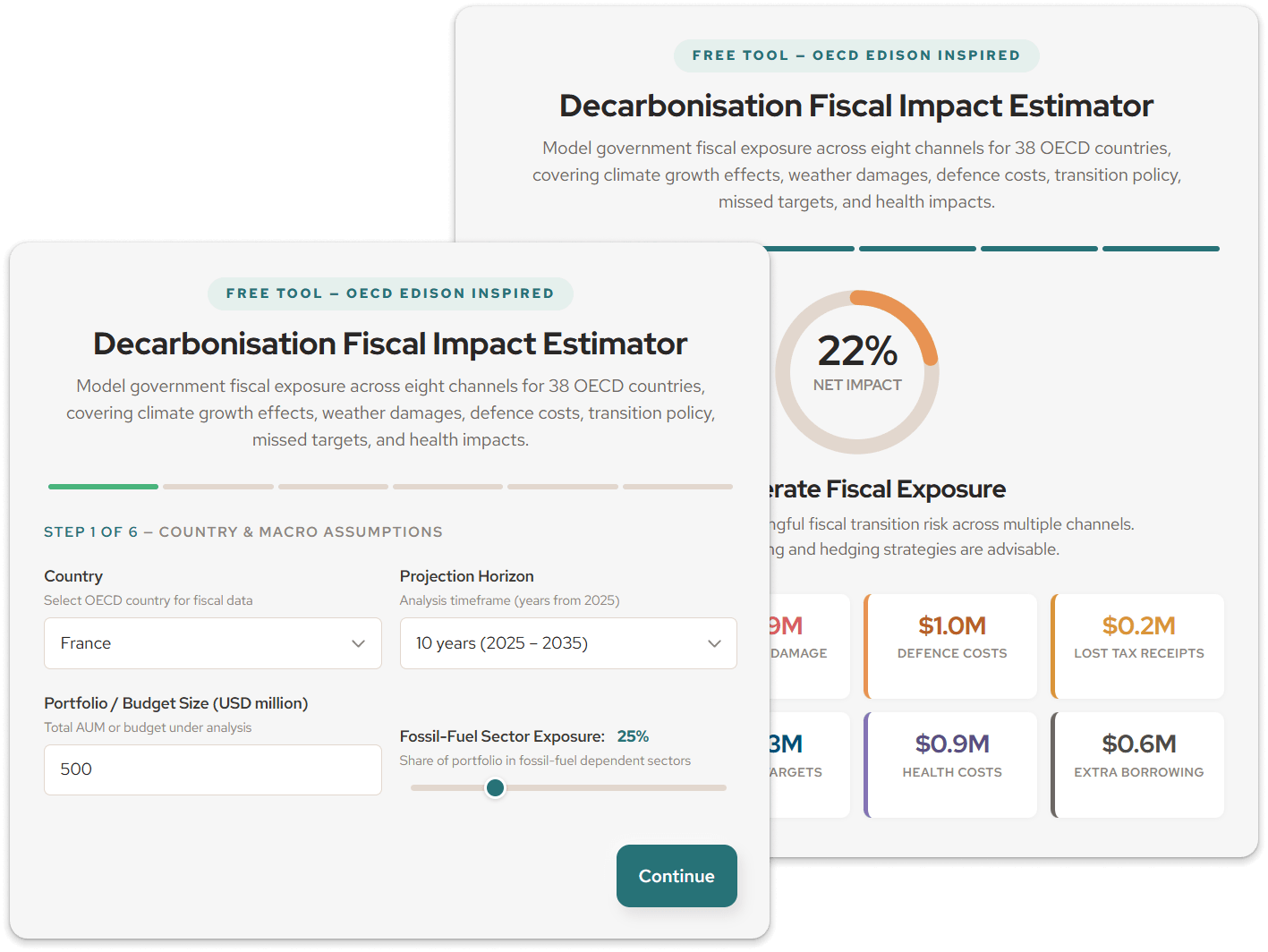
How the OECD-EDISON Framework Models Fiscal Impacts
The OECD-EDISON tool assesses fiscal sustainability through five interconnected modules. It starts with baseline macroeconomic assumptions — standard growth and price forecasts that do not yet incorporate climate effects. These are then layered with climate damage projections based on selected warming scenarios, followed by emissions pathway inputs that determine how fuel and energy consumption will evolve.
The fourth module addresses transition policy — this is where the real fiscal trade-offs emerge. Users specify the current tax structure and estimate the spending required to support decarbonisation, from building retrofits and EV subsidies to sectoral industrial support. Finally, the tool synthesises these inputs to project how the government budget balance, revenues, and expenditure will change under each scenario. At Generation Impact Global, we help financial institutions operationalise exactly this kind of scenario analysis through structured ESG data management workflows.
Key Fiscal Channels Affected by Decarbonisation
The tool identifies seven distinct channels through which climate change and decarbonisation affect public finances. Understanding these channels is essential for investors conducting climate risk assessments and for sustainability teams reporting under frameworks like TCFD/ISSB and SFDR.
Macroeconomic drag from warming.
Rising temperatures reduce labour productivity, increase heat-related health costs, and damage infrastructure. The OECD’s median damage function, based on Howard and Sterner (2017), projects global output losses of roughly 9% by 2100 under a 2.5°C warming scenario. Higher-damage estimates from Bilal and Känzig (2024) push this figure to 36%. These GDP-level impacts directly reduce government revenue capacity.
Declining fossil fuel revenues.
As economies shift away from petrol, diesel, and coal, excise duties, carbon taxes, and VAT receipts on these fuels fall significantly. In many OECD countries, these revenue streams represent 2–4% of GDP. Without active tax policy adaptation, this creates a structural fiscal gap.
Extreme weather damage costs.
Floods, storms, wildfires, droughts, and extreme temperature events impose direct fiscal costs — from infrastructure repair to emergency relief and household compensation. The OECD tool uses the EM-DAT database to estimate country-specific historical damage averages, then scales these forward using IPCC risk multipliers.
Adaptation and defence expenditure.
Governments must invest in flood defences, hazard-proofing infrastructure, coastal protection, and early warning systems. These costs rise with higher warming scenarios but can partially offset future damage costs.
Transition support spending.
The shift to a low-carbon economy requires public investment in building retrofits, electric vehicle subsidies, sectoral decarbonisation support, and green R&D. The UK Office for Budget Responsibility (2021) estimated these costs at approximately 1–2% of GDP per year.
Costs of missing climate targets.
For EU Member States, failure to meet binding emissions targets under the Effort Sharing Regulation can trigger significant compliance costs. These are modelled as the gap between projected emissions and binding allocations, multiplied by an assumed carbon price.
Health co-benefits and costs.
Air pollution reduction from lower fossil fuel use delivers healthcare savings. Conversely, higher temperatures increase heat stress, respiratory illness, and other climate-related health burdens. The tool models both channels based on OECD and academic estimates.
Model government fiscal exposure across eight channels for 38 OECD countries, covering climate growth effects, weather damages, defence costs, transition policy, missed targets, and health impacts.
| Country | FF Tax % GDP | GDP (USD tn) |
|---|
Methodology note — This estimator is inspired by the analytical framework behind the OECD EDISON tool (Environmental and Decarbonisation Impact Simulations On National budgets). For full methodology and the original Excel-based tool, consult the OECD EDISON Technical Guidance (PDF). All intellectual property related to the OECD EDISON framework belongs to the OECD. This tool uses independent, simplified multipliers for illustrative purposes and does not reproduce OECD proprietary methodology or data. Results are indicative only and must not be relied upon for investment or policy decisions. No data is transmitted — all calculations run in your browser.
Why This Matters for Financial Institutions
Climate fiscal risk is not confined to government balance sheets. It flows directly into sovereign credit assessments, bond yields, and the risk profiles of assets held by institutional investors. When a government faces a structural fiscal gap from declining fossil fuel revenues — or must finance large-scale adaptation spending — these pressures affect the broader investment environment.
For asset managers reporting under CSRD/ESRS and SFDR, understanding how fiscal decarbonisation scenarios translate into transition risk factors is increasingly relevant. The OECD-EDISON methodology provides a structured way to assess these dynamics — which is precisely the kind of analytical framework that underpins robust sustainability data management.
Frequently Asked Questions
What is the OECD-EDISON budgets tool?
The OECD-EDISON (Environmental and Decarbonisation Impact Scenarios On National budgets) tool is an analytical framework developed by the OECD to help institutions calculate the long-term fiscal impacts of climate change and decarbonisation. It models how government revenues, expenditure, and the overall budget balance are affected under different warming and policy scenarios.
What climate scenarios does the tool support?
The tool includes six OECD scenarios. Two are business-as-usual scenarios (BAU1 and BAU2) assuming 2.5°C warming with median and high damage functions respectively. Four are energy transition scenarios (ET1–ET4) limiting warming to 1.6°C, varying by the speed and cost of the transition and the damage function used.
How are extreme weather damages estimated?
Historical damage data come from the EM-DAT database maintained by the Centre for Research on the Epidemiology of Disasters. The tool uses country-specific averages for the period 2000–2024, then projects how event frequency will change using risk multipliers from the IPCC Sixth Assessment Report (Seneviratne et al., 2023).
Can I use this calculator for formal fiscal sustainability analysis?
This interactive version is a simplified illustration of the OECD-EDISON methodology designed to help users understand the direction and scale of fiscal impacts. For formal analysis requiring detailed country-specific inputs on fuel consumption, tax structures, vehicle fleets, and sectoral support, the full OECD-EDISON spreadsheet tool should be used.
Which countries has the OECD-EDISON tool been applied to?
The tool has been applied in the United Kingdom, the Netherlands, and Luxembourg, with several other OECD countries producing findings for release. The methodology is designed as a common framework applicable to all 38 OECD member countries.