Interoperability
Collect once. Disclose everywhere.
Regulatory frameworks overlap, but they never align perfectly. Most platforms give you separate templates for each and leave you to reconcile manually.
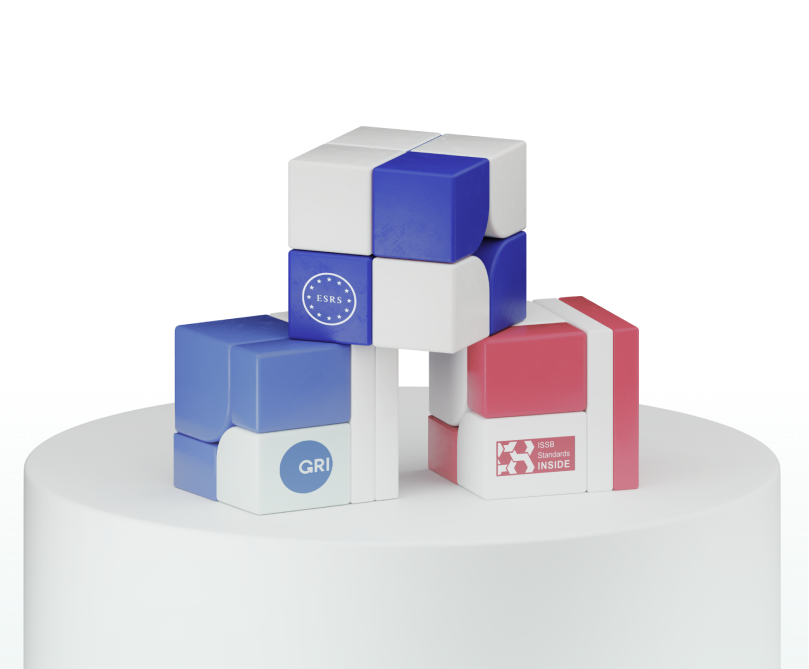
Our engine maps data points at paragraph and sub-paragraph level. It operates at three levels: framework to framework, QB to framework, and QB to QB. Built-in mappings for ESRS, GRI, SFDR, ISSB, EU Taxonomy, and VSME. You can build your own on top

QB-EDGE
Questionnaires
Any Framework
Direct entry into ESRS, GRI, SFDR, etc.
VitAI
AI extraction from documents
Interoperability engine
Framework to Framework
ESRS – GRI – SFDR – ISSB – EU Taxonomy – VSME
Data point maps across all connected frameworks
QB to Framework
QB-EDGE responses map to framework disclosures
Answer once, populates the relevant framework
QB to QB
Responses in one questionnaire populate overlapping questions in another
Five similar questionnaires, one set of answers
ESRS to GRI
Data-point-level mappings reflecting EFRAG-GRI cooperation.
GHG emissions
E1-8
GRI 305 / 102
Core figures equivalent. Scope 3 diverges on categories.
Transition plan
E1-1
GRI 102-1
GRI 102-1 (from 2027) aligns with ESRS E1-1.
Employee diversity
S1-8
GRI 405-1
Common data auto-populates. Requests incremental gaps only.
ESRS to ISSB
Same data serves European and international audiences.
Climate governance
GOV-1
IFRS S2 ¶5–7
Single source of truth
Financial impact
E1-11
IFRS S2 ¶15–21
Distinguishes double vs financial materiality
GHG emissions
E1-8
IFRS S2 ¶29(a)
Unified EU and international collection
SFDR to ESRS, GRI, EU Taxonomy
PAI indicators mapped to ESRS, GRI, and EU Taxonomy.
GHG emissions (PAI)
PAI 1,2,3
E1-8
GRI 305 / 102
Collected once, populates all three
Board gender diversity
PAI 13
GOV-1
GRI 405-1
Provided once, distributed everywhere
Fossil fuel exposure
PAI 4
SBM-1
Fossil-fuel revenue from ESRS 2 SBM-1
VSME to ESRS, GRI
EU Voluntary Standard (Del. Reg. (EU) 2026/1560) and EFRAG template v1.3.0. ESRS codes follow ESRS (2026), Del. Reg. (EU) 2026/1563. SME data maps upward to ESRS and across to SFDR PAI.
Energy and GHG
VSME B3
E1-7, E1-8
GRI 302/103, 305/102
Simplified data maps upward
Workforce
VSME B8
S1-5
GRI 2-7, 401
Headcount and turnover map to S1-5
Governance
VSME B11
G1-4
GRI 205-3
Simplified to full disclosures
Interoperability between questionnaires
Organisations collect ESG data through multiple instruments. When a portfolio company responds to one questionnaire, the platform identifies every other instrument requiring the same data point. The response populates all of them. Five similar questionnaires from five investors: one set of answers.
Built-in
Major framework mappings
User-configurable
Client and custom questionnaires
Industry instruments
Open-ES, GRESB, and similar
How the interoperability engine works
Framework to Framework
Pre-built, data-point-level mappings across ESRS, GRI, SFDR, ISSB, EU Taxonomy, VSME. Paragraph and sub-paragraph granularity. Bidirectional.
QB-EDGE to Framework
QB-EDGE responses map directly to disclosure requirements. A portfolio company answering a due diligence questionnaire populates ESRS, SFDR, or GRI disclosures.
QB-EDGE to QB-EDGE
Overlapping questions across instruments are mapped. A response in one questionnaire populates corresponding questions in every other.
User-configurable
Build custom mappings for client questionnaires, internal structures, or emerging frameworks.
New framework onboarding
Adapt new standards not yet in the system. Framework builder defines and connects to existing mappings.
Governance lifecycle
Draft, approved, deprecated. Standards evolve; mappings update without breaking connections.
Cross-solution
Operates across Reporting, QB-EDGE, and all GIG solutions. No additional configuration.
Why interoperability matters now
The global sustainability reporting landscape is converging. EFRAG and ISSB have published joint alignment guidance. National regulators from Singapore to Brazil to the UK are adopting international standards. ISSB is becoming the baseline outside Europe, while the EU connects SFDR, Taxonomy, and CSRD into an integrated architecture.
For organisations operating across borders, interoperability at the data-point level is what allows you to collect once and satisfy obligations wherever they arise: European, international, or national.




We participate in the discussions that shape these standards, across European and international processes.
See the mappings in action
Book a walkthrough and we’ll show you how your reporting obligations connect.
Request a demo