
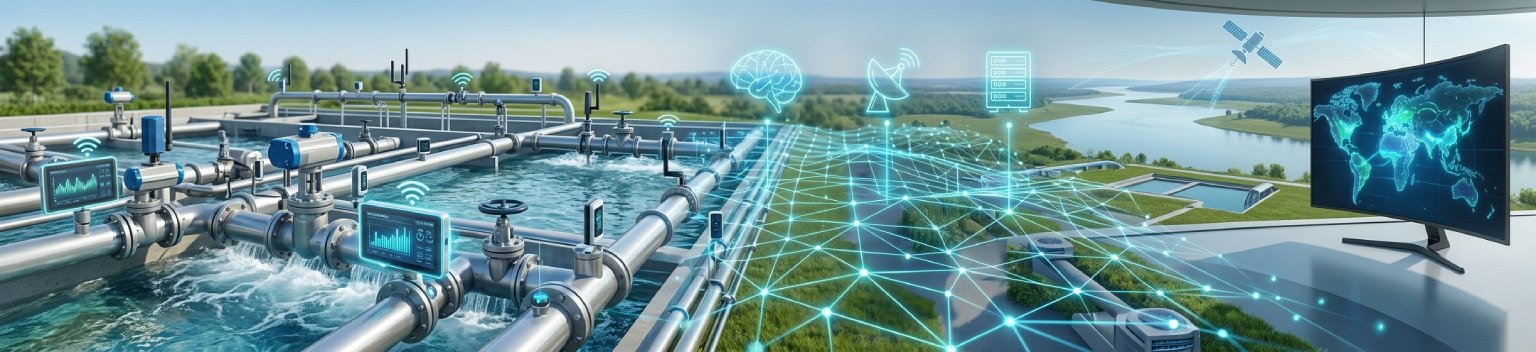
The European Commission opened a call for evidence on 27 May 2026 for a new initiative titled “Water sector — accelerating digitalisation for better management and sustainability.” Referenced as Ares(2026)5310172, the document outlines the political context, problem definition, and strategic pillars for a forthcoming Communication to the European Parliament and the Council, scheduled for Q4 2026.
The initiative is a flagship action under the European water resilience strategy and sits within the Commission Work Programme for 2026. Stakeholder feedback closes on 24 June 2026. The responsible unit is DG ENV.C.1 (Sustainable Freshwater Management).
What the Commission is proposing
The digital action plan aims to modernise and standardise water management across the EU through advanced digital technologies. According to the call for evidence, it operates at the intersection of the green and digital transitions and supports the objectives of the Competitiveness Compass by securing resource availability across multiple sectors.
The plan builds on three existing Commission strategies. The Apply AI strategy and AI Continent Plan target the deployment of artificial intelligence for predictive maintenance and real-time monitoring. The Data Union strategy supports water data sharing by fostering national data portals. The Open Data Directive sets the requirements for data to be findable, accessible, interoperable, and reusable.
The stated objective is to accelerate digitalisation across all levels and actors in the water sector — from municipal utilities to national authorities and EU coordination bodies — to reduce management inefficiencies, cut administrative burdens, build capacity, and close the digitalisation gaps that limit cross-border cooperation.
€111.7bn
Global water technology market value per year (Eurostat)
81,500
Enterprises in the EU water sector, mostly SMEs (Eurostat)
40%
Share of global water-related patents held by the EU
The problem the initiative addresses
The call for evidence identifies the core challenge as the fragmented and inefficient state of digitalisation across Europe’s water management systems. This fragmentation runs along two axes: across stages of the water cycle (drinking water supply, wastewater treatment, discharge, and reuse) and between administrative levels (municipalities, regional authorities, national governments, and EU institutions).
The Commission states that this fragmented digital infrastructure prevents the sector from reducing management inefficiencies, lowering administrative burdens, and monitoring transboundary water risks — including droughts, floods, water scarcity, and pollution. It also blocks the implementation of the water-efficiency-first principle.
The document attributes the slow uptake of ICT in the water sector to five factors. First, high initial investment costs that are difficult to recover, partly because water tariffs across many Member States do not reflect the true value of water — described as a market failure. Second, older technology in utilities that cannot connect with modern IoT systems, creating interoperability barriers. Third, proprietary data formats that trap information in silos and block predictive analysis. Fourth, unresolved questions around data governance and ownership. Fifth, the sector’s inability to achieve economies of scale, owing to its modest size and the absence of coordinated data strategies across Member States. The document also notes that many technical staff lack the digital skills to operate modern tools, compounded by connectivity gaps in remote areas.
The Commission warns that without action, traditional monitoring will become increasingly inadequate as climate change intensifies, and Europe’s water sector risks missing the digitalisation wave — resulting in lost economic potential and reduced resilience.
Four strategic pillars
The action plan is structured around four technology pillars. The Commission describes these as strategic priorities, while noting the list is not yet exhaustive — the consultation process specifically invites stakeholders to confirm priorities and highlight developments that may have been overlooked.
AI-driven big data analytics
▸Large-scale IoT deployment
▸Earth observation
▸Digital governance framework
▸Expected impacts
The call for evidence sets out projected impacts across three categories, drawing on Eurostat data throughout.
| Category | Stated impact |
|---|---|
| Economic | Smart metering can reduce water use by up to 25%; digital systems save an additional 5–8%; leak detection reduces consumption by a further 7–14%. The plan aims to strengthen the EU's position in a global water technology market worth €111.7 billion per year and boost competitiveness of 81,500 enterprises, mostly SMEs. The EU holds 40% of global water-related patents. |
| Social | Improved monitoring for greater data transparency and water security, aligned with the NIS2 Directive. The sector supports 1.6 million jobs; digitalisation is expected to create new high-skilled positions. |
| Environmental | Real-time data collection and modelling to improve monitoring of water quality, floods, droughts, and scarcity. Predictive analytics to forecast demand, environmental patterns, and system stress. Directly advances SDG 6 (Clean Water and Sanitation) and SDG 9 (Industry, Innovation and Infrastructure). |
| Administrative | Burden reduction through automated reporting and maximised synergies between existing digital tools used for Earth observation. |
Projected water use reductions cited in the call for evidence
Source: European Commission, Ares(2026)5310172
Legal basis and subsidiarity
The initiative is not a legal act. The Commission frames EU-level action as necessary because the EU has the largest number of transboundary river basins in the world, and cross-border water risks (pollution, droughts, floods) require coordinated digital monitoring. It also argues that technical fragmentation creates barriers to the free movement of water technology services and that uncoordinated procurement and digital strategies prevent economies of scale in the internal market.
EU-level action will focus specifically on interoperability and standardisation — areas the Commission states Member States cannot address effectively on their own. Implementation specifics will be left to national and local authorities.
Consultation process and timeline
The call for evidence opens a consultation process that will run throughout 2026. Targeted stakeholders include public authorities at all levels, river basin managers, water utilities, technology providers, water-intensive sectors (agriculture, energy, and data centres), IT and digital solution providers, and research and academic institutions.
27 May 2026
Call for evidence published (Ref. Ares(2026)5310172)
24 June 2026
Feedback deadline
Q2–Q3 2026
Consultative workshop and targeted engagement with Member States via WFD common implementation strategy working groups (drinking water, urban wastewater)
Q4 2026
Expected adoption of the Communication from the Commission to the European Parliament and the Council
The Water Resilience Stakeholder Platform will also be formally consulted. No impact assessment is planned for the Communication itself, as it will contain non-binding actions. Any future legislative initiatives that emerge from it will be subject to impact assessments where applicable. Progress will be monitored through the mid-term and final reviews of the European water resilience strategy.
Regulatory cross-references in the document
The call for evidence references several existing EU instruments. The Water Framework Directive (Directive 2000/60/EC) provides the baseline legal framework for water quality and management; the action plan explicitly aims to improve implementation and reporting under its Article 8. The NIS2 Directive (Directive (EU) 2022/2555) is referenced in the context of cybersecurity safeguards for water infrastructure. The Open Data Directive (Directive (EU) 2019/1024) underpins the data sharing and interoperability requirements.
The document also positions the initiative as contributing to SDG 6 (Clean Water and Sanitation) and SDG 9 (Industry, Innovation and Infrastructure), and as reinforcing Europe's long-term strategic autonomy and resilience in water management.
Frequently asked questions
What is the EU digital action plan for the water sector?
A forthcoming non-binding Communication from the European Commission, expected Q4 2026, that aims to accelerate digitalisation across the EU water sector through four pillars: AI analytics, IoT sensor deployment, Earth observation, and a unified digital governance framework.
When does the call for evidence close?
Feedback closes on 24 June 2026. Further consultations, including a stakeholder workshop and engagement with Member States through WFD working groups, are planned for Q2 and Q3 2026.
Is this a legally binding initiative?
No. The planned Communication contains non-binding actions. No impact assessment is planned for it. However, any future legislative proposals that result from the plan will go through the standard EU legislative process, including impact assessments.
Which EU legislation does the initiative reference?
The call for evidence references the Water Framework Directive (Directive 2000/60/EC), the NIS2 Directive (Directive (EU) 2022/2555) for cybersecurity, and the Open Data Directive (Directive (EU) 2019/1024) for data sharing and interoperability standards.
Who is invited to respond?
Public authorities at all levels, river basin managers, water utilities and technology providers, water-intensive sectors (agriculture, energy, data centres), IT and digital solution providers, and research and academic institutions.