
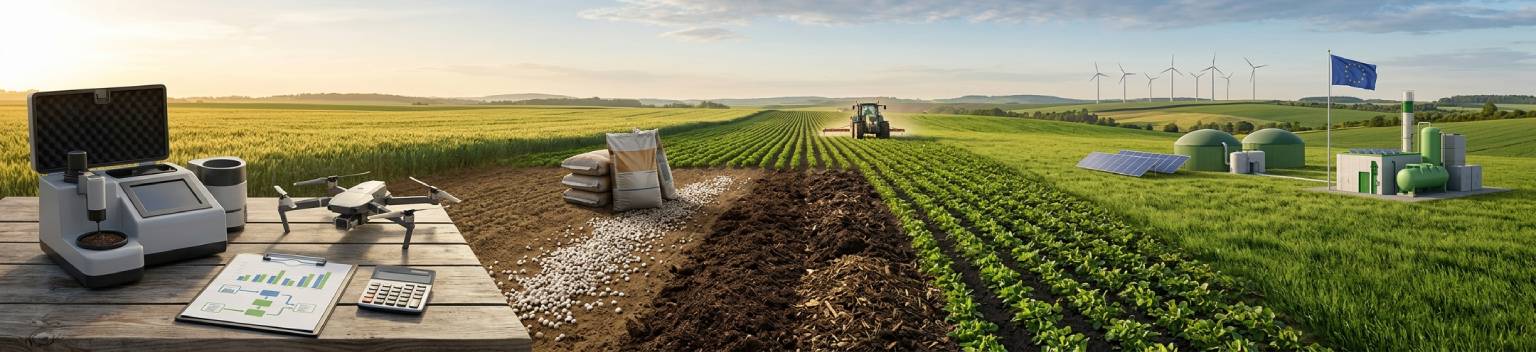
On 19 May 2026, the European Commission adopted the Fertiliser Action Plan — an initiative designed to shield European farmers from rising input costs, rebuild domestic production capacity, and reduce the bloc’s dependence on imported fertilisers. For sustainability teams, ESG data managers, and financial institutions, this is far more than an agricultural policy update. It signals a structural shift in how the EU approaches resource security, with direct consequences for ESRS-aligned sustainability reporting, supply chain materiality, and climate transition risk.
This article examines the plan’s three core pillars, connects them to current ESG disclosure obligations, and identifies the data points that reporting teams and investors should be tracking.
Why fertiliser supply matters for ESG
Fertilisers are a foundational input for global food production, but the European market has been under severe pressure since early 2026. Nitrogen fertiliser prices surged approximately 70% above their 2024 averages between February and April 2026, driven by Middle East supply disruptions and the knock-on effects of the Carbon Border Adjustment Mechanism (CBAM) on import volumes. Imports of nitrogen fertilisers collapsed — falling to less than 16% of their typical volume in January 2026 compared with the same month a year earlier.
These disruptions expose a material vulnerability. Nitrogen fertilisers account for roughly 46% of total EU consumption, with more than 30% historically imported. Phosphate dependency is even starker: around 70% of EU demand for phosphate fertilisers is met through imports of phosphate rock. When fertiliser supply chains break, the consequences cascade through food prices, farm viability, and ultimately the financial performance of any portfolio exposed to European agriculture and food systems.
Nitrogen price surge
+70%
above 2024 average (Apr 2026)
Import collapse
−84%
N-fertiliser imports, Jan 2026 vs Jan 2025
Phosphate dependency
70%
of EU phosphate demand met by imports
Input cost share
15–30%
of farmers’ production costs from fertilisers
The three pillars of the fertiliser action plan
The Commission’s plan is structured around three strategic objectives, each carrying distinct implications for ESG data collection and sustainability reporting.
Pillar 1: Direct farmer support
The most immediate measures focus on financial relief. The Commission will mobilise the EU budget to reinforce the agricultural reserve and introduce a new liquidity scheme to help farmers manage cash flow ahead of the next production cycle. Stronger incentives for nutrient management and efficient fertiliser use are also included, along with measures to facilitate the use of digestates — the nutrient-rich residual material from organic waste processing.
Pillar 2: Strategic autonomy and domestic production
The plan aims to reverse the decline in European ammonia production capacity, which has fallen by approximately 10% in recent years due to international competition. The Commission will encourage greater use of organic and bio-based fertiliser alternatives — including algal biomass, microbial solutions, biostimulants, and nutrient recovery from sewage sludge. Critically, it links the fertiliser sector to the forthcoming Emission Trading Scheme (ETS) review, signalling that decarbonisation of fertiliser production will be tied to carbon pricing policy.
Pillar 3: Market transparency and preparedness
The Commission will launch an EU fertilisers value chain partnership and strengthen market monitoring with early-warning capabilities. An assessment of strategic stockpiling options is planned, alongside a Memorandum of Understanding — expected by Q3 2026 — that would commit producers, farmers, and other stakeholders to ensuring availability and accessibility of fertilisers while decarbonising the industry.
How each pillar connects to ESG reporting obligations
Pillar 1 — Farmer support
Affects upstream cost structures reported under ESRS S2 (workers in the value chain) and ESRS E4 (biodiversity, nutrient management). Financial institutions tracking agricultural portfolio risk need updated input-cost data.
Pillar 2 — Strategic autonomy
Directly linked to ESRS E1 (climate change) through ETS-aligned decarbonisation targets. Circular fertiliser adoption triggers ESRS E5 (resource use and circular economy) disclosures. EU Taxonomy eligibility for green ammonia investments.
Pillar 3 — Market transparency
Improved market data supports supply chain due diligence. Early-warning mechanisms feed into risk management disclosures. Stockpiling assessments relevant to ESRS G1 (business conduct) and operational resilience reporting.
Implications for CSRD and ESRS reporting
The Fertiliser Action Plan does not exist in regulatory isolation. For companies in scope of the Corporate Sustainability Reporting Directive, this policy creates new data demands and reinforces existing ones across multiple European Sustainability Reporting Standards.
Under ESRS E1 (climate change), companies with fertiliser-dependent supply chains must now account for the potential shift towards lower-carbon fertiliser inputs — and the transition risks associated with ETS-linked carbon pricing for ammonia production. Under ESRS E5 (resource use and circular economy), the Commission’s push for digestates and bio-based alternatives introduces new metrics around circular material flows in agricultural value chains.
The supply chain dimension is equally significant. Companies conducting double materiality assessments will need to consider fertiliser supply disruption as a financial materiality trigger — particularly where food and agriculture represent a significant share of value chain exposure. The import collapse documented in early 2026 is precisely the type of external shock that a well-executed impact materiality analysis should capture.
EU nitrogen fertiliser imports: January comparison (thousands of tonnes)
Source: European Commission data via Copa-Cogeca, February 2026
EU Taxonomy and green ammonia investment
The plan’s emphasis on decarbonising fertiliser production and creating green ammonia corridors between the EU, Africa, and the Middle East positions green ammonia as an emerging EU Taxonomy-eligible activity. Investors and asset managers assessing Taxonomy alignment in their portfolios should monitor how the forthcoming ETS review defines eligibility thresholds for low-carbon ammonia production.
The Commission’s reference to Global Gateway and Team Europe partnerships for green ammonia sourcing also introduces a geopolitical dimension to Taxonomy reporting. Portfolio companies involved in fertiliser production, distribution, or agricultural inputs will need to demonstrate not only environmental credentials but also supply chain resilience — a data challenge that requires integrated ESG data management infrastructure.
What financial institutions should track
For banks, asset managers, and insurers with exposure to European agriculture, food retail, or chemical manufacturing, the Fertiliser Action Plan creates several monitoring priorities. The intersection of CBAM implementation, fertiliser price volatility, and the planned ETS review means that transition risk in agricultural portfolios is now a multi-regulatory concern — one that touches SFDR principal adverse impact reporting as much as climate scenario analysis.
Key monitoring points for ESG and risk teams
CBAM-fertiliser interaction
Track how the carbon border mechanism continues to affect nitrogen fertiliser import volumes and domestic price formation. This data feeds directly into climate transition risk models.
ETS review scope
The upcoming ETS review will determine decarbonisation incentives for fertiliser manufacturing. Asset owners with exposure to European chemical producers need to model the carbon cost impact.
MoU and value chain partnership
The planned Q3 2026 Memorandum of Understanding between producers, farmers, and stakeholders will shape market transparency. Watch for data standards that improve supply chain reporting quality.
Circular fertiliser metrics
Adoption rates for digestates, bio-based alternatives, and nutrient recovery from sewage sludge will become relevant ESRS E5 data points for companies in agricultural and food value chains.
Strategic stockpiling framework
The Commission’s stockpiling assessment may create new operational resilience disclosure requirements. Current stocks cover only 45–50% of estimated needs for the 2026 harvest on average, with some member states significantly below this level.
Connecting the dots: from policy to reporting infrastructure
The Fertiliser Action Plan is a clear example of how EU policy developments in one sector rapidly translate into ESG reporting requirements in another. A food retailer’s ESRS submission, a bank’s climate risk stress test, and an asset manager’s principal adverse impact statement may all need to reflect the structural changes in European fertiliser markets that this plan aims to address.
At Generation Impact Global, we build the data infrastructure that connects regulatory change to reporting workflows — from double materiality assessments through to environmental data collection with UtilityIQ and ESRS-aligned disclosure outputs. When a policy like the Fertiliser Action Plan shifts the reporting landscape, the organisations that respond fastest are those with integrated, regulation-aware data systems already in place.
Frequently asked questions
What is the EU Fertiliser Action Plan?
The Fertiliser Action Plan is a European Commission initiative adopted on 19 May 2026. It addresses rising fertiliser costs and supply disruptions through three pillars: direct financial support for farmers, measures to boost domestic production and reduce import dependency, and improved market transparency and preparedness mechanisms.
How does the fertiliser crisis affect ESG reporting?
Fertiliser supply disruptions create reporting obligations across multiple ESRS standards, including ESRS E1 (climate change and transition risk from ETS-linked carbon pricing), ESRS E5 (circular economy through bio-based fertiliser adoption), and ESRS S2 (workers in the value chain affected by agricultural cost pressures). Companies conducting double materiality assessments must also evaluate fertiliser supply as a potential financial materiality trigger.
What is the connection between CBAM and fertiliser prices?
The Carbon Border Adjustment Mechanism applies to nitrogen fertiliser imports. Since CBAM entered its definitive phase, EU nitrogen fertiliser imports dropped dramatically — to less than 16% of their typical volume in January 2026. This import collapse, combined with Middle East supply disruptions, contributed to domestic nitrogen fertiliser prices rising approximately 70% above their 2024 averages.
Why should financial institutions pay attention to fertiliser policy?
Banks, asset managers, and insurers with exposure to agriculture, food retail, or chemical manufacturing face transition risks from fertiliser market restructuring. The planned ETS review, CBAM effects on import flows, and shifting towards green ammonia all affect portfolio risk assessments, climate scenario modelling, and SFDR principal adverse impact reporting.
What are circular fertilisers?
Circular fertilisers are alternatives to conventional mineral fertilisers produced from recycled or renewable sources. The Commission’s plan promotes digestates (nutrient-rich material from organic waste), algal biomass, microbial solutions, biostimulants, and nutrient recovery from sewage sludge. Their adoption is relevant to ESRS E5 (resource use and circular economy) disclosures.