
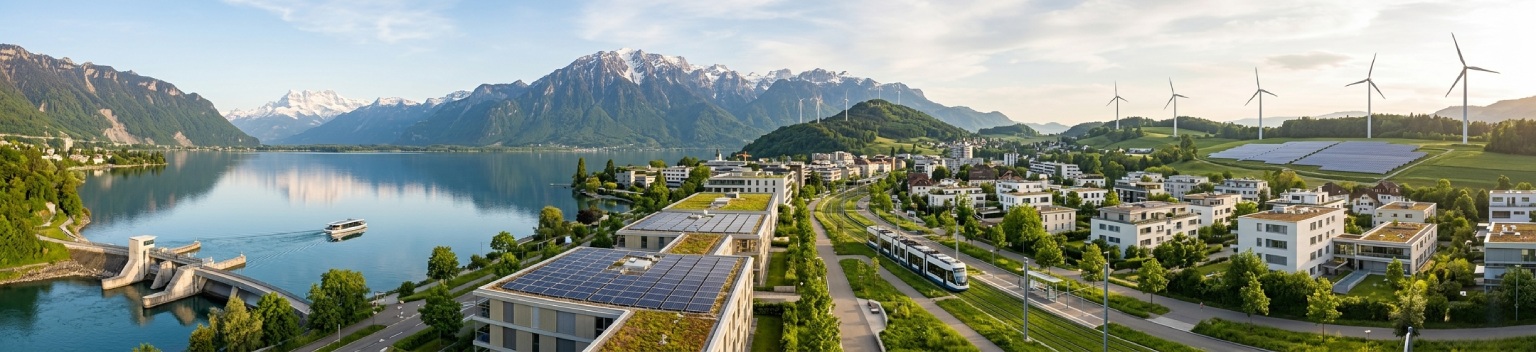
On 21–22 April 2026, the United Nations Economic Commission for Europe (UNECE) Regional Forum on Sustainable Development convened in Geneva to assess how member states are advancing the 17 Sustainable Development Goals (SDGs). Switzerland, as host country, used the forum to highlight both its domestic implementation and its international cooperation efforts — with a particular focus this year on clean water and sanitation (SDG 6), affordable and clean energy (SDG 7), and sustainable cities (SDG 11).
The forum arrives at a critical juncture. With fewer than four years remaining before the 2030 deadline, global progress on the SDGs remains uneven. According to the Sustainable Development Report 2025, Switzerland ranks 26th globally out of 167 countries, with an SDG Index score of 79.16. While the country has already met several targets — including the elimination of extreme poverty and universal access to quality education — persistent challenges remain in areas such as responsible consumption (SDG 12) and climate action (SDG 13).
This article examines Switzerland’s dual commitment to the 2030 Agenda: the national strategy structures that govern domestic implementation, and the international partnerships through which Switzerland contributes to the SDGs globally.
International commitment
National commitment
The 2030 Sustainable Development Strategy
Switzerland’s approach to the 2030 Agenda is anchored in the 2030 Sustainable Development Strategy (2030 SDS), adopted by the Federal Council in June 2021. The strategy sets a ten-year framework for Switzerland’s sustainability policy and uses the 17 SDGs as its reference framework. It establishes guidelines across all federal policy areas and defines political priorities for both domestic and foreign policy.
The Federal Council has identified three priority topics that structure domestic implementation.
Sustainable consumption and production
Reducing resource consumption, addressing Switzerland’s significant environmental footprint abroad, and promoting circular economy principles across supply chains.
Climate, energy and biodiversity
Aligning with the Paris Agreement, accelerating the energy transition, and protecting Switzerland’s alpine ecosystems and biodiversity corridors.
Equal opportunities and social cohesion
Advancing gender equality, integrating migrants, supporting participation of people with disabilities, and strengthening volunteer and community structures.
Decentralised governance and the MONET 2030 system
Switzerland has opted for a decentralised implementation model. Two Federal Council delegates for the 2030 Agenda co-chair an interdepartmental steering committee, and approximately 30 federal government units are involved in producing, delivering, or validating data for the SDG indicator framework. At the national level, the MONET 2030 indicator system tracks Switzerland’s progress through over 100 indicators, covering all 17 SDGs and the three dimensions of sustainable development.
At the subnational level, cantons and cities use the Cercle Indicateurs platform — a shared monitoring framework structured around approximately 30 indicators across ten sustainability topics. At the April 2026 Regional Forum, Switzerland highlighted a new development: the cities of Geneva, Bern, and Basel, alongside the canton of Aargau, have each produced their first Voluntary Local Reviews (VLRs) — localised assessments that evaluate SDG progress at the municipal and cantonal level.
“Implementing the goals requires the cooperation of all state and non-state actors.” — Markus Reubi, Federal Council Delegate for the 2030 Agenda, April 2026
International cooperation and multilateral engagement
Switzerland’s commitment to the 2030 Agenda extends well beyond its borders. The country is active in international forums and maintains 41 priority countries for bilateral development cooperation during the 2025–28 period. The international commitment operates across three channels: bilateral cooperation through the Swiss Agency for Development and Cooperation (SDC), economic policy engagement through the State Secretariat for Economic Affairs (SECO), and multilateral diplomacy at the UN, UNECE, and HLPF.
Geneva’s role as a global sustainability hub is central to this positioning. The Geneva Water Hub, highlighted at the 2026 Regional Forum, serves as an internationally recognised platform that strengthens dialogue and global water governance — directly supporting SDG 6 (clean water and sanitation). Switzerland is also actively promoting cooperation ahead of the upcoming UN Water Conference.
The Swiss delegation to the 2026 Regional Forum reflected this cross-government approach, comprising representatives from the FDFA, SECO, SDC, the Federal Office of Energy, the Federal Office for Housing, and the Federal Office for Spatial Development, alongside the Swiss Bankers Association and youth representatives.
A bilateral exchange on country reporting between the SDG Council of Bosnia and Herzegovina and the Swiss Federal Council delegate also took place on the forum’s sidelines — illustrating how Switzerland uses these multilateral gatherings not only for reporting but for peer-to-peer knowledge transfer. The country’s Foreign Policy Strategy 2024–27 explicitly frames the 2030 Agenda as a guiding element of its foreign affairs priorities, particularly in areas such as peacebuilding, climate adaptation, and governance strengthening in fragile states.
Switzerland’s SDG performance: where progress stands
Switzerland has met several foundational SDG targets. Extreme poverty has been eliminated (target 1.1), there is no hunger (target 2.1), and education (target 4.1) is free, compulsory, and of high quality. However, the country’s external environmental footprint — the resources consumed abroad to support domestic consumption — remains a significant challenge. Use of resources from within Switzerland for domestic consumption is decreasing, but use of resources from abroad continues to increase in ways that are not sustainable.
The spillover dimension is particularly relevant. Switzerland’s spillover score — which measures the negative effects of a country’s policies and consumption on other nations — stands at just 42.07 out of 100, reflecting the impact of international supply chains, financial centre activities, and embedded carbon in imported goods. For a country that scores above 79 on domestic SDG achievement, this gap underscores the tension between national prosperity and global sustainability obligations.
The chart below summarises Switzerland’s performance across representative SDG clusters, based on the 2025 Sustainable Development Report dashboard assessments.
Source: Sustainable Development Report 2025 — dashboard assessments. Scale: 0 = major challenges, 100 = SDG achieved.
The 2026 country report: what it means for the business sector
Switzerland is preparing its third Voluntary National Review (VNR) for the High-level Political Forum on Sustainable Development in New York in July 2026. The previous reviews were submitted in 2018 and 2022. For this reporting cycle, the Federal Department of Foreign Affairs coordinated a stakeholder assessment through the SDGital2030 digital platform, collecting inputs from cantons, communes, businesses, financial institutions, academia, and civil society through May 2025.
This matters for the business and financial sector because the findings from the assessment will feed not only into the country report but also into the further development of Switzerland’s sustainable development strategy and action plan. For organisations subject to sustainability reporting requirements — whether under the EU’s CSRD/ESRS framework, SFDR, or Switzerland’s own evolving disclosure expectations — the 2026 VNR signals the direction of future policy.
Switzerland’s 2030 Agenda milestones
Implications for ESG reporting and sustainability strategy
Switzerland’s SDG framework intersects directly with corporate ESG reporting. The Federal Council adopted double materiality in principle — the same conceptual framework underpinning the EU’s European Sustainability Reporting Standards. Swiss-domiciled and Swiss-listed companies, particularly those with cross-border operations, increasingly face overlapping requirements from both Swiss disclosure expectations and EU regulations.
For financial institutions, the connection is even more direct. The Swiss Bankers Association participated in the 2026 Regional Forum delegation, reflecting the financial sector’s integration into national SDG implementation. Funds, asset managers, and insurance companies operating under SFDR classifications must already map investment impacts to sustainability factors that closely mirror the SDG indicator framework. Organisations using the GRI Standards will find direct alignment between their materiality assessments and several of the MONET 2030 indicators used by the Swiss government.
The spillover dimension identified in the SDG Index is also relevant for portfolio companies and value chain assessments. Financial institutions conducting principal adverse impact (PAI) assessments under SFDR, or companies mapping supply chain risks under the EU’s Corporate Sustainability Due Diligence Directive (CSDDD), will recognise the same cross-border impact logic that drives Switzerland’s low spillover score. The alignment between government-level SDG tracking and corporate ESG disclosure is no longer theoretical — it is becoming the operational standard.
At Generation Impact Global, we build the data infrastructure that helps organisations manage this complexity — connecting sustainability data across frameworks like CSRD/ESRS, SFDR, GRI, and ISSB, and mapping disclosures to the SDG targets that governments are actively monitoring. Our ESG Reporting Readiness Assessment evaluates your organisation’s profile against these frameworks and produces a personalised readiness score.
Frequently asked questions
What is Switzerland’s 2030 Sustainable Development Strategy?
The 2030 SDS is the Federal Council’s policy framework for implementing the UN 2030 Agenda domestically. Adopted in June 2021, it sets ten-year guidelines across all federal policy areas and identifies three priorities: sustainable consumption and production, climate, energy and biodiversity, and equal opportunities and social cohesion.
How does Switzerland monitor SDG progress?
At the national level, the MONET 2030 indicator system uses over 100 indicators to track progress across all 17 SDGs. At the subnational level, cantons and cities use the Cercle Indicateurs platform. Switzerland also submits Voluntary National Reviews to the UN every four years.
What are Voluntary Local Reviews?
VLRs are localised assessments produced by cities and regions to evaluate their SDG implementation at the subnational level. In 2026, the cities of Geneva, Bern, and Basel, and the canton of Aargau published their first VLRs — the first time Swiss municipalities have conducted these assessments.
How does Switzerland’s SDG framework relate to ESG reporting?
Switzerland has adopted double materiality in principle — the same conceptual foundation as the EU’s CSRD/ESRS. The MONET 2030 indicators align closely with the metrics used in GRI, ISSB, and SFDR reporting. Swiss companies with cross-border operations face overlapping requirements from Swiss and EU disclosure frameworks.
Where does Switzerland rank on the SDG Index?
According to the Sustainable Development Report 2025, Switzerland ranks 26th globally out of 167 countries with an overall SDG Index score of 79.16 out of 100. The country has achieved or nearly achieved targets on poverty, education, and health, but faces significant challenges on responsible consumption (SDG 12) and climate action (SDG 13).