
Table of contents
GRI Reporting Software, from a licensed GRI partner
Collect, validate and report every GRI disclosure in one platform, then reuse the same data for ESRS, ISSB and other frameworks without collecting it twice.
Generation Impact Global is a Swiss software company licensed by GRI and listed on GRI’s official Licensed Software and Tools Partners directory. GRI’s licensing team has reviewed how the Standards are built into the platform.
Start free




Generation Impact Global and GRI
Report in accordance with the GRI Standards or with reference to them. The platform guides your team through collecting, reviewing and approving data, and exports the finished report in the format you need.
Data entered once can be reused for ESRS, ISSB and other frameworks, so your figures stay consistent across every report.
Why organisations choose Generation Impact Global for GRI
Licensed by GRI
We are a Swiss software company licensed by GRI and listed on GRI’s official Licensed Software and Tools Partners directory, so you are reporting on a platform built directly against the Standards.
One system, not several
Collection, validation, tracking and reporting sit in a single platform, rather than being stitched together across separate tools.
Secure by design
The platform is ISO 27001 certified and GDPR compliant, with encryption, access controls and full audit traceability.
Part of the reporting community
We are members of Swiss Sustainable Finance and Eurosif, and a Friend of EFRAG contributing to European sustainability reporting.
What our clients say about our solution

“(…) GIG’s software has been instrumental in transforming how we approach sustainability, providing robust tools that streamline our data collection, analysis, and reporting processes. (…)”

United Manganese of Kalahari (UMK)
Malcolm Curror (CEO)
“The GRI solution exceeded expectations! Also, the team was professional, efficient, and attentive to every detail. I highly recommend them for their quality, reliability, and excellent customer experience.”

DataPack SA de CV
María Guerrero (ESG Manager)

For a worked example, see how Xlife Sciences AG produced its GRI-aligned ESG report across 11 portfolio companies on our platform.
Read reportWhat is GRI?
The Global Reporting Initiative (GRI) is an independent, not-for-profit organisation that sets the world’s most widely used sustainability reporting standards. The GRI Standards give organisations a common global language for reporting their impacts on the economy, the environment and people, whether in a standalone sustainability report or an integrated ESG report.
GRI’s June 2026 study of almost 15,000 large listed companies found that 40% use the GRI Standards, together representing 62% of global market capitalisation, with reporters headquartered in 107 jurisdictions. Adoption is growing fastest in Asia and the Global South.
Report your climate impact with GRI 305
GRI 305: Emissions covers direct (Scope 1), energy indirect (Scope 2) and other indirect (Scope 3) greenhouse gas emissions, along with emissions intensity and reductions. Collect the activity data behind each figure and track progress year on year in one place.

The next generation of GRI Topic Standards
GRI is expanding its Topic Standards. Three new standards take effect over the next two years, and our platform already supports them:
- GRI 101: Biodiversity 2024, required for reporting from 1 January 2026.
- GRI 102: Climate Change 2025, required from 1 January 2027.
- GRI 103: Energy 2025, required from 1 January 2027, with early adoption encouraged.
They sit alongside the Universal Standards (GRI 1, 2 and 3) and the Topic Standards you already report against, so you can begin preparing early.
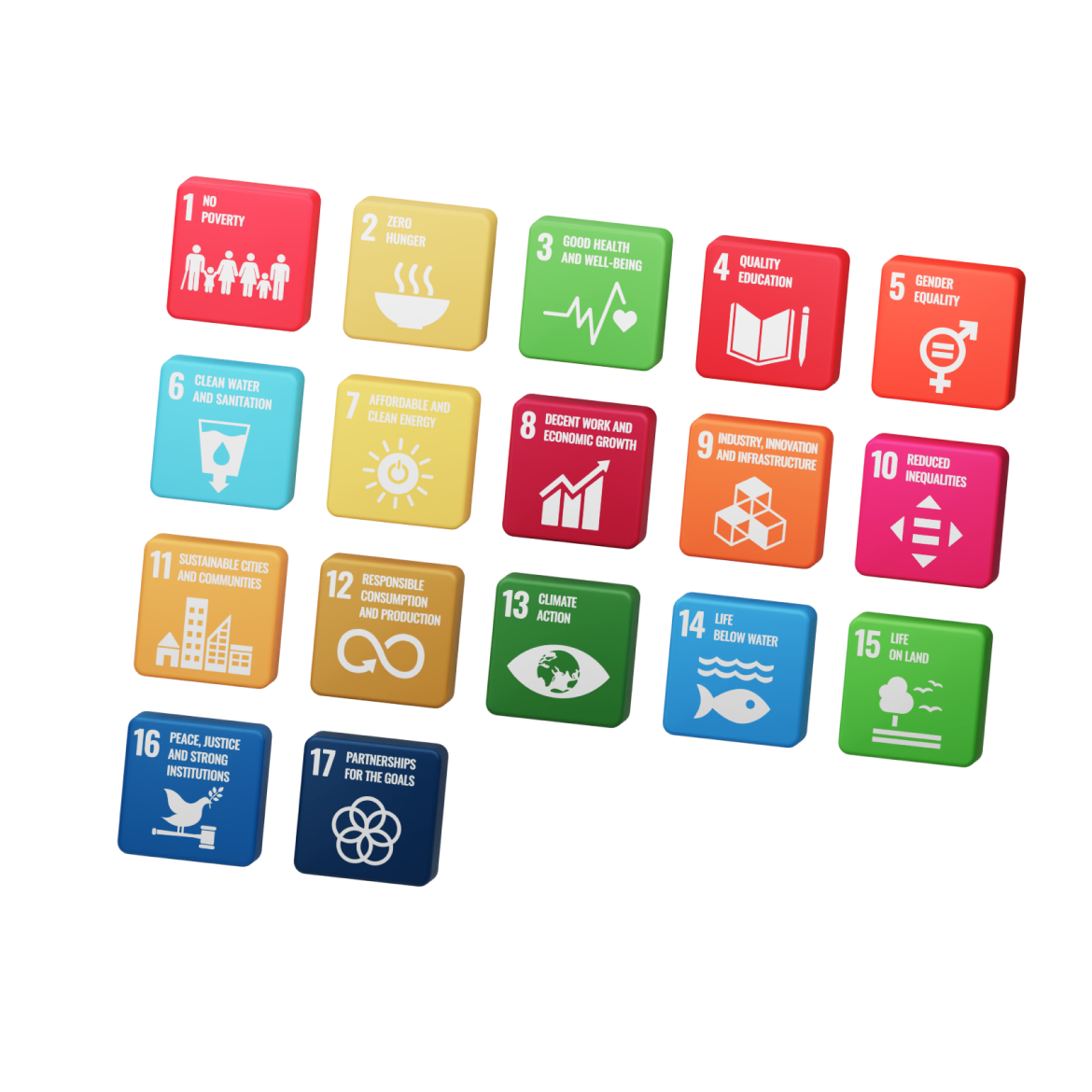
Connecting GRI with the SDGs
Link your GRI disclosures to the UN Sustainable Development Goals (SDGs) to show which goals your activities support and how your contribution changes over time.
How markets and policymakers use GRI
Referenced by stock exchanges
More than 40 stock exchanges and market regulators reference or require the GRI Standards for sustainability reporting by listed companies.
Referenced by policymakers
Governments and regulators draw on the GRI Standards when designing disclosure rules. In the EU, GRI and EFRAG have confirmed a high level of interoperability between the GRI Standards and the ESRS for impact reporting.
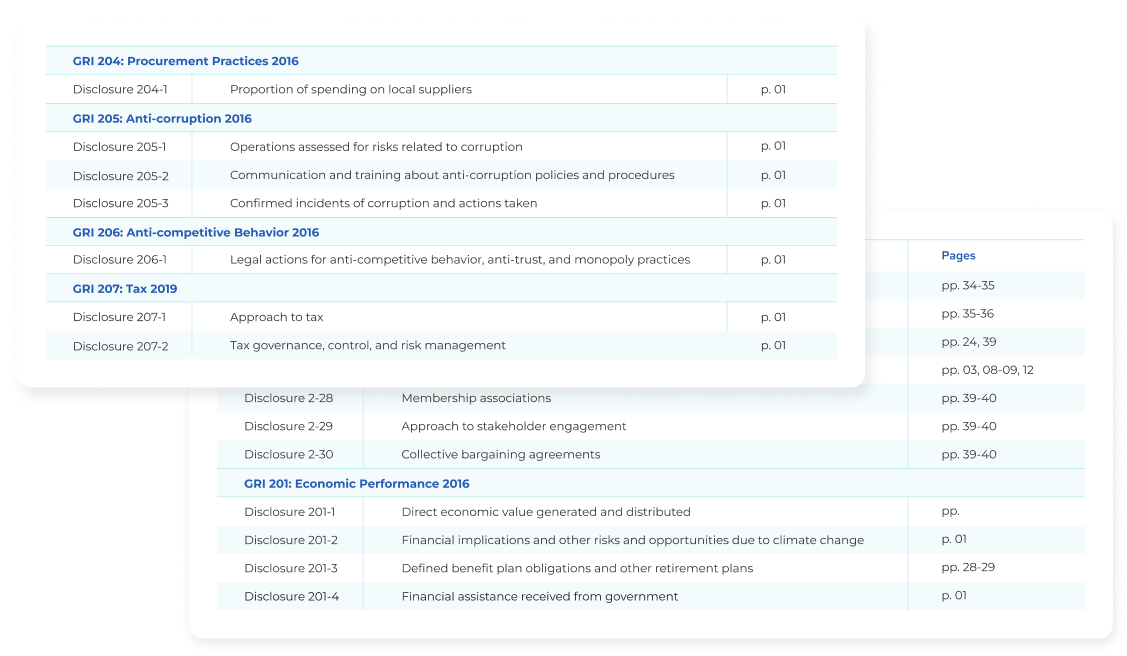
What is the GRI Content Index?
The GRI Content Index is a structured table included in a sustainability report that shows exactly where each required GRI disclosure is reported. It acts as a navigation and transparency tool, allowing readers, auditors, investors, and regulators to quickly verify your disclosures.
A GRI content index and a statement of use are required whether you report in accordance with the GRI Standards or with reference to them.
GRI for portfolio disclosure
Xlife Sciences AG produced a GRI-aligned ESG report across 11 portfolio companies on Generation Impact Global’s platform. The content index shows which disclosures the report covers and where readers can find them. Because the data was collected once, it can be reused for ESRS and other frameworks.
Page updated: 2 October 2026.
Key Benefits
Our GRI Tools: From Materiality to Reporting

Efficiency and impact
GRI reporting helps organisations assess, manage, and communicate their sustainability impact in a structured and transparent way.

Trust and credibility
Investors, lenders and customers increasingly ask for comparable ESG data. Clear GRI disclosures answer those requests from one consistent source.

Competitive advantage
GRI is interoperable with the ESRS and complementary to the ISSB Standards, so a well-kept GRI dataset gives you a head start on mandatory and investor-focused reporting.
Perfect for newcomers and experienced reporters alike
First-time reporters can start by reporting with reference to selected GRI Standards, then move to reporting in accordance as their data and processes mature.
Scalable and inclusive
The GRI Standards apply to any organisation, large or small, public or private, so the same approach works for a single company or a group of subsidiaries.
GRI Reporting
Start by identifying your material topics: the areas where your organisation has its most significant impacts on the economy, environment and people. The platform then guides data collection, disclosure and report creation.
How to use GRI
How to use GRI Standards for ESG Reporting
Understand the structure
The GRI Standards are built as a modular system of three parts, meant to be used together:
- GRI 1: Foundation – The starting point for every report. It explains how to use the Standards and sets out the reporting principles and requirements.
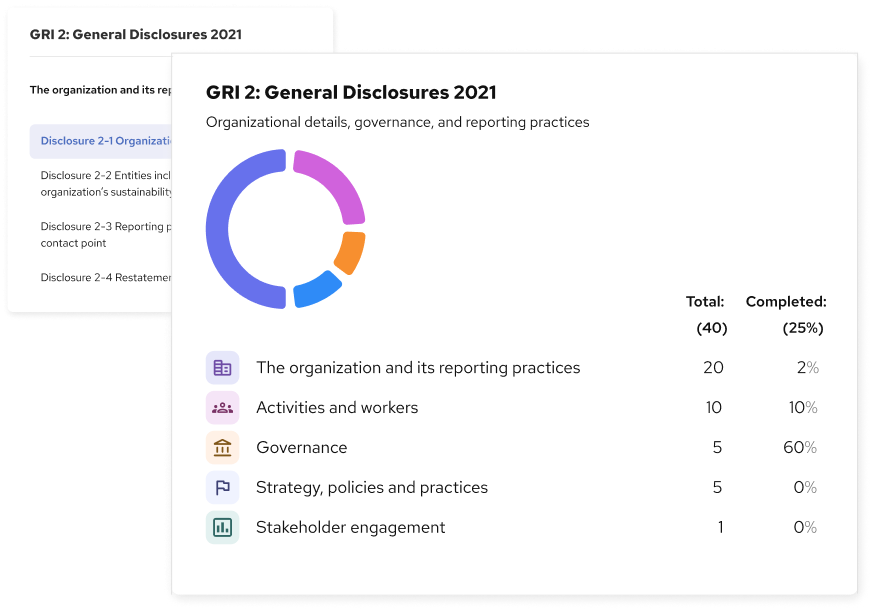
- GRI 2: General Disclosures – Information about your organisation that every reporter provides, such as governance, strategy, policies and stakeholder engagement.
- GRI 3: Material Topics – Explains how to determine your material topics and report how you manage them.
- Sector and Topic Standards
- Sector Standards address the specific impacts typical of an industry (e.g., mining, oil & gas, agriculture) and help narrow down which topics are likely material.
- Topic Standards cover individual subjects (e.g., emissions, anti-corruption, occupational health) and are used to report on whichever topics you determine are material.
Declare the reporting approach
Declare whether your report is prepared in accordance with the GRI Standards or with reference to them.
‘In accordance’ with the GRI Standards
You meet all nine requirements in GRI 1: Foundation, report on all your material topics, and publish a GRI content index and a statement of use.
‘With reference’ to the GRI Standards
You report selected disclosures, publish a GRI content index and a statement of use, and notify GRI. A practical first step for new reporters.
Material topics
If you report in accordance with the GRI Standards, GRI 3: Material Topics guides you through identifying and prioritising your most significant impacts on the economy, environment and people, including impacts on human rights. This usually involves reviewing sector and peer information, engaging internal and external stakeholders, and assessing how significant each impact is. If you report with reference, you can select specific topics without a full assessment. The main steps are:
- Engage stakeholders – Consult with internal and external stakeholders to understand their concerns and expectations.
- Assess impacts – Evaluate the organisation’s activities to identify significant economic, environmental, and social impacts.
- Prioritise topics – Prioritise the impacts that are most significant, based on their severity and likelihood.
Select the relevant standards
Every report uses the three Universal Standards. Sector and Topic Standards are then chosen based on your sector and your material topics.
- Universal Standards (GRI 1, GRI 2, GRI 3). Apply GRI 1, GRI 2 and GRI 3 in every report. The revised Universal Standards were published in October 2021 and have applied to reports since 1 January 2023.
- Sector Standards help you report the impacts typical of your sector and identify which topics are likely to be material. Use the one for your sector where GRI has published it.
- Topic Standards set out the disclosures for each material topic, for example GRI 305 for emissions, GRI 403 for occupational health and safety or GRI 205 for anti-corruption.
Collect and prepare your ESG report
Gather qualitative and quantitative data for each material topic from internal systems (HR, finance, operations) and external sources such as suppliers. Apply GRI’s eight reporting principles: accuracy, balance, clarity, comparability, completeness, sustainability context, timeliness and verifiability. Then compile the GRI content index and publish the report, either on its own or as part of your annual report.
Review and improve
GRI reporting is an ongoing cycle, not a one-time exercise. Use insights from each report to refine data collection, update material topics, and track progress year over year.
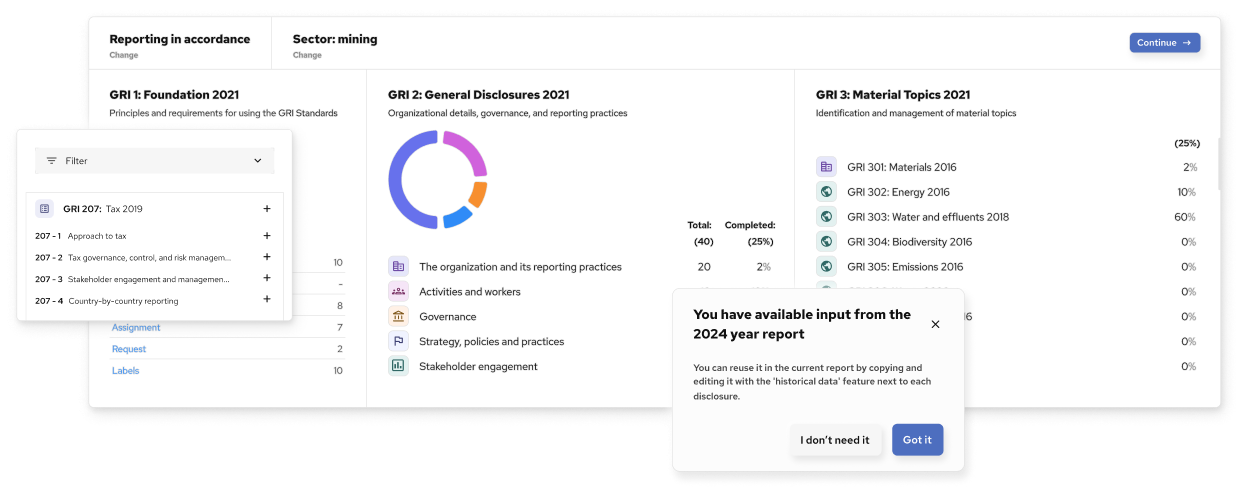
Your GRI reports database
Keep every GRI disclosure in one place across teams, years and reporting cycles. Answer, store and track each disclosure, see who changed what and compare years, without hunting through spreadsheets.
Key features
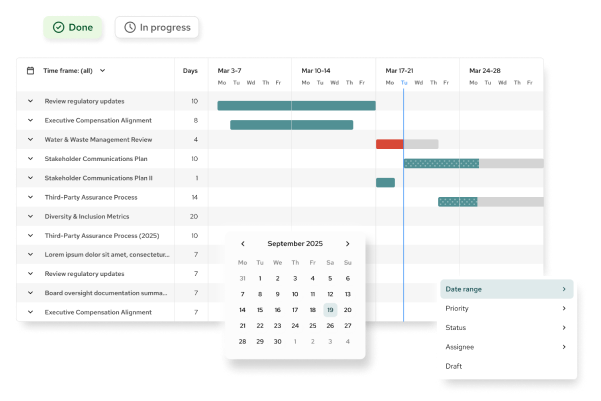
Action Plan
Create, assign, and track targeted steps to address issues or achieve objectives, ensuring accountability and progress monitoring.
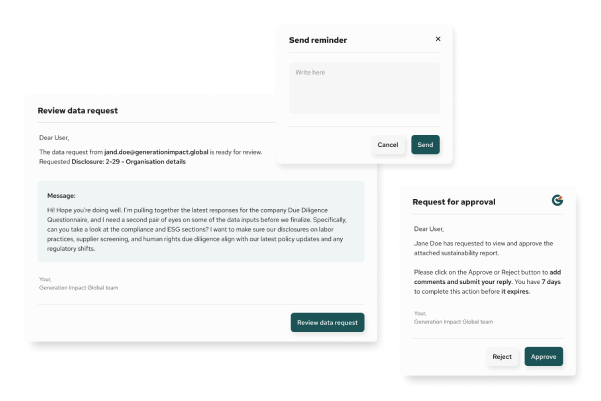
Request reviews and approval
Send disclosures to colleagues, managers, portfolio companies or funds for review and approval, with a record of who signed off.
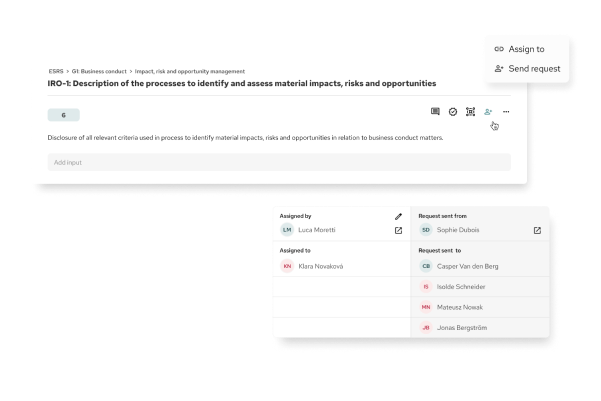
Assign disclosures
Give each disclosure an owner and a deadline, and follow progress in one view.
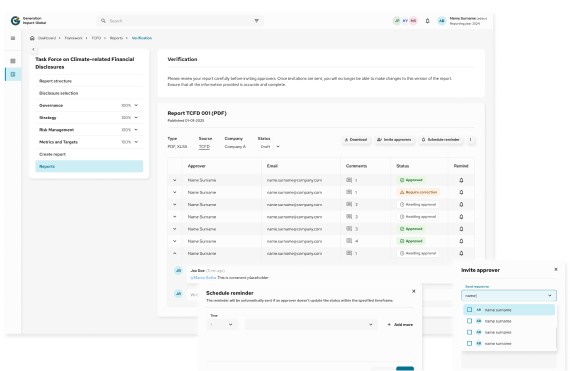
Report management
Generate, organise and export reports, and keep earlier versions for comparison and audit.
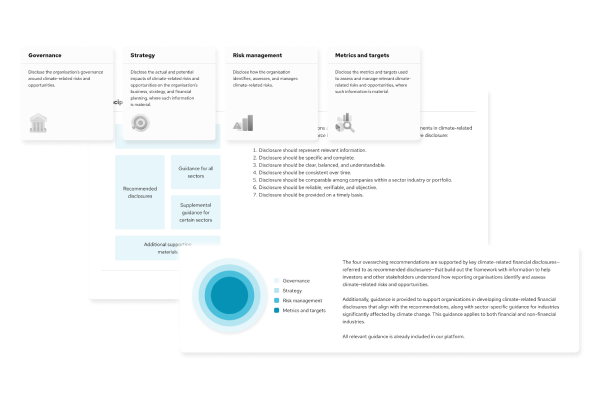
Evidence and audit trail
Attach evidence to each answer and keep a full history of changes, ready for internal review or external assurance.
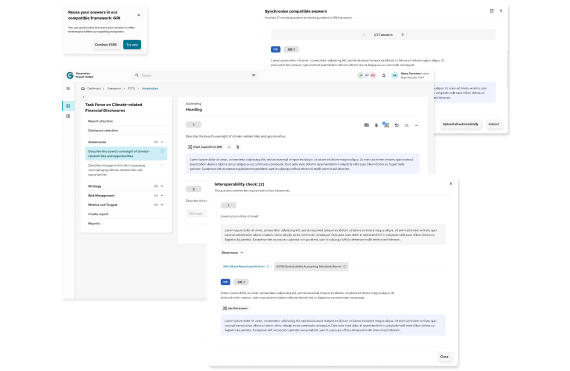
Interoperability
Reuse GRI data for ESRS, ISSB and other frameworks through built-in mappings, so each figure is collected once.

GRI materiality
Under GRI, materiality is about impact: the topics where your organisation has its most significant effects on the economy, the environment and people.
If you’re still working out what’s material to your organisation, our GRI materiality assessment tool can help.
Reuse your GRI data across frameworks
Most organisations report under more than one framework. Data collected for GRI maps directly to overlapping disclosures in ESRS, SFDR and ISSB, so you enter it once and report it many times. For example, under the revised ESRS adopted by the European Commission in July 2026, GRI 305 emissions data maps to ESRS E1-8 and GRI 405-1 diversity data maps to ESRS S1-8.
Our pre-built mappings keep the numbers consistent across every framework.
Many organisations also report under other frameworks, so it helps to be clear on how they differ. GRI reports your impact on the world. The investor-focused frameworks report how sustainability affects enterprise value. They are built to work together.
In a joint statement of 26 May 2026, GRI and the IFRS Foundation set out how the GRI and ISSB Standards can be used together, serving distinct but complementary purposes.
| Framework | Materiality basis | Primary audience | Status |
|---|---|---|---|
| GRI | Impact materiality, covering the economy, environment and people | Multi-stakeholder, including investors, regulators and civil society | Voluntary |
| ESRS (CSRD) | Double materiality | EU regulators and stakeholders | Mandatory for companies in scope of the CSRD, and highly interoperable with GRI |
| ISSB / IFRS S1 and S2 | Financial materiality, focused on enterprise value | Investors | Voluntary baseline, adopted by a growing number of jurisdictions |
| SASB | Financial materiality, by industry | Investors | Now consolidated under the ISSB |
GRI Sustainability Taxonomy
GRI launched its Sustainability Taxonomy in June 2025: a machine-readable version of the GRI Standards built on XBRL. Our platform supports tagged GRI reporting, so your report stays readable for people and can be processed by machines.
GRI taxonomy
Questions related to GRI
1. What is the definition of GRI?
GRI, the Global Reporting Initiative, is an independent, not-for-profit organisation that sets the world’s most widely used sustainability reporting standards. It enables organisations to report their environmental, social and economic impacts.
2. Is GRI reporting mandatory?
No. GRI is voluntary. It is widely adopted by companies, financial institutions, non-profits and public bodies to demonstrate transparency, and some regulations, such as the EU’s CSRD, draw on GRI: the ESRS under the CSRD are highly interoperable with the GRI Standards.
3. Is there a deadline for GRI compliance?
GRI reporting does not have a fixed deadline. Organisations choose their reporting cycle based on internal governance, regulatory requirements, or stakeholder expectations.
4. Is this an official GRI software?
While our software is not directly developed by GRI, we are an official GRI Software and Tools Partner. Our platform fully supports GRI reporting, built against the current GRI Standards and reviewed by GRI’s licensing team.
5. What is the difference between “In Accordance” and “With Reference”?
“In accordance” means full use of the GRI Standards to report your material topics comprehensively. “With reference” means selective use of specific disclosures, without meeting every requirement for full compliance.
6. Does the tool support qualitative and quantitative requirements?
Yes, our software allows users to report both qualitative narratives and quantitative data, and lets you attach supporting evidence to each.
7. What is the difference between GRI and integrated reporting?
GRI focuses specifically on sustainability and ESG impacts, using detailed, standardised disclosures. Integrated reporting takes a broader view, showing how sustainability, financial, and strategic factors together create value for the business over time.
8. How does GRI compare with ESRS, ISSB and SASB?
GRI reports your impact on the economy, environment and people, for a broad range of stakeholders. ESRS is the EU’s mandatory framework and uses double materiality. ISSB (IFRS S1 and S2) and SASB focus on what is financially material to investors. GRI is designed to work alongside all three. The comparison table above sets out the differences.
Report against the GRI Standards with confidence
See how quickly GRI reporting can move when collection, validation and disclosure all live in one licensed platform.
Start free, or book a demo to see the full platform.
Related articles
 Read more: VSME and GRI: how the two frameworks connect
VSME and GRI: how the two frameworks connect
 Read more: GRI completes financial sector trio with new draft standard for banking
GRI completes financial sector trio with new draft standard for banking
 Read more: Why the new GRI draft standard could reshape how insurers report on sustainability
Why the new GRI draft standard could reshape how insurers report on sustainability