
GRI Reporting Software,
from a licensed GRI partner
One platform for the whole GRI report, not just the data.
Generation Impact Global is a Swiss software company licensed by GRI and listed on GRI’s official Licensed Software and Tools Partners directory. Collect, validate, track and report every GRI disclosure in one place. You can then reuse the same data across ESRS, SFDR, ISSB and the EU Taxonomy, without collecting it twice.
Request a demo
GRI Licensed Software and Tools Partner · ISO 27001 · GDPR compliant · Swiss Sustainable Finance · EFRAG
Your GRI reports database
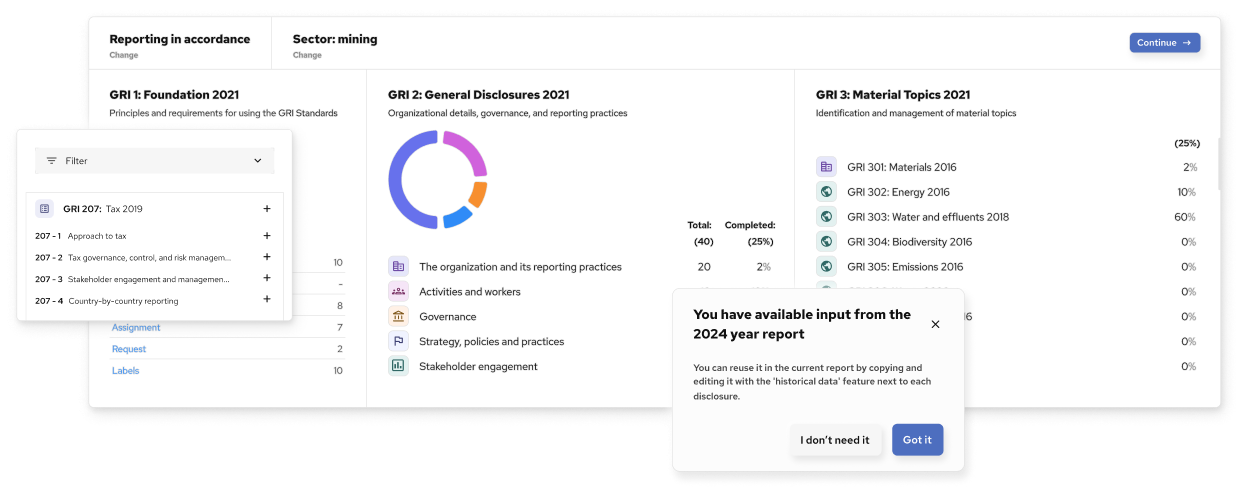
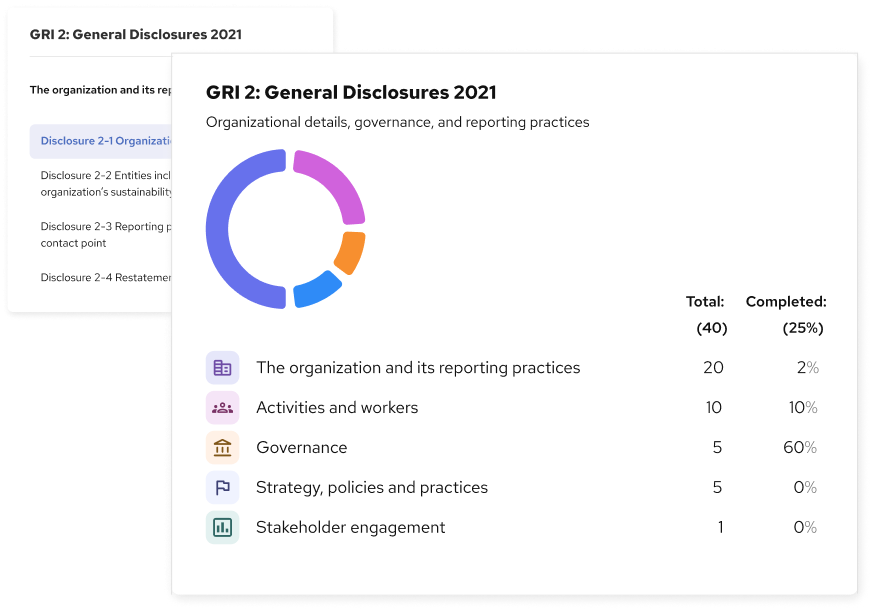
Managing GRI disclosures across teams, years, and reporting cycles shouldn’t mean digging through spreadsheets or scattered files. Our GRI reporting database gives your organisation one central place to answer, store, and track every disclosure. Built to follow official GRI criteria from day one.
What our clients say about our solution

“(…) GIG’s software has been instrumental in transforming how we approach sustainability, providing robust tools that streamline our data collection, analysis, and reporting processes. (…)”

United Manganese of Kalahari (UMK)
Malcolm Curror (CEO)
“The GRI solution exceeded expectations! Also, the team was professional, efficient, and attentive to every detail. I highly recommend them for their quality, reliability, and excellent customer experience.”

DataPack SA de CV
María Guerrero (ESG Manager)
What is GRI?
The Global Reporting Initiative (GRI) is an independent, not-for-profit organisation that sets the world’s most widely used sustainability reporting standards. The GRI Standards give organisations a common global language for reporting their impacts on the economy, the environment and people, whether in a standalone sustainability report or an integrated ESG report.
According to GRI, the Standards are used by more than 10,000 reporters across over 100 countries. GRI’s June 2026 research found that it remains the top choice for sustainability reporting worldwide, with adoption growing fastest across Asia and the Global South.
Universal and Well-Established
The GRI standards are among the most widely used sustainability reporting frameworks, with over 10,000 organisations across 100+ countries relying on them.
They apply to businesses of all sizes, as well as governments and non-profits, helping them measure impact and track sustainability progress.
Perfect for newcomers and experienced reporters alike
GRI makes ESG reporting accessible, even for those with limited experience, by providing a clear and flexible structure. Organizations can either fully comply with GRI in accordance or use the standards as a reference.
Scalable and inclusive
GRI makes ESG reporting accessible, even for those with limited experience, by providing a clear and flexible structure. Organizations can either fully comply with GRI in accordance or use the standards as a reference.
GRI Reporting
Begin by identifying the most relevant ESG topics based on industry impact, business priorities, and stakeholder expectations. The framework provides a structured approach, guiding the process of data collection, GRI disclosure, and report creation.
Read more
Key Benefits
Our GRI Tools: From Materiality to Reporting

Efficiency and impact
GRI reporting helps organisations assess, manage, and communicate their sustainability impact in a structured and transparent way.

Trust and credibility
With increasing scrutiny from investors, regulators, and stakeholders, organisations that provide clear, data-driven ESG disclosures can enhance their reputation and attract long-term investment.

Competitive advantage
Organisations that adopt GRI are better positioned to meet compliance requirements, manage risks, and integrate sustainability into their business strategy.
How to use GRI Standards for ESG Reporting
Understand the structure
The GRI Standards are built as a modular system of three parts, meant to be used together:
- GRI 1: Foundation – The starting point for every report. It explains how to use the Standards and sets out the reporting principles.
- GRI 2: General Disclosures – Standard information every organization reports, regardless of sector (governance, strategy, stakeholder engagement, etc.).
- GRI 3: Material Topics – Guides how you identify and report on the topics most significant to your organization.
- Sector Standards vs. Topic Standards
- Sector Standards address the specific impacts typical of an industry (e.g., mining, oil & gas, agriculture) and help narrow down which topics are likely material.
- Topic Standards cover individual subjects (e.g., emissions, anti-corruption, occupational health) and are used to report on whichever topics you determine are material.
Declare the reporting approach
Organizations can declare their ESG report as “In accordance”, or “With reference”.
‘In accordance’ with the GRI Standards
This indicates full compliance with the GRI Standards requirements.
‘With reference’ to the GRI Standards
This indicates partial use of the GRI Standards, focusing on specific topics.
Material topics
If reporting “in accordance with,” identify and prioritize the sustainability topics that matter most, based on your organization’s actual and potential impacts on the economy, environment, and people. GRI 3: Material Topics guides this process, which typically involves reviewing peer reports and industry guidance, engaging internal teams and external stakeholders, and scoring topics by significance. (If reporting “with reference to,” you can instead select specific topics of interest without running a full assessment.) Material topics reflect significant impacts on the economy, environment, and people, including human rights:
- Engage Stakeholders – Consult with internal and external stakeholders to understand their concerns and expectations.
- Assess Impacts – Evaluate the organization’s activities to identify significant economic, environmental, and social impacts.
- Prioritize Topics – Focus on topics that are most significant to stakeholders and the organization’s sustainability context.
The GRI Standards: how they are structured
The GRI Standards are a modular system that applies to any organisation, large or small, private or public. There are three types.
- Universal Standards (GRI 1, GRI 2, GRI 3). These apply to every organisation. GRI 1 sets out the purpose and the reporting principles, GRI 2 covers general disclosures about the organisation’s profile and governance, and GRI 3 guides how you identify and manage material topics. The revised Universal Standards were published in October 2021 and took effect for reporting from 1 January 2023.
- Sector Standards help you report the impacts typical of your industry more consistently, and make it easier to identify what is likely to be material.
- Topic Standards set out the disclosures relevant to a particular topic, such as emissions (GRI 305), occupational health and safety, or anti-corruption.
Collect and Prepare Your ESG Report
Gather qualitative and quantitative data for each material topic from internal systems (HR, finance, operations) and external sources (suppliers, audits). Apply GRI’s core reporting principles: accuracy, balance, clarity, comparability, completeness, and timeliness. Compile a GRI content index, a reference table showing exactly where each disclosure appears then publish the report, whether standalone or as part of a broader annual report.
Review and improve
GRI reporting is an ongoing cycle, not a one-time exercise. Use insights from each report to refine data collection, update material topics, and track progress year over year.
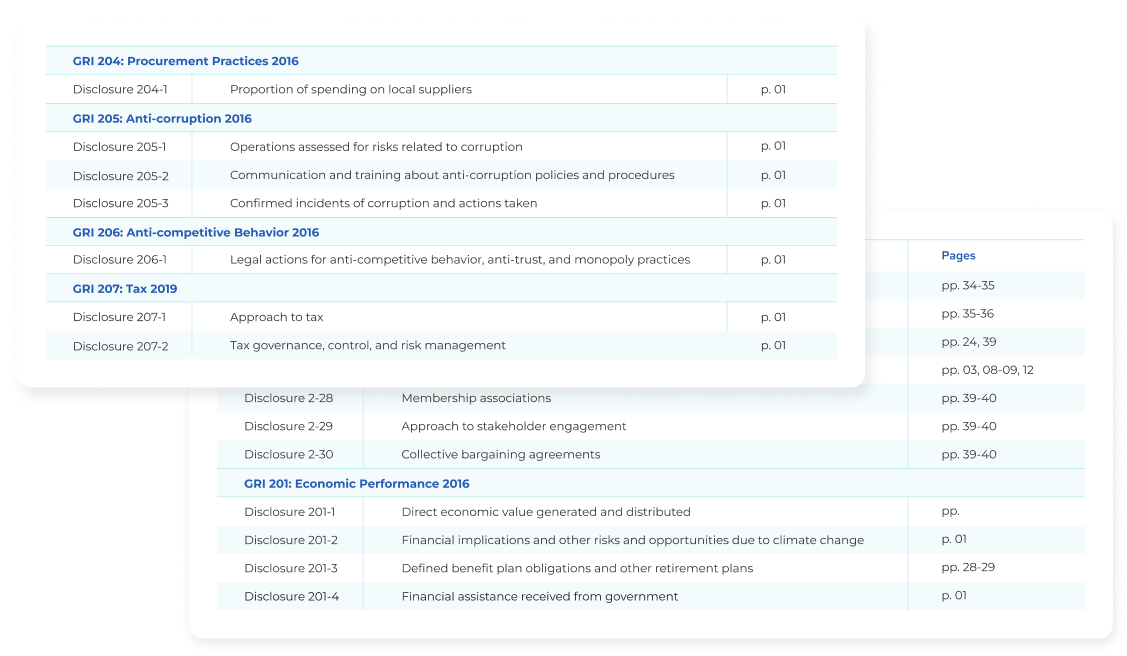
What is the GRI Content Index?
The GRI Content Index is a table at the end of a sustainability report that shows exactly where each GRI disclosure can be found by page, section, or link.
For every disclosure, it lists:
- The disclosure number and title (e.g., GRI 302-1: Energy consumption)
- Where to find it in the report
- The reporting option used (“in accordance with” or “with reference to”)
- Any omissions and why
The GRI Index is essentially a map so that stakeholders can go straight to the information they need, without reading the whole report.
Connecting GRI with the SDGs
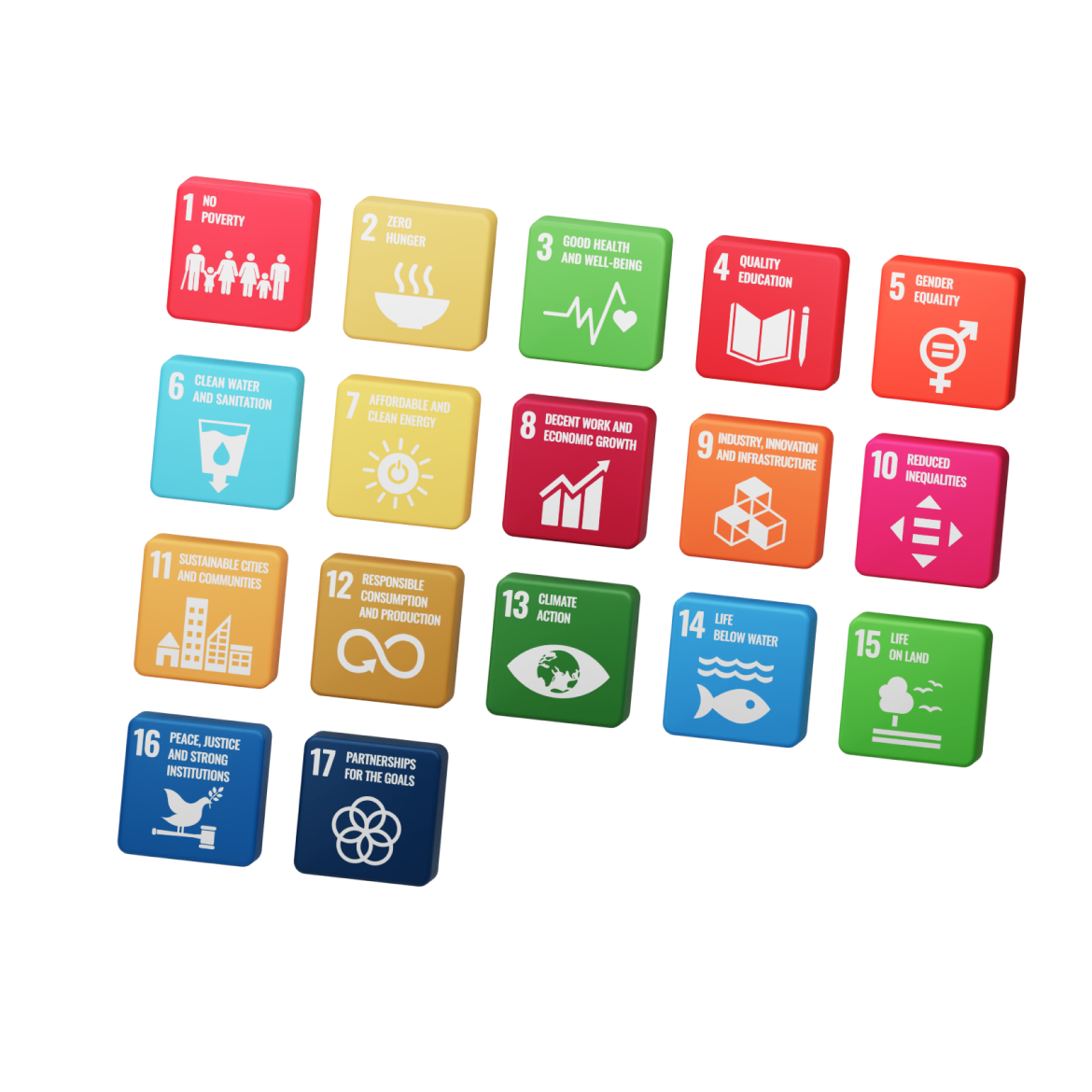
Take your ESG reporting further with Generation Impact Global’s SDG Mapper.
It automatically matches your GRI Disclosures to the UN’s 17 Sustainable Development Goals database, so you can see exactly how your report connects to each one. Tag content by sustainability topic and show, clearly, where your efforts are making progress.
GRI materiality
GRI materiality is the foundation of any solid GRI report. It’s how you decide which topics actually matter to your business and stakeholders.
If you’re still working out what’s material to your organization, our GRI materiality assessment tool can help.


Understand your climate impact through the GRI lens
Track and disclose your climate impact using GRI 305: Emissions — covering greenhouse gas output, energy intensity, and reduction targets. It’s the standard investors and regulators look for, and it connects directly to how your business manages risk and plans for the future
Generation Impact Global and GRI
With our GRI Tools, users can choose to report either in accordance or with reference to the standards. They are provided with a clear path towards collecting, tracking, verifying, and communicating ESG data, as well as exporting reports in different formats.
Go further by using our interoperability features to manage ESG data across multiple frameworks, saving time and maintaining consistency in reporting materials.
Why organisations choose Generation Impact Global for GRI
Licensed by GRI
We are a Swiss software company licensed by GRI and listed on GRI’s official Licensed Software and Tools Partners directory, so you are reporting on a platform built directly against the Standards.
One system, not several
Collection, validation, tracking and reporting sit in a single platform, rather than being stitched together across separate tools.
Secure by design
The platform is ISO 27001 certified and GDPR compliant, with encryption, access controls and full audit traceability.
Part of the reporting community
We are members of Swiss Sustainable Finance and Eurosif, and a Friend of EFRAG contributing to European sustainability reporting.
GRI compared with other frameworks
Many organisations also report under other frameworks, so it helps to be clear on how they differ. GRI reports your impact on the world. The investor-focused frameworks report how sustainability affects enterprise value. They are built to work together.
| Framework | Materiality basis | Primary audience | Status |
|---|---|---|---|
| GRI | Impact materiality, covering the economy, environment and people | Multi-stakeholder, including investors, regulators and civil society | Voluntary |
| ESRS (CSRD) | Double materiality | EU regulators and stakeholders | Mandatory in the EU, and built for high interoperability with GRI |
| ISSB / IFRS S1 and S2 | Financial materiality, focused on enterprise value | Investors | Voluntary baseline, adopted by a growing number of jurisdictions |
| SASB | Financial materiality, by industry | Investors | Now consolidated under the ISSB |
GRI and the IFRS Foundation confirmed in May 2026 that GRI and ISSB Standards are complementary, and that organisations can report efficiently using both.
Reuse your GRI data across frameworks
Most organisations report under more than one framework. Data collected for GRI maps directly to overlapping disclosures in ESRS, SFDR and ISSB, so you enter it once and report it many times. For example, GRI 305 emissions data maps to ESRS E1-6, and GRI 405-1 diversity data maps to ESRS S1-15.
Our pre-built mappings keep the numbers consistent across every framework.

Praise and recognition for GRI reporting standards
Endorsed by stock exchanges
The Global Reporting Initiative (GRI) Standards are widely endorsed by stock exchanges and regulatory bodies worldwide, underscoring their importance in sustainability reporting. As of 2023, approximately 96% of stock exchanges globally reference the GRI framework in their environmental, social, and governance (ESG) guidance.
Recognized by policy makers
The Global Reporting Initiative (GRI) collaborates with policymakers worldwide to develop effective policies and regulatory frameworks that align private sector disclosures with sustainable development goals. By engaging with governments, market regulators, and stock exchanges, GRI promotes the integration of transparency and sustainability disclosures into laws, regulations, and listing requirements.
GRI Sustainability Taxonomy
GRI is developing a digital taxonomy for the GRI Standards, which turns disclosures into a structured, machine-readable data model using XBRL. Our platform supports digital, tagged GRI reporting, so your reports stay human-readable while machines can process them too.
Read more
Questions related to GRI
1. What is the definition of GRI?
GRI, the Global Reporting Initiative, is an independent, not-for-profit organisation that sets the world’s most widely used sustainability reporting standards. It enables organisations to report their environmental, social and economic impacts.
2. Is GRI reporting mandatory?
No. GRI is voluntary. It is widely adopted by companies, financial institutions, non-profits and public bodies to demonstrate transparency, and some regulations, such as the EU’s CSRD, draw on GRI concepts.
3. Is there a deadline for GRI compliance?
GRI reporting does not have a fixed deadline. Organisations choose their reporting cycle based on internal governance, regulatory requirements, or stakeholder expectations.
4. Is this an official GRI software?
While our software is not directly developed by GRI, we are an official GRI Software and Tools Partner. Our platform fully supports GRI reporting, ensuring compliance with the latest standards.
5. What is the difference between “In Accordance” and “In Reference”?
“In accordance” means full use of the GRI Standards to report your material topics comprehensively. “With reference” means selective use of specific disclosures, without meeting every requirement for full compliance.
6. Does the tool support qualitative and quantitative requirements?
Yes, our software allows users to report both qualitative narratives and quantitative data, ensuring full alignment with GRI disclosure requirements.
7. What is the difference between GRI and integrated reporting?
GRI focuses specifically on sustainability and ESG impacts, using detailed, standardized disclosures. Integrated reporting takes a broader view, showing how sustainability, financial, and strategic factors together create value for the business over time.
8. How does GRI compare with ESRS, ISSB and SASB?
GRI reports your impact on the economy, environment and people, for a broad range of stakeholders. ESRS is the EU’s mandatory framework and uses double materiality. ISSB (IFRS S1 and S2) and SASB focus on what is financially material to investors. GRI is designed to work alongside all three. The comparison table above sets out the differences.
Report against the GRI Standards with confidence
See how quickly GRI reporting can move when collection, validation and disclosure all live in one licensed platform.
Start free, or book a demo to see the full platform.
Related news
 Read more: VSME and GRI: how the two frameworks connect
VSME and GRI: how the two frameworks connect
 Read more: GRI completes financial sector trio with new draft standard for banking
GRI completes financial sector trio with new draft standard for banking
 Read more: Why the new GRI draft standard could reshape how insurers report on sustainability
Why the new GRI draft standard could reshape how insurers report on sustainability