
Indice
Software per la rendicontazione GRI, fornito da un partner autorizzato GRI
Collect, validate and report every GRI disclosure in one platform, then reuse the same data for ESRS, ISSB and other frameworks without collecting it twice.
Generation Impact Global is a Swiss software company licensed by GRI and listed on GRI’s official Licensed Software and Tools Partners directory. GRI’s licensing team has reviewed how the Standards are built into the platform.
Inizia gratuitamente



Generation Impact Global e GRI
Report in accordance with the GRI Standards or with reference to them. The platform guides your team through collecting, reviewing and approving data, and exports the finished report in the format you need.
Data entered once can be reused for ESRS, ISSB and other frameworks, so your figures stay consistent across every report.
Perché le organizzazioni scelgono Generation Impact Global per il GRI
Concesso in licenza da GRI
Siamo un’azienda svizzera di software autorizzata dal GRI e inserita nell’elenco ufficiale dei partner autorizzati per software e strumenti del GRI; pertanto, la vostra rendicontazione avviene su una piattaforma realizzata in piena conformità con gli Standard.
Un unico sistema, non diversi
La raccolta, la convalida, il monitoraggio e la rendicontazione sono integrati in un'unica piattaforma, anziché essere gestiti separatamente tramite strumenti diversi.
Sicuro fin dalla progettazione
La piattaforma è certificata ISO 27001 e conforme al GDPR, con crittografia, controlli di accesso e piena tracciabilità degli audit.
Parte della comunità dei giornalisti
Siamo membri di Swiss Sustainable Finance e di Eurosif, nonché “Friend of EFRAG”, e contribuiamo alla rendicontazione europea in materia di sostenibilità.
Cosa dicono i nostri clienti della nostra soluzione

“(…) Il software di GIG ha svolto un ruolo fondamentale nel trasformare il nostro approccio alla sostenibilità, fornendoci strumenti affidabili che ottimizzano i nostri processi di raccolta, analisi e rendicontazione dei dati. (…)”

United Manganese of Kalahari (UMK)
Malcolm Curror (amministratore delegato)
“La soluzione GRI ha superato le aspettative! Inoltre, il team si è dimostrato professionale, efficiente e attento a ogni dettaglio. Li consiglio vivamente per la loro qualità, affidabilità ed eccellente esperienza cliente.”

DataPack SA de CV
María Guerrero (Responsabile ESG)

Per un esempio concreto, scopri come Xlife Sciences AG ha redatto sulla nostra piattaforma il proprio rapporto ESG in linea con i principi GRI, riguardante 11 società del proprio portafoglio.
Leggi il rapportoChe cos’è il GRI?
La Global Reporting Initiative (GRI) è un’organizzazione indipendente senza scopo di lucro che definisce gli standard di rendicontazione sulla sostenibilità più diffusi al mondo. Gli standard GRI forniscono alle organizzazioni un linguaggio comune a livello globale per rendicontare il proprio impatto sull’economia, sull’ambiente e sulle persone, sia in un rapporto di sostenibilità autonomo che in un rapporto ESG integrato.
GRI’s June 2026 study of almost 15,000 large listed companies found that 40% use the GRI Standards, together representing 62% of global market capitalisation, with reporters headquartered in 107 jurisdictions. Adoption is growing fastest in Asia and the Global South.

Report your climate impact with GRI 305
GRI 305: Emissions covers direct (Scope 1), energy indirect (Scope 2) and other indirect (Scope 3) greenhouse gas emissions, along with emissions intensity and reductions. Collect the activity data behind each figure and track progress year on year in one place.

The next generation of GRI Topic Standards
GRI is expanding its Topic Standards. Three new standards take effect over the next two years, and our platform already supports them:
- GRI 101: Biodiversity 2024, required for reporting from 1 January 2026.
- GRI 102: Climate Change 2025, required from 1 January 2027.
- GRI 103: Energy 2025, required from 1 January 2027, with early adoption encouraged.
They sit alongside the Universal Standards (GRI 1, 2 and 3) and the Topic Standards you already report against, so you can begin preparing early.
Collegare i GRI agli SDG
Link your GRI disclosures to the UN Sustainable Development Goals (SDGs) to show which goals your activities support and how your contribution changes over time.
How markets and policymakers use GRI
Referenced by stock exchanges
More than 40 stock exchanges and market regulators reference or require the GRI Standards for sustainability reporting by listed companies.
Referenced by policymakers
Governments and regulators draw on the GRI Standards when designing disclosure rules. In the EU, GRI and EFRAG have confirmed a high level of interoperability between the GRI Standards and the ESRS for impact reporting.
Che cos’è l’Indice dei contenuti GRI?
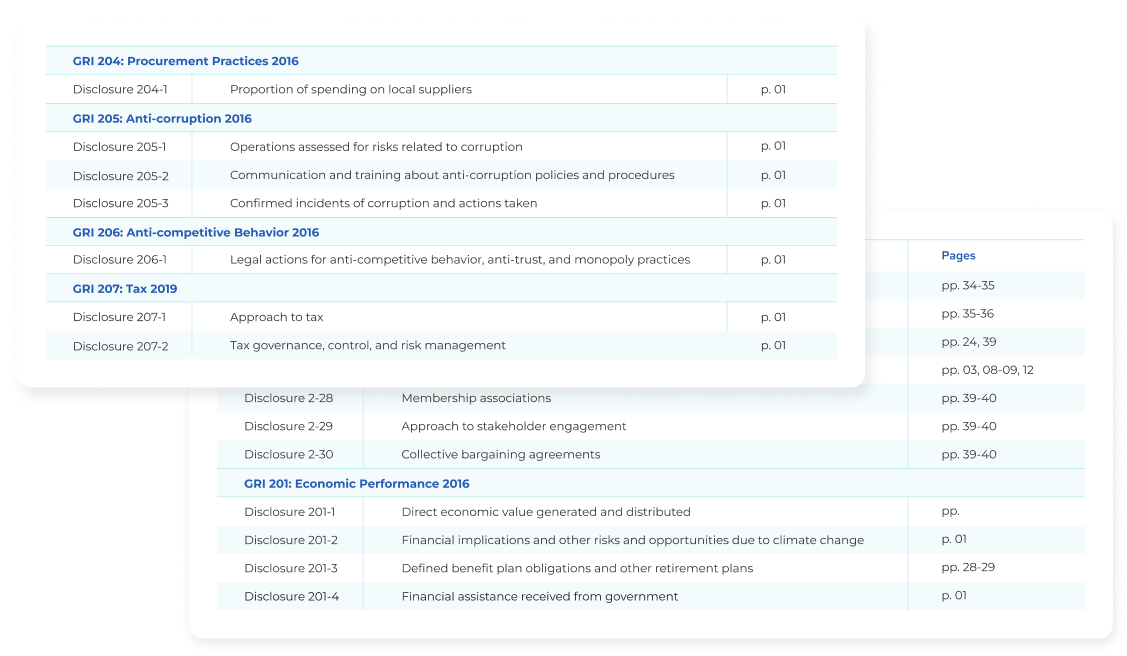
L'Indice dei contenuti GRI è una tabella strutturata inclusa in un rapporto di sostenibilità che indica esattamente dove è riportata ciascuna informazione richiesta dal GRI. Funge da strumento di navigazione e trasparenza, consentendo a lettori, revisori, investitori e autorità di regolamentazione di verificare rapidamente le informazioni fornite.
A GRI content index and a statement of use are required whether you report in accordance with the GRI Standards or with reference to them.
GRI for portfolio disclosure
Xlife Sciences AG produced a GRI-aligned ESG report across 11 portfolio companies on Generation Impact Global’s platform. The content index shows which disclosures the report covers and where readers can find them. Because the data was collected once, it can be reused for ESRS and other frameworks.
Page updated: 2 October 2026.
Vantaggi principali
I nostri strumenti GRI: dalla materialità alla rendicontazione

Efficienza e impatto
La rendicontazione GRI aiuta le organizzazioni a valutare, gestire e comunicare il proprio impatto in termini di sostenibilità in modo strutturato e trasparente.

Fiducia e credibilità
Investors, lenders and customers increasingly ask for comparable ESG data. Clear GRI disclosures answer those requests from one consistent source.

Vantaggio competitivo
GRI is interoperable with the ESRS and complementary to the ISSB Standards, so a well-kept GRI dataset gives you a head start on mandatory and investor-focused reporting.
Ideale sia per i principianti che per i giornalisti esperti
First-time reporters can start by reporting with reference to selected GRI Standards, then move to reporting in accordance as their data and processes mature.
Scalabile e inclusivo
The GRI Standards apply to any organisation, large or small, public or private, so the same approach works for a single company or a group of subsidiaries.
Rendicontazione GRI
Start by identifying your material topics: the areas where your organisation has its most significant impacts on the economy, environment and people. The platform then guides data collection, disclosure and report creation.
Come utilizzare il GRI
Come utilizzare gli standard GRI per la rendicontazione ESG
Comprendere la struttura
Gli standard GRI sono strutturati come un sistema modulare composto da tre parti, pensate per essere utilizzate insieme:
- GRI 1: Foundation – The starting point for every report. It explains how to use the Standards and sets out the reporting principles and requirements.
- GRI 2: General Disclosures – Information about your organisation that every reporter provides, such as governance, strategy, policies and stakeholder engagement.
- GRI 3: Material Topics – Explains how to determine your material topics and report how you manage them.
- Sector and Topic Standards
- Gli standard settoriali affrontano gli impatti specifici tipici di un determinato settore (ad esempio, minerario, petrolifero e del gas, agricolo) e aiutano a individuare quali argomenti possano essere rilevanti.
- Gli standard tematici riguardano singole tematiche (ad esempio, emissioni, lotta alla corruzione, salute sul lavoro) e vengono utilizzati per rendere conto degli argomenti che ritenete rilevanti.
Definire l'approccio di rendicontazione
Declare whether your report is prepared in accordance with the GRI Standards or with reference to them.
“In conformità” con gli standard GRI
You meet all nine requirements in GRI 1: Foundation, report on all your material topics, and publish a GRI content index and a statement of use.
“Con riferimento” agli standard GRI
You report selected disclosures, publish a GRI content index and a statement of use, and notify GRI. A practical first step for new reporters.
Temi rilevanti
If you report in accordance with the GRI Standards, GRI 3: Material Topics guides you through identifying and prioritising your most significant impacts on the economy, environment and people, including impacts on human rights. This usually involves reviewing sector and peer information, engaging internal and external stakeholders, and assessing how significant each impact is. If you report with reference, you can select specific topics without a full assessment. The main steps are:
- Engage stakeholders – Consult with internal and external stakeholders to understand their concerns and expectations.
- Assess impacts – Evaluate the organisation’s activities to identify significant economic, environmental, and social impacts.
- Prioritise topics – Prioritise the impacts that are most significant, based on their severity and likelihood.
Select the relevant standards
Every report uses the three Universal Standards. Sector and Topic Standards are then chosen based on your sector and your material topics.
- Universal Standards (GRI 1, GRI 2, GRI 3). Apply GRI 1, GRI 2 and GRI 3 in every report. The revised Universal Standards were published in October 2021 and have applied to reports since 1 January 2023.
- Sector Standards help you report the impacts typical of your sector and identify which topics are likely to be material. Use the one for your sector where GRI has published it.
- Topic Standards set out the disclosures for each material topic, for example GRI 305 for emissions, GRI 403 for occupational health and safety or GRI 205 for anti-corruption.
Raccogli i dati e prepara il tuo rapporto ESG
Gather qualitative and quantitative data for each material topic from internal systems (HR, finance, operations) and external sources such as suppliers. Apply GRI’s eight reporting principles: accuracy, balance, clarity, comparability, completeness, sustainability context, timeliness and verifiability. Then compile the GRI content index and publish the report, either on its own or as part of your annual report.
Rivedere e migliorare
La rendicontazione GRI è un ciclo continuo, non un’attività una tantum. Utilizzate le informazioni ricavate da ogni rapporto per perfezionare la raccolta dei dati, aggiornare i temi rilevanti e monitorare i progressi di anno in anno.
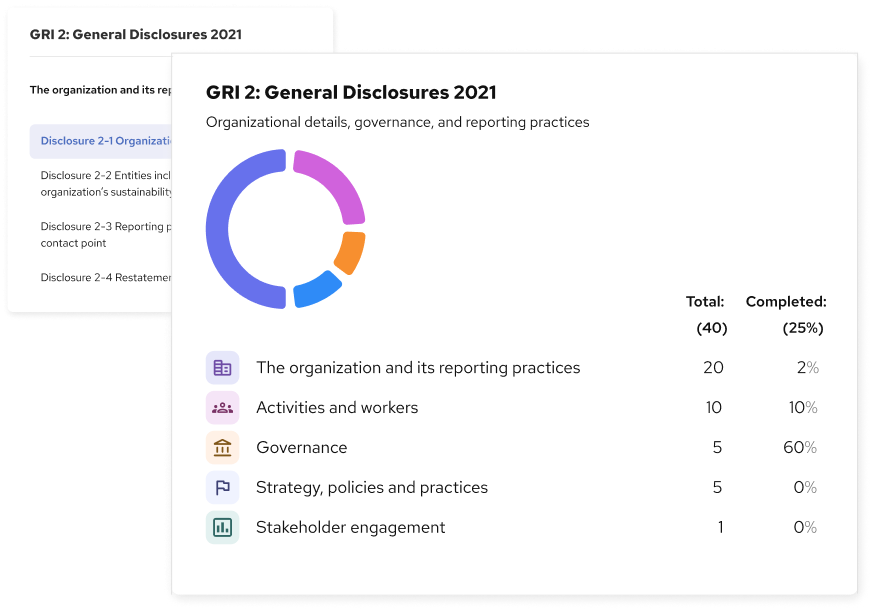
Il tuo database dei rapporti GRI
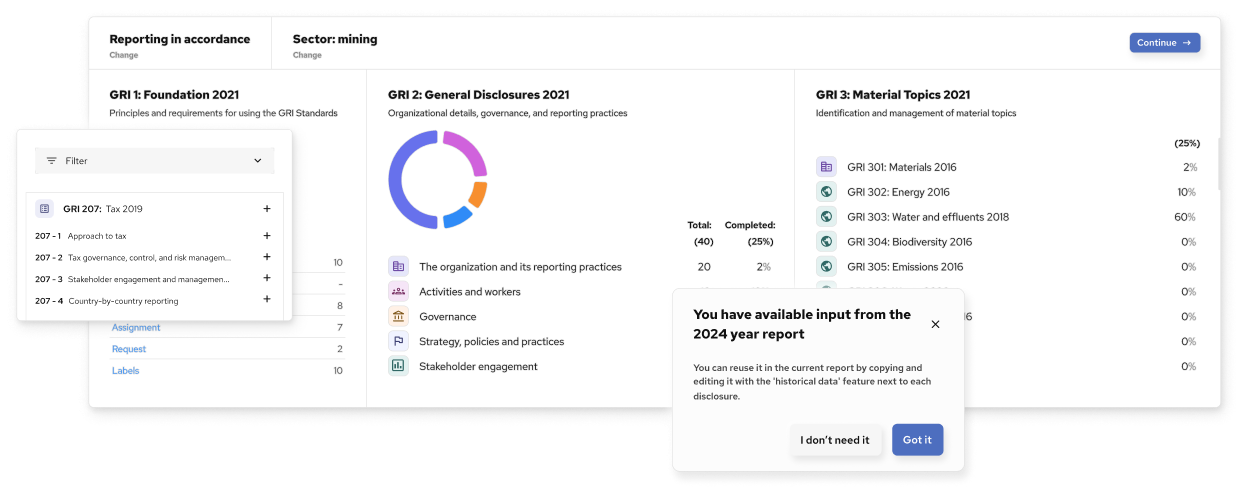
Keep every GRI disclosure in one place across teams, years and reporting cycles. Answer, store and track each disclosure, see who changed what and compare years, without hunting through spreadsheets.
Caratteristiche principali
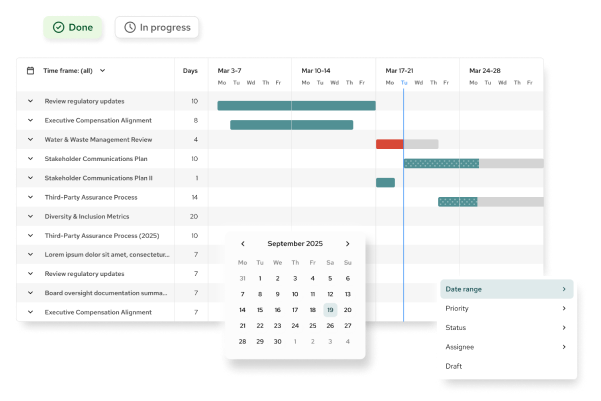
Piano d'azione
Creare, assegnare e monitorare le azioni mirate per risolvere i problemi o raggiungere gli obiettivi, garantendo la responsabilità e il monitoraggio dei progressi.
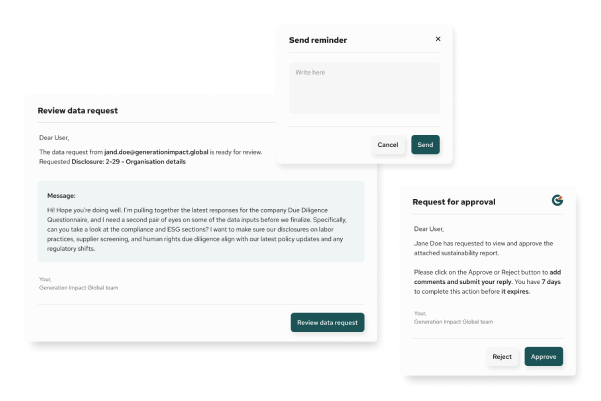
Richiedere revisioni e approvazione
Send disclosures to colleagues, managers, portfolio companies or funds for review and approval, with a record of who signed off.
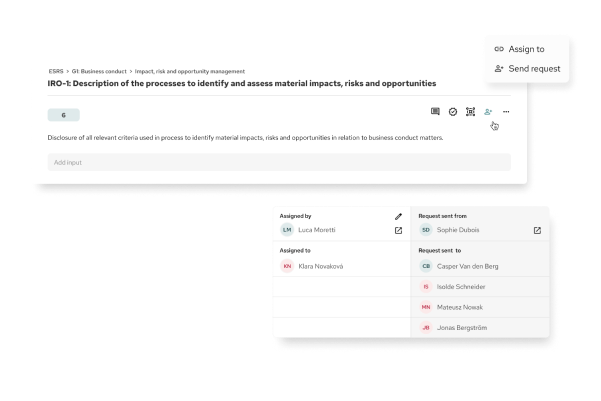
Assegnare le note esplicative
Give each disclosure an owner and a deadline, and follow progress in one view.
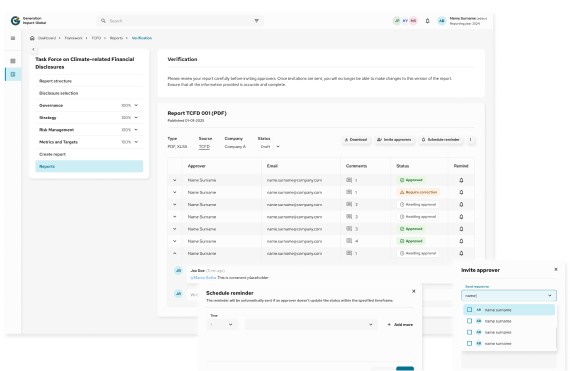
Gestione dei report
Generate, organise and export reports, and keep earlier versions for comparison and audit.
Evidence and audit trail
Attach evidence to each answer and keep a full history of changes, ready for internal review or external assurance.
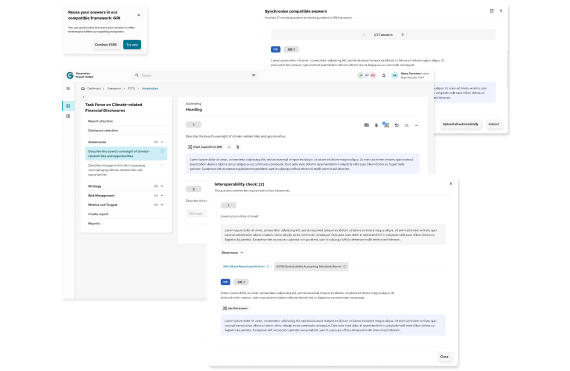
Interoperabilità
Reuse GRI data for ESRS, ISSB and other frameworks through built-in mappings, so each figure is collected once.

Materialità GRI
Under GRI, materiality is about impact: the topics where your organisation has its most significant effects on the economy, the environment and people.
If you’re still working out what’s material to your organisation, our GRI materiality assessment tool can help.
Riutilizza i tuoi dati GRI in diversi contesti
Most organisations report under more than one framework. Data collected for GRI maps directly to overlapping disclosures in ESRS, SFDR and ISSB, so you enter it once and report it many times. For example, under the revised ESRS adopted by the European Commission in July 2026, GRI 305 emissions data maps to ESRS E1-8 and GRI 405-1 diversity data maps to ESRS S1-8.
Our pre-built mappings keep the numbers consistent across every framework.
Molte organizzazioni redigono rapporti anche secondo altri standard, quindi è utile chiarire in che modo questi si differenziano. Il GRI illustra l’impatto che la vostra organizzazione ha sul mondo. Gli standard orientati agli investitori descrivono invece in che modo la sostenibilità influisce sul valore aziendale. Sono concepiti per funzionare in sinergia.
In a joint statement of 26 May 2026, GRI and the IFRS Foundation set out how the GRI and ISSB Standards can be used together, serving distinct but complementary purposes.
| Quadro di riferimento | Criteri di rilevanza | Destinatari principali | Stato |
|---|---|---|---|
| GRI | Materialità dell’impatto, che comprende l’economia, l’ambiente e le persone | Con il coinvolgimento di più parti interessate, tra cui investitori, autorità di regolamentazione e società civile | Volontario |
| ESRS (CSRD) | Doppia rilevanza | Autorità di regolamentazione dell'UE e parti interessate | Mandatory for companies in scope of the CSRD, and highly interoperable with GRI |
| ISSB / IFRS S1 e S2 | Rilevanza finanziaria, incentrata sul valore aziendale | Investitori | Riferimento volontario, adottato da un numero crescente di giurisdizioni |
| SASB | Rilevanza finanziaria, per settore | Investitori | Ora consolidato nell'ambito dell'ISSB |
Tassonomia della sostenibilità GRI
GRI launched its Sustainability Taxonomy in June 2025: a machine-readable version of the GRI Standards built on XBRL. Our platform supports tagged GRI reporting, so your report stays readable for people and can be processed by machines.
GRI taxonomy
Domande relative al GRI
1. Qual è la definizione di GRI?
La GRI (Global Reporting Initiative) è un’organizzazione indipendente senza scopo di lucro che definisce gli standard di rendicontazione sulla sostenibilità più diffusi al mondo. Consente alle organizzazioni di rendere conto del proprio impatto ambientale, sociale ed economico.
2. La rendicontazione GRI è obbligatoria?
No. GRI is voluntary. It is widely adopted by companies, financial institutions, non-profits and public bodies to demonstrate transparency, and some regulations, such as the EU’s CSRD, draw on GRI: the ESRS under the CSRD are highly interoperable with the GRI Standards.
3. Esiste una scadenza per l’adeguamento alle linee guida GRI?
La rendicontazione GRI non prevede una scadenza fissa. Le organizzazioni scelgono il proprio ciclo di rendicontazione in base alla governance interna, ai requisiti normativi o alle aspettative degli stakeholder.
4. Si tratta di un software ufficiale della GRI?
While our software is not directly developed by GRI, we are an official GRI Software and Tools Partner. Our platform fully supports GRI reporting, built against the current GRI Standards and reviewed by GRI’s licensing team.
5. What is the difference between “In Accordance” and “With Reference”?
“In conformità” indica il ricorso completo agli Standard GRI per rendere conto in modo esaustivo dei temi rilevanti della propria organizzazione. “Con riferimento” indica l’uso selettivo di specifiche informazioni, senza soddisfare tutti i requisiti necessari per la piena conformità.
6. Lo strumento supporta requisiti qualitativi e quantitativi?
Yes, our software allows users to report both qualitative narratives and quantitative data, and lets you attach supporting evidence to each.
7. Qual è la differenza tra GRI e rendicontazione integrata?
GRI focuses specifically on sustainability and ESG impacts, using detailed, standardised disclosures. Integrated reporting takes a broader view, showing how sustainability, financial, and strategic factors together create value for the business over time.
8. Qual è il rapporto tra GRI, ESRS, ISSB e SASB?
I report GRI illustrano il vostro impatto sull’economia, sull’ambiente e sulle persone, rivolgendosi a un’ampia gamma di stakeholder. L’ESRS è il quadro normativo obbligatorio dell’UE e si avvale del principio della doppia materialità. L’ISSB (IFRS S1 e S2) e il SASB si concentrano su ciò che è finanziariamente rilevante per gli investitori. Il GRI è concepito per integrarsi con tutti e tre questi standard. La tabella comparativa riportata sopra illustra le differenze.
Rendicontare in conformità agli standard GRI in tutta sicurezza
Scopri quanto può diventare veloce la rendicontazione GRI quando la raccolta, la convalida e la pubblicazione dei dati avvengono tutte su un’unica piattaforma con licenza.
Inizia gratuitamente o prenota una demo per scoprire la piattaforma completa.
Articoli correlati
 Per saperne di più: VSME e GRI: come si collegano i due quadri di riferimento
VSME e GRI: come si collegano i due modelli di riferimento
 Per saperne di più: il GRI completa la trilogia dedicata al settore finanziario con una nuova bozza di standard per il settore bancario
La GRI completa il trio dedicato al settore finanziario con una nuova bozza di standard per il settore bancario
 Per saperne di più: Perché la nuova bozza di standard GRI potrebbe rivoluzionare il modo in cui le compagnie assicurative rendicontano la sostenibilità
Perché la nuova bozza di standard GRI potrebbe rivoluzionare il modo in cui le compagnie assicurative rendono conto della sostenibilità