
Everything you need to understand and implement the VSME standard.
From regulatory context and disclosure breakdowns to interactive tools that map your reporting obligations across frameworks.
Your VSME reports database
Our software guides small and medium-sized enterprises through the Voluntary SME Standard with clear, step-by-step data collection, automated calculations, and ready-to-share reports. Alongside the platform, we offer free tools like checklists, mappers, and calculators to help you get started with sustainability disclosure today.

Definition of VSME
Definition of VSME: The Voluntary Sustainability Reporting Standard for non-listed SMEs is a simplified reporting framework developed by EFRAG, aligned with the broader European Sustainability Reporting Standards (ESRS) but proportionate to the resources and capacities of smaller organisations. It enables businesses across sectors to disclose their environmental, social, and governance (ESG) performance in a clear and standardised manner.
Purpose-built for SMEs
Developed by EFRAG and published in 2024, the VSME Standard is specifically designed for small and medium-sized enterprises, unlike broader frameworks built with large corporations in mind.
It offers a simplified, proportionate approach to sustainability reporting, helping SMEs across industries measure their ESG impact and respond to growing demands from banks, investors, and business partners.
Key Benefits
Our VSME Tools: Check, map, and comply.
Save time on compliance
Guided, proportionate reporting cuts hours of manual work, letting lean teams meet ESG requirements without hiring specialists or consultants.
Unlock financing opportunities
Structured, credible ESG data improves your standing with banks and investors, supporting better loan terms and investment readiness.
Meet client and partner demands
Respond quickly to sustainability questionnaires from larger customers, protecting existing contracts and winning new supply chain business.
Where should I start?
The VSME reaches four distinct audiences with different information needs. Select your role to see the content recommended for your starting point, whether that is a preparer building their first report, an institutional user integrating the standard into ESG data workflows, or an adviser helping clients navigate the transition.
Recommended for SMEs and preparers
What is the VSME standard? A practical guide
ARTICLE
VSME Basic vs Comprehensive module
ARTICLE
VSME Readiness checker
FREE TOOL
Module Calculator
FREE TOOL
The VSME Digital Template and XBRL explained
ARTICLE
Recommended for banks and investors
How VSME changes ESG data collection for banks
ARTICLE
Disclosure Mapper
(VSME ←→ESRS←→ SFDR)
FREE TOOL
VSME Basic vs Comprehensive module
ARTICLE
The VSME Digital Template and XBRL explained
ARTICLE
Recommended for corporate buyers
VSME and CSRD/ESRS: How they connect
ARTICLE
How VSME changes ESG data collection
ARTICLE
Disclosure Mapper
(VSME ←→ESRS←→ SFDR)
FREE TOOL
VSME and GRI: How they connect
ARTICLE
Recommended for advisors and consultants
Disclosure mapper (all frameworks)
FREE TOOL
Che cos’è lo standard VSME?
ARTICLE
VSME←→GRI heatmap mapper
FREE TOOL
From exposure draft to recommendation: How VSME evolved
ARTICLE
VSME Digital template and XBRL
ARTICLE
Read our complete guide: What is the VSME standard? A practical guide for non-listed SMEs covering modules, XBRL reporting, interoperability, and FAQs.
Read the guideThe VSME, at a glance
Four numbers that define the standard’s scope, structure and ecosystem, drawn directly from EFRAG’s adopted text and its technical Digital Template.
7
In-depth articles across the VSME content library
4
Interactive tools. All free, ungated, client-side
20
Disclosures across Basic (B1–B11) and Comprehensive (C1–C9)
4
Frameworks connected: ESRS, SFDR PAI, GRI, EBA Pillar 3
How to use VSME for ESG Reporting
Select your module
Identify whether you fall under the target group (non-listed micro, small, or medium-sized undertakings) and decide whether to start with the Basic Module only or move into the Comprehensive Module based on stakeholder demands (usually banks, investors, large clients).
Gather existing data first
Before collecting new data, it is suggested to compile what you already have. Electricity bills, heating invoices, waste disposal records, and HR master data typically cover a large share of the required disclosures.
Complete the module disclosures
Report core quantitative and narrative datapoints (e.g., energy use, GHG emissions in Scope 1 and 2, workforce data, basic policies). The specific disclosures will depend on the module selected (Basic vs Comprehensive module).
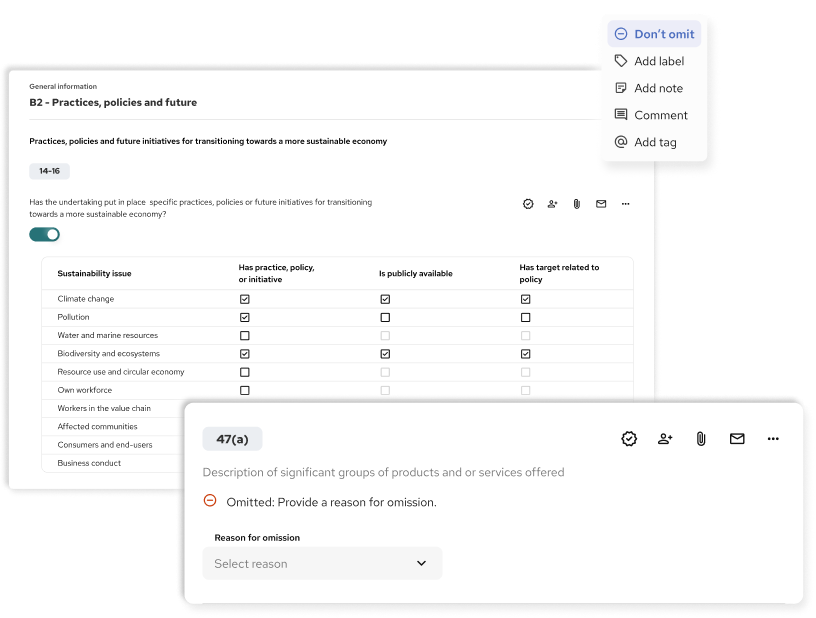
Document any omissions
If certain data isn’t available yet (a common first-year gap, e.g., Scope 3 emissions or biodiversity data), the VSME explicitly allows this: disclosures can be listed as omitted with a reason inside our system.
Compile and share the report
Once all disclosures have been answered you can proceed and generate a report. This report is generated in pre-approved formats and templates including machine readable XBRL. Your report is saved in your account, ready for consultation or as historical data for the next reporting cycle.
What Is the VSME Basic Module?
The VSME Basic Module is the entry-level tier of VSME, designed as the target module for micro undertakings, companies with fewer than 10 employees. It covers essential ESG disclosures with minimal complexity, requiring only Scope 1 and Scope 2 GHG emissions data, making it accessible for smaller businesses with limited reporting resources or experience.
What Is the VSME Comprehensive Module?
The Comprehensive Module builds on the Basic Module with additional, more detailed disclosures, suited to small and medium-sized companies facing greater stakeholder demands, such as requests from banks, investors, or larger business partners.
While Scope 3 emissions data is not mandatory under either module, it’s more likely to be relevant here, supporting more complete reporting where relevant to the company’s sector.
Generation Impact Global and VSME
With our VSME Tools, users are provided with a clear path towards collecting, tracking, verifying, and communicating ESG data, as well as exporting reports in different formats. All fulfilling the standards set by the developer EFRAG.
Go further by using our interoperability features to align VSME data with other frameworks like ESRS or GRI, saving time and maintaining consistency across reporting materials.

Support VSME Tools
Free, client-side tools to assess your VSME readiness and map disclosures across frameworks. No sign-up, no download, no data leaves your browser.
Strumento di verifica della compatibilità con VSME
Score and diagnose your current progress on VSME
VSME SUPPORTING TOOL
VSME Mapper per l'informativa
Discover connections to ESRS, SFDR PAI, and GRI
VSME SUPPORTING TOOL
Calcolatore dei moduli VSME
Identify the VSME disclosures that apply to your organisation.
VSME SUPPORTING TOOL
VSME ←→ GRI Mapper
Find intersecting VSME and GRI datapoints.
VSME SUPPORTING TOOL
Ready to operationalise VSME reporting?
From structured data collection across both modules to XBRL-ready export, cross-framework mapping to ESRS, SFDR and GRI, and portfolio-level aggregation for banks and investors.
Questions related to VSME
What is the VSME Standard?
The VSME (Voluntary SME) Standard is a simplified sustainability reporting framework developed by EFRAG for non-listed micro, small, and medium-sized enterprises. Published in 2024, it lets SMEs disclose environmental, social, and governance performance in a proportionate way, without the full complexity of ESRS reporting under CSRD.
Who should use the VSME Standard?
VSME is built for non-listed SMEs, whether they need to respond to sustainability data requests from banks, investors, or larger corporate customers, or simply want a structured starting point for ESG reporting. It isn’t mandated by CSRD, but it’s increasingly used as common ground between SMEs and the larger companies in their value chain that are required to report.
What’s the difference between the Basic and Comprehensive Module?
The Basic Module is the entry-level tier, aimed at micro undertakings with fewer than 10 employees, covering essential disclosures such as Scope 1 and Scope 2 GHG emissions with minimal complexity. The Comprehensive Module builds on it with more detailed disclosures, suited to SMEs facing greater demands from banks, investors, or large clients.
Is Scope 3 reporting required under VSME?
No. Scope 3 emissions data isn’t mandatory under either module, though it’s more likely to be relevant in the Comprehensive Module for companies where value chain emissions are significant to their sector.
How does VSME relate to ESRS and CSRD?
VSME is aligned with the broader European Sustainability Reporting Standards (ESRS) that apply to companies in scope of CSRD, but scaled to the resources of smaller organisations. It’s designed so large companies can request VSME-based data from SME suppliers to help fill their own ESRS value-chain disclosure requirements.
Can I skip disclosures I don’t have data for yet?
Yes. VSME explicitly allows disclosures to be marked as omitted with a stated reason, so first-year reporters with gaps such as Scope 3 emissions or biodiversity data can still complete and submit a report.
What format is the final VSME report generated in?
Reports are generated in pre-approved formats, including the machine-readable XBRL digital template, and saved in your account for consultation or as a baseline for the next reporting cycle.
Are Generation Impact Global’s VSME tools free to use?
Yes. The VSME readiness checker, disclosure mapper, module calculator, and GRI mapper are free, client-side tools — no sign-up or download required, and no data leaves your browser.
Articoli correlati
 Per saperne di più: VSME e GRI: come si collegano i due quadri di riferimento
VSME e GRI: come si collegano i due modelli di riferimento
 Per saperne di più: Spiegazione del modello digitale VSME e della tassonomia XBRL
Spiegazione del modello digitale VSME e della tassonomia XBRL
 Per saperne di più: In che modo VSME rivoluziona la raccolta dei dati ESG per banche e investitori
In che modo VSME rivoluziona la raccolta dei dati ESG per banche e investitori