
ESG Risk, Regulation, Compliance &
Governance
Understand what applies. Start your ESG compliance register.
ESG compliance can feel confusing when requirements, data, owners and evidence are spread across different teams, spreadsheets, emails, policies and consultants, with the same questions resurfacing every cycle. Which rules apply to us? Who owns each topic? What evidence do we already have, and what’s missing?
Generation Impact helps you check ESG readiness, understand governance gaps and turn requirements into a simple compliance register. From there, you can move into Freemium to assign owners, collect evidence, manage data requests and prepare reporting workflows.
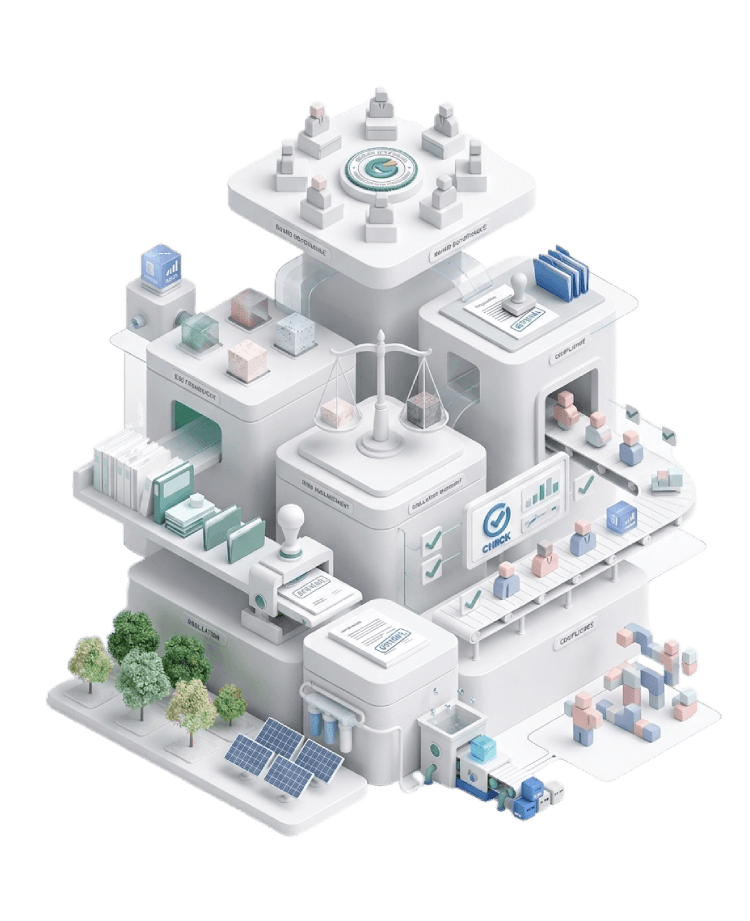
Understanding ESG Risk & Risk Management
ESG risk is the possibility that an environmental, social or governance issue affects your business, reputation, value chain, stakeholders or reporting obligations.
On this page, the focus stays on the compliance angle specifically:
Which ESG risks may need to be disclosed?
Which risks affect our regulatory or investor obligations?
Who owns each risk?
What evidence supports the assessment?
What action is required?
ESG risk management is the process of identifying, assessing, monitoring and responding to those exposures on an ongoing basis — not a one-off checklist. For the deeper internal risk-register and ownership process, see ESG Management.
Why ESG compliance feels difficult
Most teams do not struggle because they ignore ESG.
They struggle because ESG work is spread across too many places: spreadsheets, emails, policies, reports, consultants, suppliers and internal teams.
The same questions come back again:
Which ESG rules apply to us?
Who owns each topic?
What data do we need?
What evidence do we already have?
What is missing?
Are we ready to report?
Generation Impact turns those questions into a simple workflow:
Requirement
Owner
Data
Evidence
Recensione
Stato
Report or dashboard
Key ESG Regulations You Need to Know (EU, US, UK)
There’s no single ESG regulation — what applies depends on where you operate, your size, listing status, sector, and whether investors or regulators ask you for sustainability data.
Snapshot as of September 2026. Regulatory status here moves quickly — verify the row that applies to you before you rely on it.
Europe
CSRD, as amended by Omnibus I
In force since 18 March 2026 (Directive (EU) 2026/470). Now applies only where a company exceeds both €450 million net turnover and 1,000 average employees. Reporting starts for financial years from 2027.
ESRS (2026 revision)
Adopted 3 July 2026. Mandatory datapoints cut by more than 60% compared with the original standard.
SFDR & EU Taxonomy
Both remain in force. Financial market participants continue reporting Principal Adverse Impact indicators; SFDR reform is under discussion.
Stati Uniti
SEC climate rules (2024)
Stayed before ever taking effect. In May 2026 the SEC proposed rescinding them entirely; the comment period closed August 2026 and a final Commission vote is still pending.
SEC 2010 climate guidance
Materiality-based, not rule-based. Remains in force regardless of how the rescission proposal is resolved.
California (SB 253 / SB 261)
State-level climate disclosure laws continue on their own track, independent of the federal position.
Regno Unito
UK SRS S1 & S2
UK-endorsed versions of IFRS S1/S2, published February 2026. Currently available for voluntary use.
FCA consultation (CP26/5)
Proposes mandatory reporting for certain listed categories, for financial years beginning on or after 1 January 2027. A policy statement is expected in autumn 2026.
Che cos’è la conformità ESG?
ESG compliance means understanding which environmental, social and governance requirements apply to your organisation, and managing the work needed to respond: data collection, evidence, policies, controls, owners, reviews, approvals and reporting outputs.
An ESG policy helps define how you manage E, S and G topics, and for compliance purposes it matters because it shows expectations, responsibilities and controls — for sustainability commitments, supplier expectations, portfolio company data requests, emissions data, workforce indicators, and review and approval processes. For the strategic-planning side of policy, see ESG Strategy.
That work usually includes:
01
Raccolta dei dati
02
Evidence
03
Policies
04
Controls
05
Owners
06
Reviews
07
Approvals
08
Reporting outputs
The important part is proof.
It is not enough to say, “we comply”.
You need to show:
What was checked
Who was responsible
What evidence was used
What remains open
What Is ESG Governance?
ESG governance means knowing who owns what.
It answers simple questions:
Who is responsible?
Who provides the data?
Who checks it?
Who approves it?
Which policy supports it?
What happens if something is missing?
Without governance, ESG compliance stays reactive. With it, ESG work becomes something you can assign, review and explain.
Is ESG reporting mandatory?
Sometimes, ESG reporting can be mandatory depending on where your organisation operates, how large it is, whether it is listed, what sector it is in and whether clients, investors or regulators ask for sustainability data.
That is why the first step should be a readiness check, not guesswork.
Start by identifying:
What applies?
What data is needed?
Who owns it?
What evidence exists?
What gaps remain?
For the practical reporting workflow itself, see ESG Reporting.
What policies and evidence do you need?
An ESG policy helps define how your organisation manages environmental, social and governance topics.
For compliance, policies are useful because they show expectations, responsibilities and controls.
You may need policies or evidence for:
Sustainability commitments
Risk ownership
Supplier expectations
Portfolio company data requests
Emissions or environmental data
Workforce and social indicators
Governance controls
Review and approval processes
ESG Compliance Software & Tools
ESG compliance software should turn obligations into tasks, evidence and review status — mapping requirements, assigning owners, collecting data, requesting evidence, tracking gaps, and preparing dashboards and reporting outputs.
QB-EDGE™
ESG compliance software should turn obligations into tasks, evidence and review status — mapping requirements, assigning owners, collecting data, requesting evidence, tracking gaps, and preparing dashboards and reporting outputs.
Explore QB-EDGENot every team is ready for a full ESG compliance platform on day one.
Some teams first need to understand what applies, what is missing and whether governance is clear.
Generation Impact’s free tools help you start. Use them to check ESG readiness, explore regulatory requirements, classify impacts, risks and opportunities, and begin shaping your ESG compliance register.

Valutazione dello stato di preparazione alla rendicontazione ESG
Check reporting readiness and likely gaps.

Bussola della tassonomia dell'UE
Explore Taxonomy activities, objectives and criteria.

Classificatore IRO
Classify impacts, risks and opportunities against the ESRS taxonomy.

Strumento di verifica della prontezza VSME
Assess SME readiness for sustainability data requests.

VSME Disclosure Mapper
See which VSME disclosures apply to you.
Continue in Freemium when you are ready to organise owners, evidence, data requests, review status and reporting workflows.
ESG data governance and regulatory reporting
ESG compliance depends on data governance.
A regulation may tell you what to disclose. Data governance helps you control how the answer is produced.
Requirement
Data owner
Data point
Evidence
Recensione
Approval
Disclosure or dashboard
This helps avoid common problems:
Numbers with no source
Disclosures with no owner
Claims with no evidence
Reports that cannot be repeated next year
Generation Impact helps connect ESG data, evidence, ownership and review so that regulatory reporting is easier to manage.
ESG compliance and governance vs generic GRC software
Generic GRC software can be useful for broad risk, control and policy management.
ESG compliance needs something more specific: sustainability data, ESG indicators, framework mapping, evidence, disclosure workflows and recurring reporting cycles.
| Generic GRC software | ESG compliance and governance with Generation Impact Global |
|---|---|
| Broad risk and control management | ESG-specific data, evidence and disclosure workflows |
| Internal controls and policies | ESG indicators, frameworks, regulations and reporting |
| Enterprise risk workflows | Sustainability risk, compliance and governance workflows |
| General audit trails | ESG evidence, ownership and reporting readiness |
| Often separate from ESG data collection | Connected to questionnaires, data points and reporting outputs |
For broader governance, risk and compliance workflows, see Compliance & Governance.
How Generation Impact Global supports ESG compliance and governance
Generation Impact Global helps teams manage ESG compliance as a workflow.
Check readiness
Identify requirements
Start compliance register
Define owners and policies
Collect data and evidence
Review gaps and quality
Track status and actions
Prepare dashboards and reporting outputs
The platform supports the steps that sit between regulation and reporting: ownership, data collection, evidence, review, approvals and reuse.
That is how teams move from “we need to comply” to “we know what applies, who owns it and what evidence supports it.”
Related resources
Start your ESG compliance register
Use free tools to check ESG readiness, explore requirements and identify gaps.
Then move into Freemium to organise owners, evidence, data requests, review status and reporting workflows.
Domande frequenti
Che cos’è il rischio ESG?
ESG risk is the possibility that environmental, social or governance issues may affect an organisation’s operations, reputation, financial position, stakeholders or regulatory obligations.
Che cos’è la conformità ESG?
ESG compliance means understanding which ESG-related requirements apply and managing the data, evidence, policies, controls and approvals needed to respond.
What are the main ESG regulations?
The main ESG regulations depend on jurisdiction and company profile. They may include CSRD, ESRS, EU Taxonomy, SFDR, UK SDR, SEC climate-disclosure rules or other sector-specific obligations.
Is ESG reporting mandatory?
ESG reporting can be mandatory for some organisations, depending on jurisdiction, company size, listing status, sector, value-chain role and regulatory scope.
What is ESG risk management?
ESG risk management is the process of identifying, assessing, monitoring and responding to environmental, social and governance risks.
What are ESG regulatory requirements for businesses?
ESG regulatory requirements may include disclosure obligations, governance expectations, data collection, risk assessment, due diligence, evidence retention and reporting controls.
What is the EU ESG regulation?
There is no single EU ESG regulation. EU ESG requirements include several instruments, including CSRD, ESRS, EU Taxonomy, SFDR and other sustainability-related rules depending on the organisation.
What is the SEC ESG rule?
The SEC adopted climate-related disclosure rules in 2024, but the status has evolved. Companies should check the current legal position before relying on any requirement.
What is ESG data governance?
ESG data governance is the process of assigning ownership, controls, evidence, review and approval to ESG data so it can support reporting, compliance and decision-making.
What is ESG regulatory reporting?
ESG regulatory reporting is the process of preparing sustainability, climate, governance or ESG-related information for mandatory or voluntary disclosure under applicable rules or frameworks.
Articoli correlati
 Read more: EFRAG Opens Consultation on Draft ESRS XBRL Taxonomy for Digital Sustainability Disclosures
EFRAG Opens Consultation on Draft ESRS XBRL Taxonomy for Digital Sustainability Disclosures
 Read more: SEC Proposes Rescission of Shareholder Proposal Rule and Reforms to Proxy Solicitation Process
SEC Proposes Rescission of Shareholder Proposal Rule and Reforms to Proxy Solicitation Process
 Read more: CVM Technical Group Finalises Proposal for Capital Markets Tokenisation Pilot
CVM Technical Group Finalises Proposal for Capital Markets Tokenisation Pilot