Table of contents
The Sustainable Finance Disclosure Regulation (SFDR) reporting tool
Generation Impact Global’s SFDR Reporting Tool is software for SFDR reporting. It automates Articles 6, 8 and 9 disclosures and principal adverse impact statements for financial market participants.
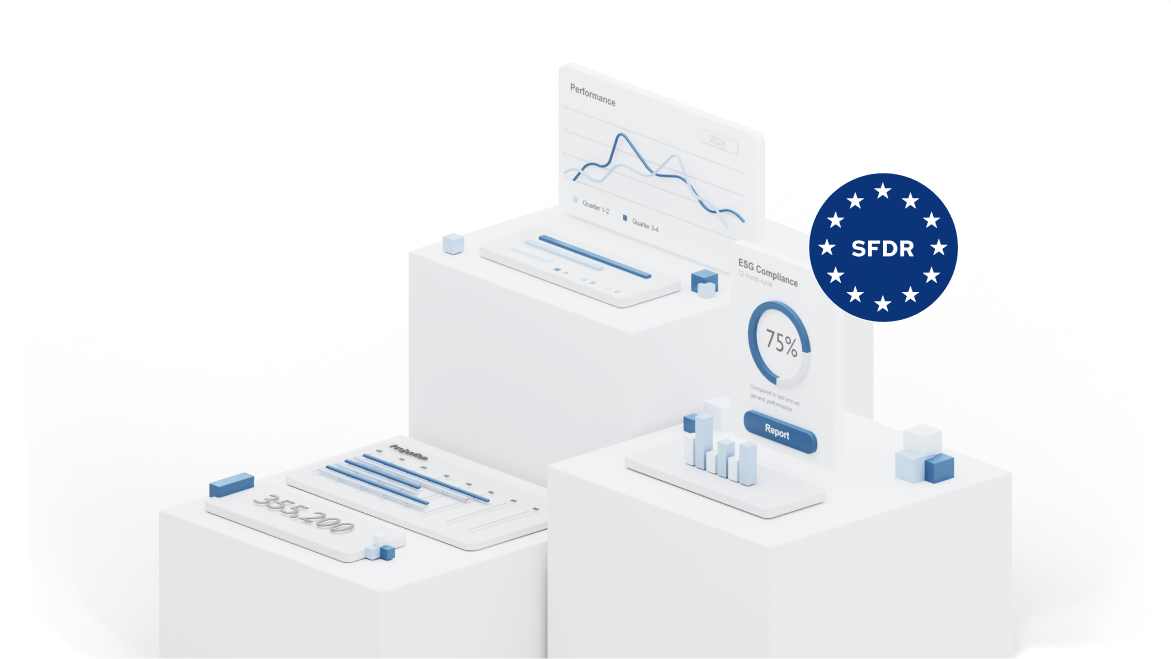




What is SFDR and why does it matter?
The Sustainable Finance Disclosure Regulation, is an EU regulation aimed at increasing transparency and standardization in sustainability-related disclosures by financial market participants. For Articles 6, 8 and 9, PAI, and entity- versus product-level duties, see the SFDR regulation guide.
SFDR enables companies to promote transparency around sustainability risks and impacts in investment decisions. By disclosing how environmental, social, and governance (ESG) factors are integrated into their processes, companies can build trust with investors, comply with EU regulatory requirements, and attract sustainability-focused capital. SFDR reporting also helps firms identify and manage long-term risks, align with global climate goals, and demonstrate their commitment to responsible business practices.
SFDR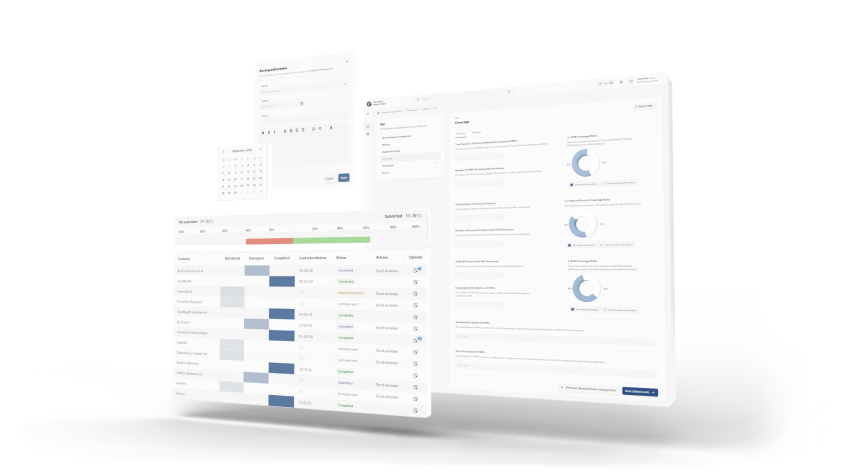
Our approach integrates:

PAI
Principal adverse sustainability impacts statement.

Article 8
Pre-contractual disclosure for the financial products referred to in Article 8, paragraphs 1, 2 and 2a, of Regulation (EU) 2019/2088 and Article 6, first paragraph, of Regulation (EU)
Article 9
Pre-contractual disclosure for the financial products referred to in Article 9, paragraphs 1 to 4a, of Regulation (EU) 2019/2088 and Article 5, first paragraph, of Regulation (EU) 2020/852
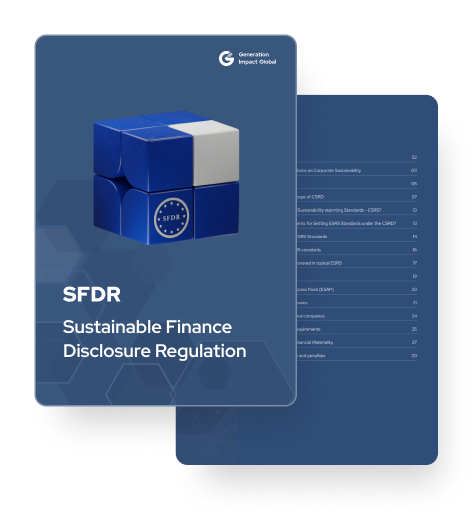
Get the SFDR White Paper
Obtain a deeper understanding of the Sustainable Finance Disclosure Regulation (SFDR) with our comprehensive guide. This white paper is your go-to resource for actionable insights and practical steps to meet ESG reporting requirements with ease. We’ll only use your email to send the PDF—nothing more.
- Brief
- Introduction
- Policy making timeline
- Scope and application of SFDR
- Regulatory Technical Standards (RTS) and amendments
- Principal Adverse Impacts (PAI) Statement
- Overview
- Key-components
- Division of SFDR indicators
- Key deliverables
- Key-components
- Example if SFDR Fund Classifications
- Qualitative data requirements
- Disclosure topics
- Data aggregation

SFDR Reporting Tool
Collect – Calculate – Aggregate – Report
Generation Impact Global has been a leading provider
of non-financial data management tools for years and is gearing
up for the release of the latest updates to their SFDR tools.
These updates will give financial institutions access to even more advanced tools that can be used to tackle regulatory compliance
and manage non-financial data.
Key benefits
Full automatisation
Data aggregation and PAI calculation
PAI regulatory report
Portfolio Companies included
Centralised data collection
Unlimited seats
“This new version of our SFDR tool is a game-changer for financial institutions seeking an automated, accurate, and scalable solution to meet SFDR obligations,” said Anna Shpak, CEO of Generation Impact Global. “With full automation and built-in PAI compliance, we are helping companies navigate complex ESG reporting with ease.
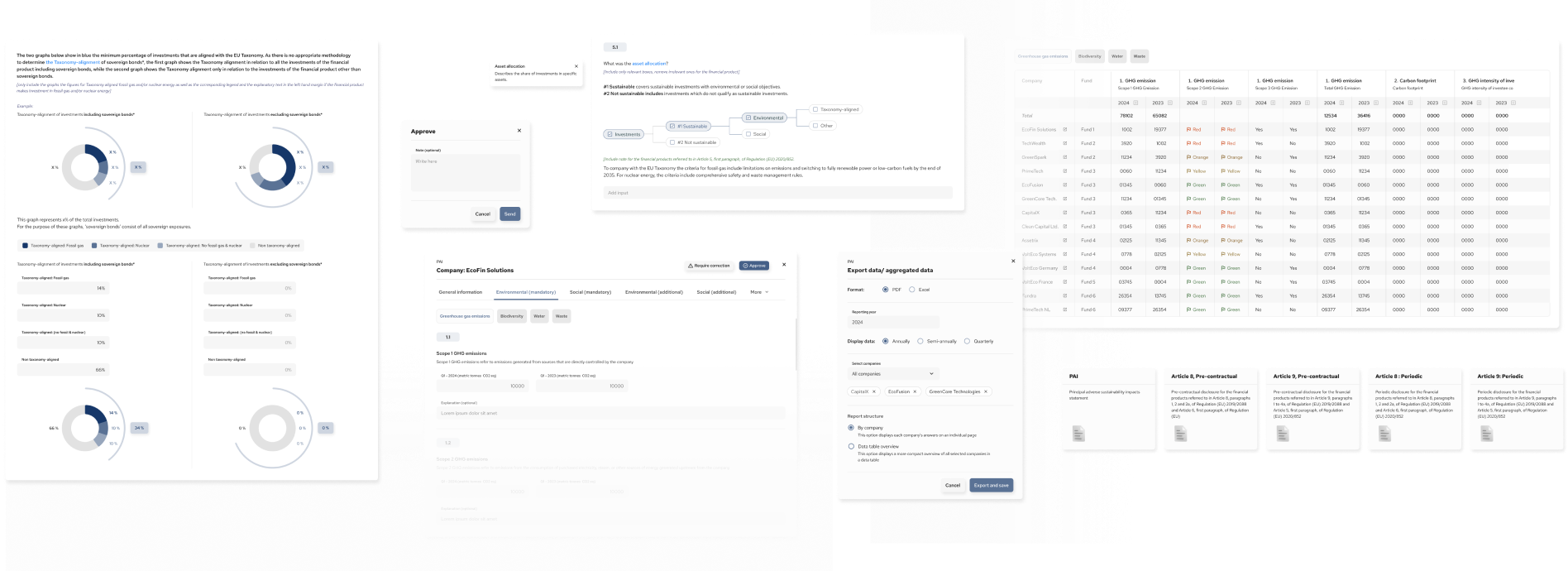
The improved SFDR tool is now accessible worldwide and is increasingly attracting progressive financial institutions that emphasise both compliance and innovation.
Explore Our Platform – Book a Demo
Discover the full potential of our platform.
Schedule a personalised demo or connect with our ESG experts to answer your questions. We are here to provide help and support every step of the way.

Missed It Live? Watch it On-Demand
SFDR in practice: tackling PAI, articles 8 & 9 with Legance
Follow our SFDR Series webinar sessions featuring expert speakers tackling the most common questions around SFDR.
Past webinarsFrequently Asked Questions
What is SFDR?
The Sustainable Finance Disclosure Regulation (SFDR), formally Regulation (EU) 2019/2088, is an EU regulation aimed at increasing transparency and standardisation in sustainability-related disclosures by financial market participants. It requires them to disclose how they integrate sustainability risks into investment decisions and how their products affect the environment and society.
Why does SFDR matter?
By disclosing how environmental, social and governance (ESG) factors are integrated into their processes, firms can build trust with investors, comply with EU regulatory requirements and attract sustainability-focused capital. SFDR reporting also helps firms identify and manage long-term risks, align with global climate goals and demonstrate their commitment to responsible business practices.
Who does SFDR apply to?
SFDR applies to financial market participants and financial advisers. The full scope is explained in our SFDR regulation guide.
When did SFDR start to apply?
SFDR came into application on 10 March 2021, and the detailed Regulatory Technical Standards under Commission Delegated Regulation (EU) 2022/1288 have applied since 1 January 2023.
Does SFDR require financial products to be sustainable?
No. SFDR requires transparency about sustainability practices and impacts, however conventional or green the product is. The risk it targets is greenwashing: products claiming sustainability characteristics they cannot substantiate.
What is the difference between Article 6, 8 and 9 products?
SFDR sorts financial products into three tiers: Articles 6, 8 and 9. Article 6 is the baseline. It covers how sustainability risks are integrated into investment decisions, and it is the category for products that neither promote environmental or social characteristics nor have a sustainable investment objective. Article 8 covers products that promote environmental or social characteristics. Its pre-contractual disclosure falls under Article 8, paragraphs 1, 2 and 2a, of Regulation (EU) 2019/2088 and Article 6, first paragraph, of Regulation (EU) 2020/852. Article 9 covers products with sustainable investment as their objective. Its pre-contractual disclosure falls under Article 9, paragraphs 1 to 4a, of Regulation (EU) 2019/2088 and Article 5, first paragraph, of Regulation (EU) 2020/852.
What is a PAI statement?
PAI stands for principal adverse sustainability impacts. The PAI statement covers the “inside-out” side of SFDR: how investment decisions harm the environment and society. That is distinct from the “outside-in” question of how sustainability risks affect the value of an investment. Our SFDR white paper covers the PAI statement in detail, including its key components, the division of SFDR indicators, key deliverables, qualitative data requirements, disclosure topics and data aggregation.
What are the SFDR Regulatory Technical Standards (RTS)?
The RTS under Commission Delegated Regulation (EU) 2022/1288 set out the detailed disclosure rules that sit beneath SFDR and have applied since 1 January 2023. See our article on the SFDR Delegated Regulation for the indicators.
Is SFDR being revised?
In November 2025, the European Commission published a legislative proposal to amend SFDR. It introduces a mandatory EU-wide product categorisation system, repeals the current Level 2 RTS and removes entity-level sustainability disclosures. The stated aims are to improve investor protection, reduce greenwashing and restore comparability across EU financial markets. For more, read SFDR 2025 reset and the SFDR regulation guide.
Where can I learn more about SFDR?
Download our free SFDR white paper, which covers the policy-making timeline, the scope and application of SFDR, the RTS and amendments, and the PAI statement. We only use your email to send the PDF. You can also visit the SFDR hub or watch the on-demand webinar “SFDR in practice: tackling PAI, articles 8 & 9 with Legance”.
Related Articles
 Read more: SFDR Regulation Explained: Articles 6, 8 & 9, PAI Requirements and the 2025 Revision
SFDR Regulation Explained: Articles 6, 8 & 9, PAI Requirements and the 2025 Revision
 Read more: SFDR 2025 reset: how the EU is replacing Article 8 and 9 disclosure with a product categorisation regime
SFDR 2025 reset: how the EU is replacing Article 8 and 9 disclosure with a product categorisation regime
 Read more: SFDR Delegated Regulation (Commission Delegated Regulation (EU) 2022/1288)
SFDR Delegated Regulation (Commission Delegated Regulation (EU) 2022/1288)