
Table of contents
VitAI™ built for structured sustainability reporting
Turn reporting requirements and your own documents into structured sustainability data that your team can review and reuse.
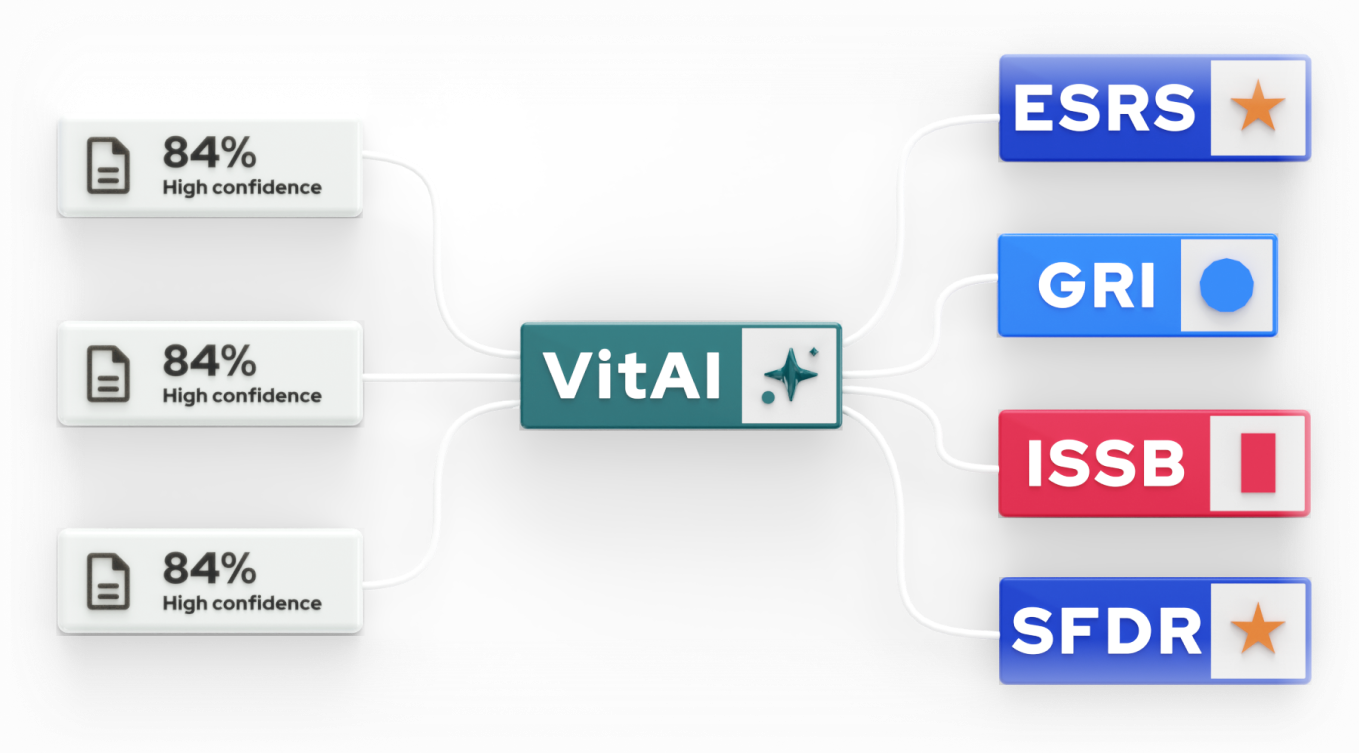
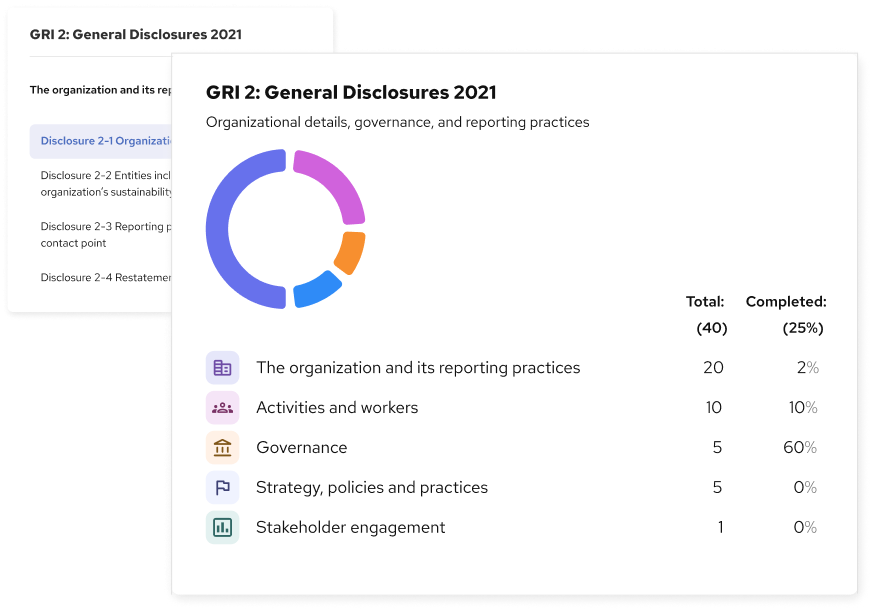
VitAI™ reads a requirement, finds the supporting information in your documents, extracts disclosure-level data and shows what is missing. Your team reviews every AI proposal, closes the gaps and reuses approved data across connected requirements.
Start free



VitAI™ works with reporting requirements, disclosures, datapoints and evidence.
From requirement to evidence.
Start from the disclosure and find the information in your documents that supports it.
From evidence to data.
Extract values, fields and statements into structured datapoints that your team can review.
From gaps to action.
See what is missing and turn each gap into an action your team can assign.
From data to reporting.
Reuse approved data wherever the same information is requested again.
What is VitAI™?
One product across the reporting cycle
VitAI™ is the AI layer of Generation Impact Global. It works across the reporting cycle, from the moment a requirement arrives to approved data that other frameworks can reuse.
Much of the information needed for sustainability reporting already exists inside the organisation. The hard part is finding it. It may sit in annual reports, policies, environmental datasets, HR spreadsheets, supplier documents and earlier disclosures.
Requirements are just as scattered. They come from standards and regulations such as CSRD/ESRS, GRI, ISSB or SFDR, from lender and customer questionnaires, and from internal methodologies.

VitAI™ connects three things that are often managed separately:
What you need to report
The requirements, disclosures and datapoints that a standard, regulation or questionnaire asks for.
+
+
The information your organisation already has
Reports, policies, spreadsheets and records spread across teams and systems.
→
↓
The structured data required for reporting
Reviewed, disclosure-level values and statements, each linked to its evidence.
VitAI™ starts from the requirement, searches your documents for the information that answers it and turns that into structured data, with the source kept alongside.
What VitAI™ does
VitAI™ supports the steps that are slow and error-prone in manual reporting: finding evidence, judging whether it is enough, preparing the answer and keeping the source record.
Framework builder
Turn legislation, standards or internal methodologies into sections, disclosures, questions and datapoints.
Evidence retrieval
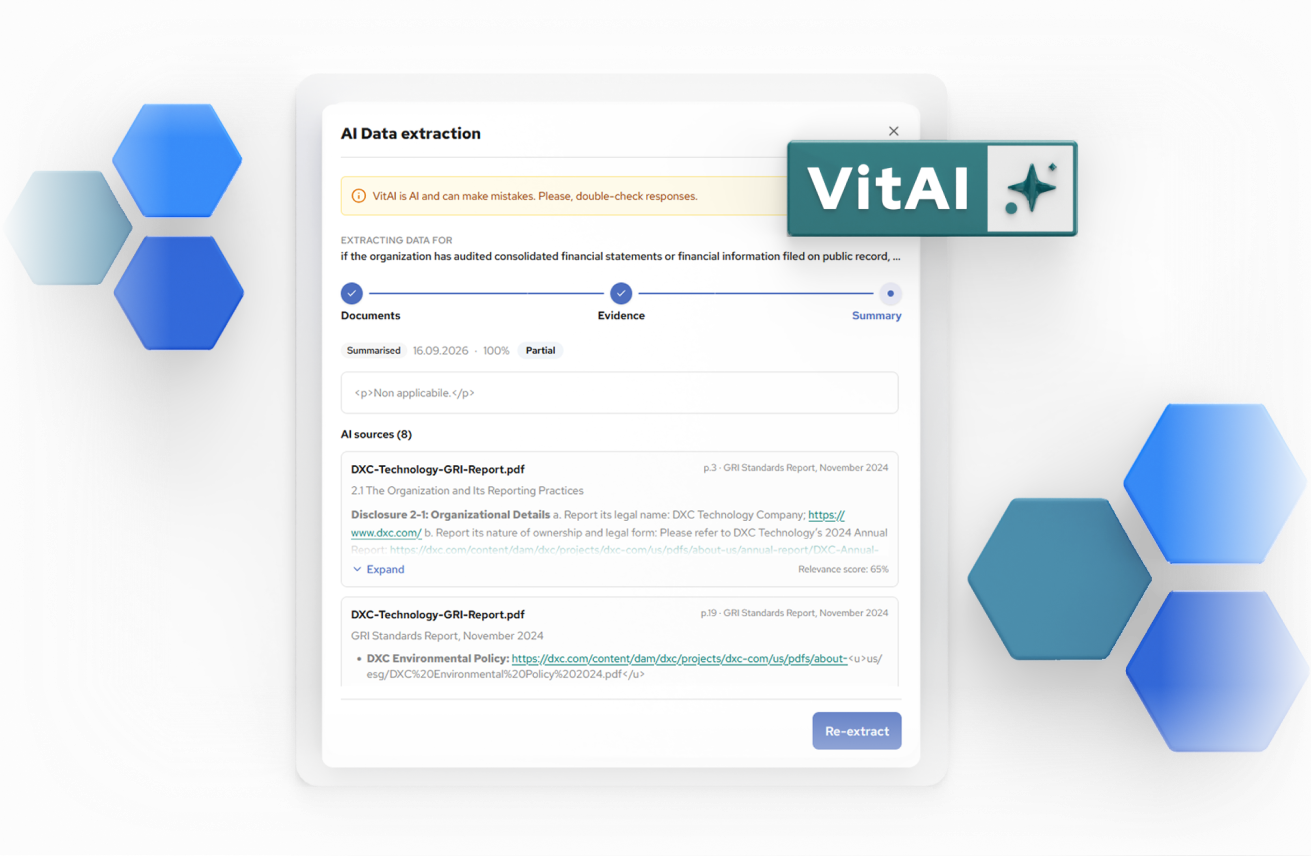
Match selected documents to one disclosure and show the source passage behind each match.
Structured extraction
Capture narrative answers, numbers, dates and units from the evidence into the fields a disclosure requires.
Gap detection
Compare evidence with the framework, flag missing fields and create actions for your team.
Human review and audit log
Accept, edit, re-extract or reject each AI proposal. Each decision is recorded in the audit log.
Managed AI
Prompts, models and indexing are maintained inside VitAI™, so your ESG team does not have to manage them.
Workflow
From requirement to saved answer in six steps
Start from the requirement
Open a disclosure, field or question. Everything that follows stays tied to that requirement, for example total greenhouse gas emissions for a reporting period.
Choose the sources
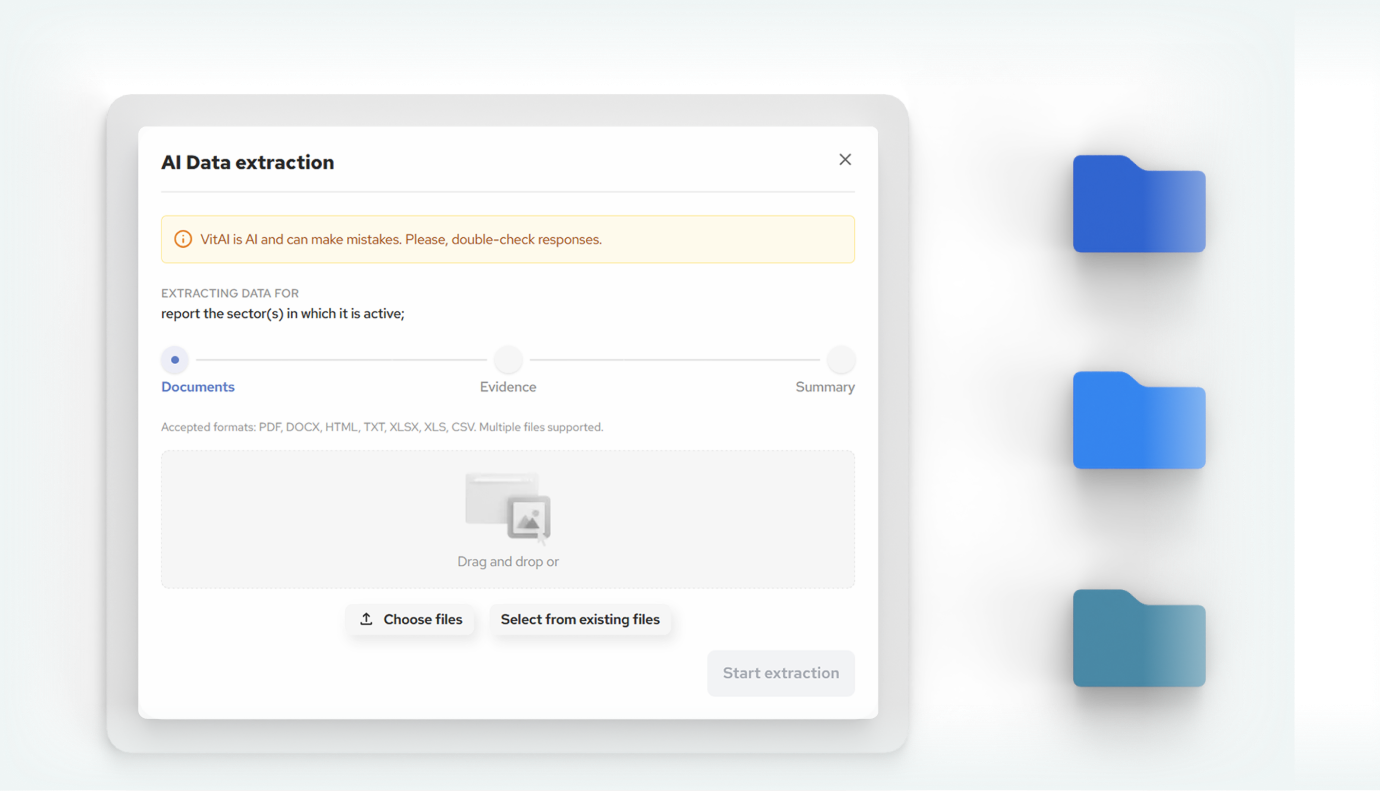
Select the files VitAI™ may use and reuse documents that are already indexed. Matching begins only after you have made that choice.
Find the evidence
VitAI™ retrieves the passages, pages and document context most relevant to the disclosure.
Curate the evidence
Include or exclude passages before they shape an answer. The reviewer decides what counts.
Prepare the draft
Summarise, extract fields or use the selected evidence as it is, depending on the answer type.
Save with context
Save the reviewed answer and keep its source context available for later review. If evidence is missing, the disclosure stays open and can become an action.
Review and sources
The best AI for reporting is the AI you can challenge
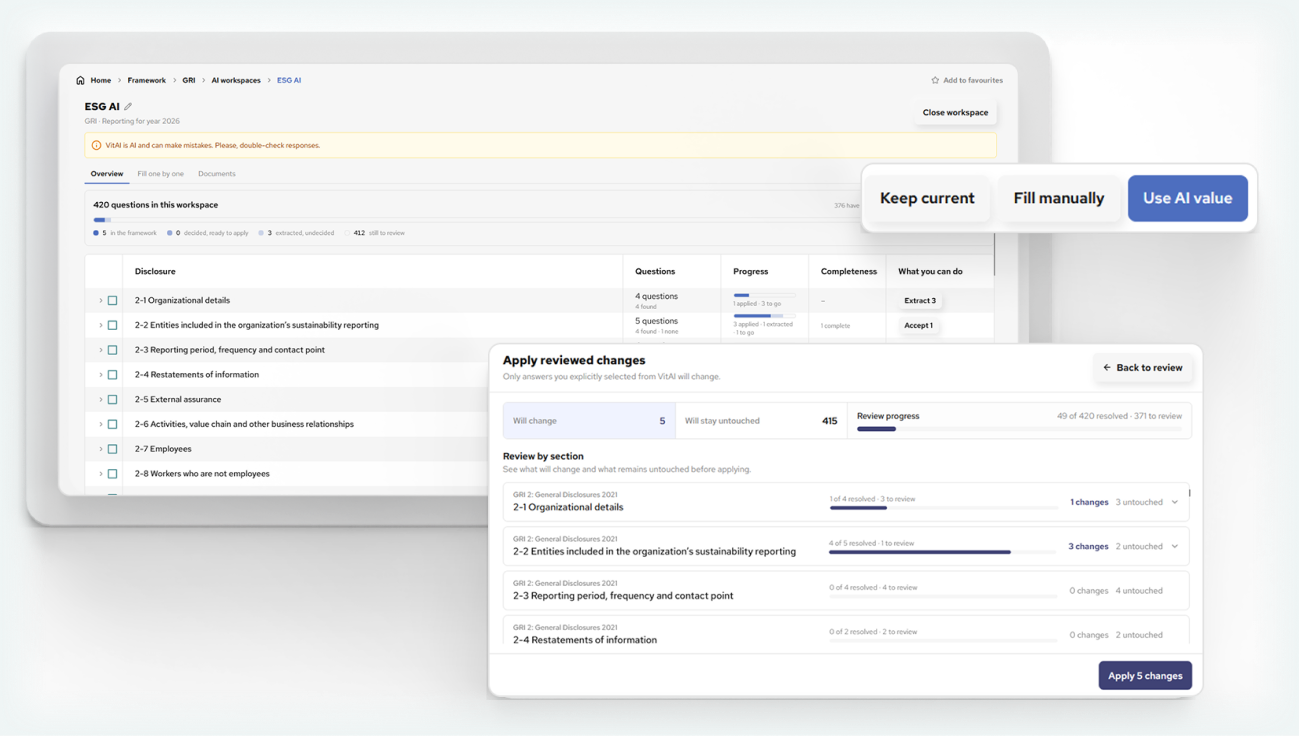
VitAI is built for teams that need speed but cannot afford vague output. Evidence passages, relevance, coverage, selected sources and applied provenance are not decorative details; they are the controls that make AI usable in ESG reporting.
Use selected as-is
For narrative fields, apply selected evidence without an additional AI summarisation call.
Summarise from evidence
Generate a disclosure-ready draft using only the evidence selected for that run.
Review structured fields
Check extracted values, field notes, repeatable rows and conditional answers before applying them.
Return to sources
Open AI sources for applied answers and inspect the evidence behind previous AI-assisted work.
VitAI assistant
Ask better questions of the data you already have
VitAI also includes a scoped assistant for sustainability data. It can answer from stored disclosure values, indexed documents or both, while staying inside the platform’s entity access boundaries.
This is where AI becomes genuinely useful: not only drafting text, but helping teams interrogate the ESG information they already manage. If the evidence is not there, VitAI says so rather than guessing.
Stored data answers
Answer questions from questionnaire and disclosure values already stored in the platform.
Document answers
Use indexed documents for narrative context, report references and supporting explanations.
Follow-up questions
Carry context across a conversation when the company or topic is clear.
Citation context
Connect answers back to fields, years, documents or pages where the data supports it.
Framework coverage
Framework-aware AI, not a floating chatbot
VitAI’s extraction types cover ESG frameworks including ESRS, GRI, VSME, SASB and SFDR. That matters because disclosure work is rarely a free-form question. The answer needs to fit a requirement, a field, an output type and a reporting context.
GRI and ESRS
Prepare evidence-backed narrative and structured responses for major sustainability reporting workflows.
VSME and questionnaires
Support stored field answers and scoped assistant questions where SME reporting data is available.
SASB and SFDR
Use framework context to keep extraction tied to the reporting requirement being reviewed.
What VitAI is not
Clear limits make AI more credible
VitAI is ambitious and honest at the same time. The strongest AI product pages do not pretend that AI removes judgement, assurance or accountability. They show where the product helps and where the reviewer remains responsible.
Not an auto-publisher
VitAI prepares evidence-backed work for review; it does not make final reporting decisions for the organisation.
Not a compliance guarantee
It supports preparation and review, while assurance and regulatory responsibility remain with the reporting organisation.
Not generic internet AI
VitAI works from selected ESG documents, stored data and framework context inside the platform.
Not a hidden black box
The workflow is designed around evidence, sources, usage visibility and human approval.
Custom frameworks
Use your own framework, not only the standard ones
Not every requirement comes from a standard. Some come from your customers, your lenders, your suppliers or your own ambitions. In VitAI™, you decide what to ask and how to structure it. VitAI™ finds the evidence.
Any requirement, any source
A standard, a customer questionnaire, a lender request, an internal policy or a supplier code of conduct. If it can be written as questions, you can work with it. You do not need to wait for a standard to exist.
Your structure, your words
Choose the sections, questions and datapoints, and phrase them the way your stakeholders do. Add, remove or reorder them as your needs change.
Across your value chain
Use one approach for what customers ask you and what you ask your suppliers. Answer incoming requests from your own documents, and check supplier responses against your own criteria, so gaps become visible and can become actions
Connected, not isolated
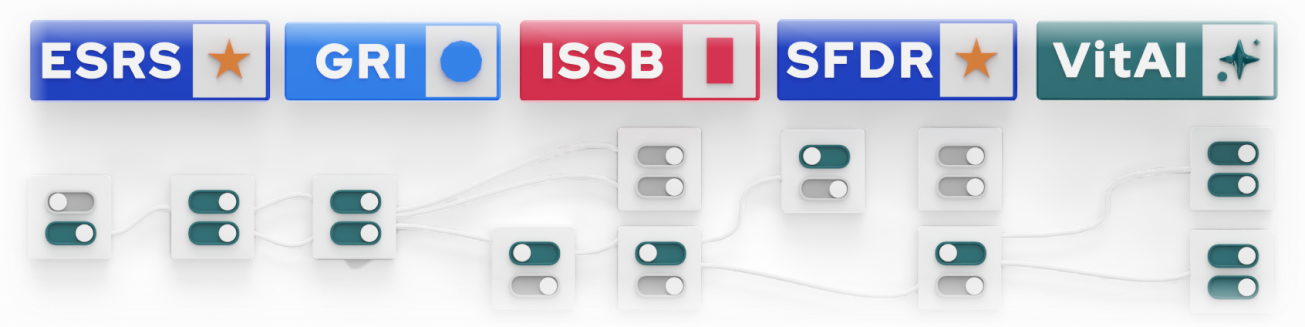
Link your framework to ESRS, GRI, VSME or SFDR datapoints. Once an answer is approved, it can be reused wherever the same information is requested again, instead of being collected a second time.
FAQ
Questions related to VitAI
What is VitAI?
VitAI is AI ESG reporting software from Generation Impact Global for evidence extraction, disclosure answer preparation, structured field extraction and scoped ESG question answering.
Does VitAI replace sustainability experts?
No. VitAI helps reduce manual evidence search and first-draft work. The user still reviews evidence, edits outputs and decides what can be applied.
Can VitAI guarantee compliance?
No. VitAI supports evidence preparation and review. Final reporting decisions, assurance work and regulatory responsibility remain with the organisation and its advisers.
What makes VitAI different from a generic AI chatbot?
VitAI starts from disclosure requirements, selected documents, framework context and platform access rules. It is designed to connect AI work back to the reporting workflow, not leave it in a separate conversation.
Why does AI need maintenance in ESG reporting?
Because reporting AI depends on current documents, usable indexes, controlled prompts, model behaviour, access rules, usage cost and reviewer decisions. VitAI keeps that operating layer inside the product so ESG teams can focus on the reporting work.
What happens when evidence is incomplete?
VitAI is instructed to use only available evidence. When evidence does not support a complete answer, the workflow surfaces the gap rather than inventing missing facts.
Can users see where an AI answer came from?
Applied answers can keep AI source context, including selected evidence, method, cost, model context and application time.
Make AI the strongest part of your ESG reporting workflow
Use VitAI to move faster from documents to reviewed disclosure work while keeping source context, human approval and AI maintenance under control.
Related articles
 Read more: ESMA outlines 2027 work programme focusing on supervision, digital resilience and market integration
ESMA outlines 2027 work programme focusing on supervision, digital resilience and market integration
 Read more: SEC Investor Advisory Committee Schedules Public Meeting on AI and Market Regulations
SEC Investor Advisory Committee Schedules Public Meeting on AI and Market Regulations
 Read more: AI Disruption in Focus: Davos 2024
AI Disruption in Focus: Davos 2024